


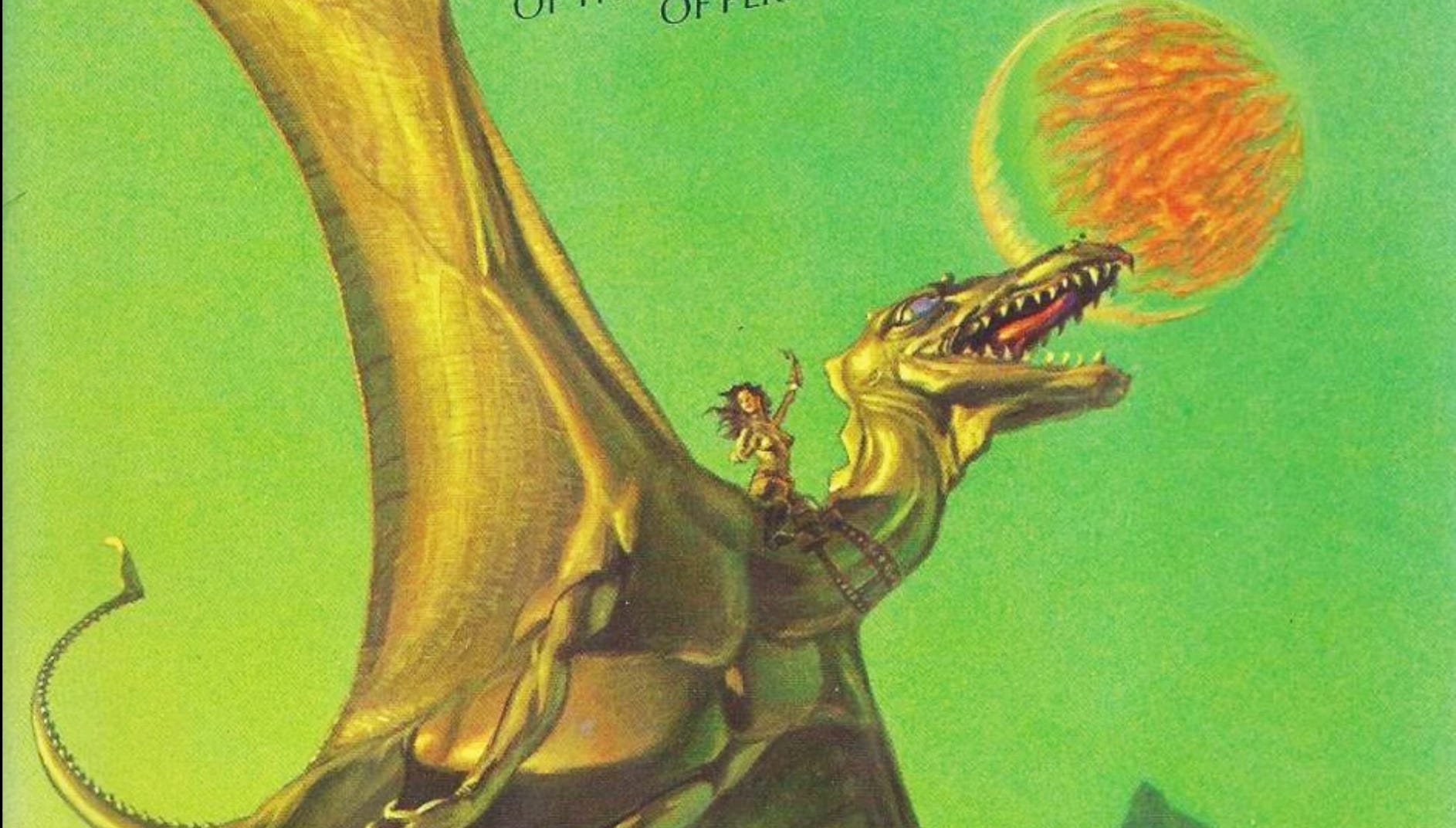
Dragonflight holds up remarkably well, more than half a century after Analog first ran it as a two-part serial. McCaffrey likes her big words. The vocabulary is dated enough in places that you might genuinely have to look one up mid-chapter, but that’s part of the charm of her prose rather than a knock against it. It reads like a writer who trusted her audience to keep up rather than one writing down to them.
The book’s two-part structure is clearly delineated, and it really does read as two stories fused into one, because that’s exactly what it is: “Weyr Search” and “Dragonrider,” originally sold and published separately, stitched together into a single novel after both had already picked up major awards on their own. “Weyr Search” is the darker half. You feel Lessa’s plight in the dregs of Ruatha in a way that’s genuinely emotional, years of a young woman reduced to a servant in her own family’s hold, quietly working to sabotage the place from the inside because open rebellion was never an option available to her. F’lar is a much harsher, more alpha, scarier presence here than he becomes anywhere later in the book, let alone the series going forward. He’s a mystery in this stretch, and he very much takes what he wants, showing up at Ruatha with all the subtlety of a man who has already decided how the story is going to go. Once Lessa reaches the Weyr, the book shifts into something closer to slice-of-life: learning to fly, learning to navigate the politics of a society she’s been thrown into overnight, and her own frustration at being overprotected by everyone around her when she’s spent her whole life being underestimated and would rather just be allowed to act.
Then “Dragonrider” picks up, and that’s where Robinton enters, giving us that first interesting dynamic with him and the first look at the Question Song and how it functions in the world, a teaching ballad that turns out to be quietly load-bearing for the entire plot once you realize what it’s actually pointing toward. One thing worth flagging as a craft note, because it’s the kind of thing you only catch on a careful reread rather than a first pass: the dragons’ inner lives are handled differently across the two halves. In “Weyr Search,” we’re told the dragons are thinking something, but we never get their thoughts directly, more reported than dramatized, glimpsed from the outside. In “Dragonrider,” the dragons start functioning almost like characters speaking directly, full participants in scenes rather than intelligent animals being described. That’s a real seam in the fix-up novel that never got fully smoothed over in editing. It’s not a flaw exactly, more a fossil record of how the book actually came together, two stories written at different times for different purposes, later stitched into something that reads as unified as it does almost in spite of that history.
The time-travel sections are genuinely fun and do real work selling this as science fiction rather than fantasy, which clearly mattered enormously to McCaffrey, who spent decades afterward insisting on that distinction in interview after interview. The opening exposition explaining the planet setup, the colony, the Red Star, the whole cosmological scaffolding, is a dated element by modern standards, the kind of upfront world-building most current SF would trust the reader to absorb through the story rather than being told directly. But it’s dated in service of exactly the right goal: making sure readers understood from page one that this was a science fiction premise wearing a fantasy costume, not the other way around. Whatever you think of the technique, it was doing real work.
Characterization throughout is elegant, and Lessa carries the book well, patient and calculating in a way that pays off the moment she actually gets power to act with instead of power to merely endure. Robinton gets more room to develop in Dragonquest, but the introduction here works fine on its own terms, enough presence to make you want more of him immediately. We don’t see much of the Oldtimer Weyrleaders yet, and they’re notably happier, funnier characters in this book than they become later in the series, which makes for an interesting contrast once you know where they end up. Knowing where the series eventually takes them makes this early version almost bittersweet in hindsight. F’lar himself lightens up considerably across the rest of the series too, a real foil to how harsh he reads here. It’s genuinely funny in retrospect how much he mellows, to the point that a reader coming to this book after the later ones might not fully recognize him in these opening chapters.
No boring stretches anywhere in it. I’ve read this one over and over, and it’s about as close to a perfect book as this series gets, one of those rare cases where a fix-up novel built from separately sold pieces ends up feeling more essential than most books planned as novels from page one. 10/10.
Six books. One unforgettable world. The Adventures of Baron Von Monocle is steampunk adventure with the kind of worldbuilding and heart that made you fall in love with fantasy in the first place. Start the series on Amazon.
NEXT: Gregg Press Turned Paperback-Only Science Fiction Into Quality Hardcovers, Then Vanished
Please. Someone explain to me. That thread should burn itself in the atmosphere of the planet and not reach the ground. Isn't the whole premise of the series false? Pern's atmosphere is similar to ours since humans can breath it. Since our atmosphere burns whole asteroids how can Pern's cannot stop a thread?
Bruh, how you gonna mention McCaffrey and not go into how she swept it up for Marion Zimmer Bradley and Walter Breen? Just because you enjoyed Dragonriders of Pern doesn’t make it not the product of a Liberal Fujoshit Irishwoman with a fetish for Gays.