



Gregg Press built one of the most respected hardcover reprint lines in science fiction history, and most readers today have never heard of it. However, these editions are some of the most collectible classic sci-fi.
The press began around 1965 in Upper Saddle River, New Jersey, founded by Charles Gregg to distribute UK antiquarian reprints in the United States. Gregg soon expanded into scholarly reprints of his own, aimed at the academic library market rather than general retail. His first major undertaking, Americans in Fiction, reprinted 70 out-of-copyright American literary titles selected by Duke University professor Clarence Gohdes, sold both as a full set and individually. A companion series, The American Humorists, followed the same library-market model on a smaller scale.
In 1972, Gregg sold the company to ITT Corporation, and operations moved to Boston under ITT’s library reference publishing arm, G.K. Hall & Co. Thomas T. Beeler came on as editor that June, initially overseeing an already-contracted American Revolutionary series. It was Beeler’s collaboration with David G. Hartwell, a friend from graduate school at Columbia, that turned Gregg Press into a name genre readers still recognize. The two developed a science fiction reprint line built around a simple, disciplined format: a facsimile of each book’s first-edition text, bound in durable library cloth on acid-free paper, paired with a newly commissioned introduction from a contemporary author or critic. Beeler managed contracts, design, and production. Hartwell chose the titles and secured the introduction writers, occasionally writing the essays himself when no one else was available. Between 1974 and 1980, 225 titles appeared in the Gregg Press Science Fiction Series.
The line’s real significance for collectors is that many of these books had never existed in hardcover before Gregg got to them. Science fiction through the 1950s and 60s was overwhelmingly a paperback-original business, and plenty of genuinely important novels simply skipped hardcover entirely on first publication. Gregg Press closed that gap for dozens of authors at once, and library binding meant the resulting books were built to survive decades of circulation rather than a single reading.

Poul Anderson received unusually thorough treatment across two separate Gregg lines. One collected his Dominic Flandry saga, the Terran Empire novels and story collections that ran from Ensign Flandry through The Day of Their Return and A Knight of Ghosts and Shadows, bound in matching burgundy cloth with a facsimile of Anderson’s signature stamped on the boards and dust jackets illustrated by Don Carter. Each volume included critic Sandra Miesel’s “Chronology of Technic Civilization,” tying the whole future history together for readers working through the series out of order. A second, separate seven-volume set, The Worlds of Poul Anderson, gathered standalone novels and collections that had nothing to do with Flandry: The Night Face and Other Stories, The Byworlder, The Horn of Time, The Long Way Home, Orbit Unlimited, The Queen of Air and Darkness, and a seventh volume, Two Worlds, combining the novels Question and Answer and World Without Stars.
Fritz Leiber and Andre Norton both got matched, jacketed sets of their own. Leiber’s Fafhrd and Gray Mouser sword-and-sorcery novels and Norton’s Witch World series appeared with introductions from critics including Thomas M. Disch and Paul Williams. Several Philip K. Dick titles received their first hardback publication anywhere through Gregg Press, a fact that matters more now than it did at the time, given how thoroughly Dick’s reputation has grown since. Isaac Asimov’s contribution came through his six-volume Lucky Starr series, juvenile science fiction novels he originally published under the pen name Paul French in the 1950s: David Starr, Space Ranger, Lucky Starr and the Pirates of the Asteroids, Lucky Starr and the Oceans of Venus, Lucky Starr and the Big Sun of Mercury, Lucky Starr and the Moons of Jupiter, and Lucky Starr and the Rings of Saturn. Complete matched sets of the Lucky Starr Gregg Press volumes now regularly command several hundred dollars when they surface on the secondary market.
Cover and frontispiece work across the line came from artists including Vincent Di Fate and Hannah Shapiro, with promotional art handled by Jim McDermott. Beyond the flagship science fiction series, Gregg Press ran a parallel mystery reprint line edited by Otto Penzler and a children’s series edited by Betsy Groban, extending the same permanent-hardcover-for-library-market approach across genres.
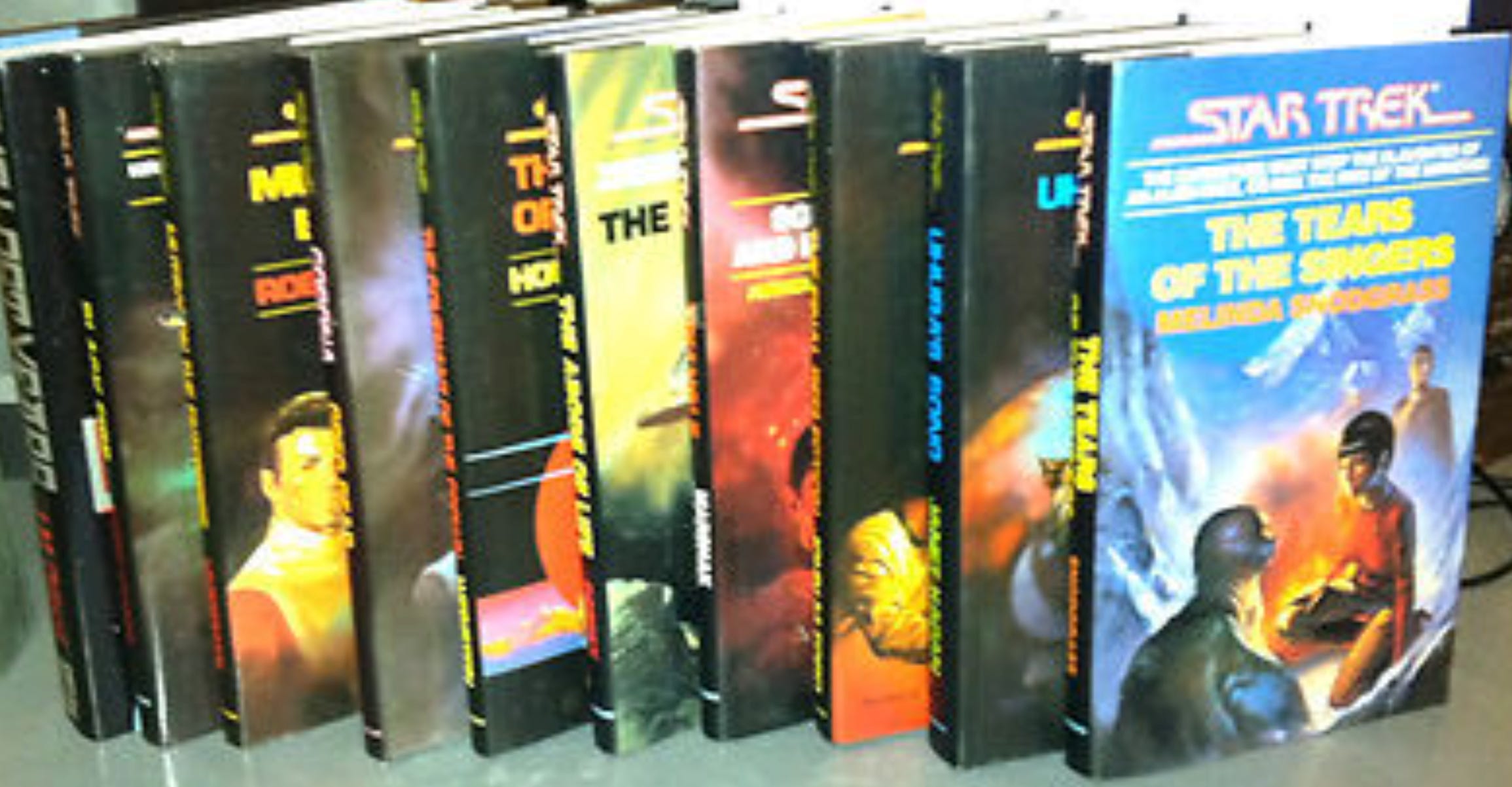
Late in its run, Hartwell’s day job gave the press an unusual second act. He was simultaneously running the Timescape science fiction imprint at Pocket Books and had created Pocket’s Star Trek publishing line. Between 1984 and 1986, Gregg Press reprinted 17 early Star Trek novels in hardcover, straight photo-reprints of the Pocket paperbacks rather than new scholarly editions, covering authors including Vonda McIntyre, Diane Duane, John M. Ford, and Greg Bear. A UK distributor, Firecrest, continued the concept briefly after Gregg folded, putting out six additional Star Trek titles on its own, including Killing Time and Dwellers in the Crucible, copies of which are now considerably harder to find than the original 17.
For collectors today, two features of the line cut in opposite directions. The acid-free paper and reinforced library binding mean the physical books have held up far better structurally than the mass-market paperbacks they reprinted; a Gregg Press hardcover from 1976 is often in better shape internally than a paperback from the same year. But because the entire line was built for institutional library circulation rather than retail sale, the overwhelming majority of surviving copies carry the marks of that history: glued-in card pockets, due-date stamps, spine labels, ownership stamps, sometimes even rebinding when a library’s original copy wore out. A genuinely clean, unmarked Gregg Press volume in fine condition is the exception rather than the rule, and that scarcity is reflected directly in what collectors are willing to pay when one turns up.
Gregg Press didn’t outlast the decade its Star Trek reprints came from. G.K. Hall was eventually absorbed into Macmillan, and the science fiction line was discontinued in the mid-1980s, taking with it one of the only hardcover homes many of these books would ever have.
How many other paperback-only genre classics from that era never got a second chance at a hardcover shelf life once Gregg Press closed its doors?
First contact with the Oridians was supposed to be humanity’s proudest moment. Instead, their chief engineer is dead, their ship is sabotaged, and an ancient alien technology is stealing souls. Book one of the Valiant Frontiers series delivers exploration, mystery, and the kind of crew you’ll want to follow across the galaxy. Read The Soul Catcher on Amazon and start the adventure.

NEXT: “How Tolkien Ruined Fantasy”: Sanderson’s Own Blog Post Title, Revisited at Oxford
Now see, this sounds like something guys like you and Vox Day could help fix...
First I've heard of this! I grew up taking the mass market paperbacks out of the library. A pity they didn't try to reach into the schools, following on the heels of Scholastic. An even bigger pity that libraries nowadays probably wouldn't be much of a market for this, and I'm not sure the market is there for fancy collector's edition reprints, either.