


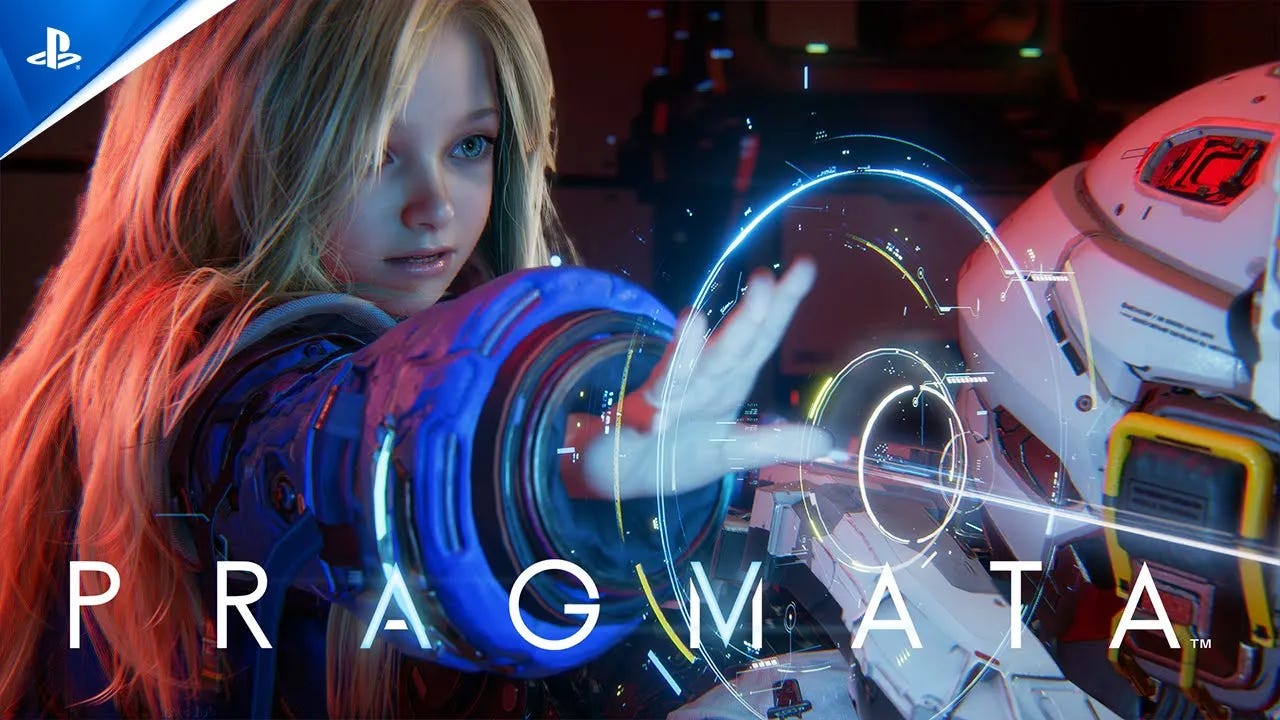
Capcom’s newest IP launched on April 17, 2026 and sold one million units worldwide in 48 hours. That’s the headline. The game is called Pragmata, it features a man protecting an android girl named Diana on a near-future lunar world, and certain corners of the internet have decided this is cause for alarm.
The controversy surrounding Pragmata reveals more about its critics than it does about the game.
What Pragmata Actually Is
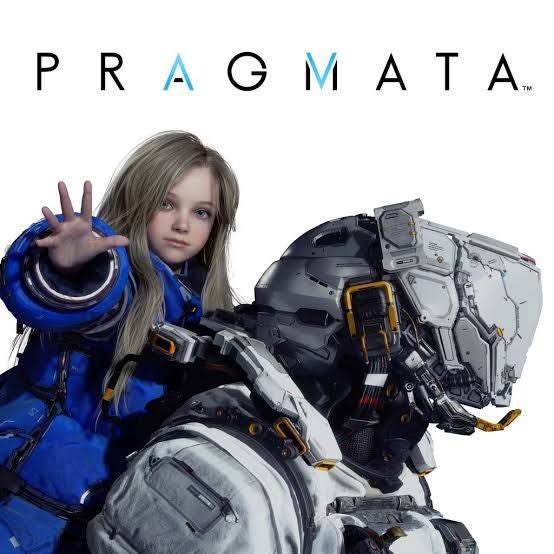
According to Capcom’s press release, Pragmata is “a science-fiction action-adventure game that depicts the journey of Hugh Williams and Diana, an android girl, in a near-future lunar world.” The game was “developed primarily by a team of younger Capcom developers, who created an innovative gameplay experience by fusing action gameplay with puzzle elements set within a distinctive world ruled over by artificial intelligence.”
The game launched simultaneously on PlayStation 5, Xbox Series X|S, Nintendo Switch 2, and Steam on April 17, 2026. Capcom’s multi-platform strategy included an early playable demo that introduced players to the game’s mechanics ahead of release. The Nintendo Switch 2 version launches April 24, 2026 in Japan and parts of Asia.
The development team responded to the milestone with genuine emotion: “As a completely new IP, PRAGMATA represents a new challenge for Capcom, built from the ground up with an original world and gameplay concept. We are truly delighted that so many players around the world have enjoyed the game, enabling us to reach this milestone of one million units sold. Moving forward, we will continue making every effort to deliver the appeal of PRAGMATA to an even broader audience.”
One million units in two days. For a brand new IP with no existing fan base or franchise recognition.
The Numbers Tell the Story

Pragmata launched on Steam to 53,394 concurrent players, strong numbers for a single-player experience on a Friday. The game climbed to nearly 60,000 peak concurrent players over the launch weekend and sat at a 96% positive rating on Steam with an initial wave of reviews before settling at 91.84% positive from 2,000 reviews. Metacritic shows an 86 from 93 critic reviews.
Player impressions across social media reflect massive enthusiasm. One early player described it as: “Gameplay is fun and unique. Feels like a game from the early 2000s—I mean that the best way possible. The game has true heart. You feel like a dad. Plays flawless on PS5 Pro with no glitches. Very, very polished game at launch. Very good graphics. Story is intriguing. Feels like a breath of fresh air. A new IP and a new idea that just works.”
Another player who put Crimson Desert on hold to try Pragmata noted: “The hacking mechanic is cool. I like how it adds an extra layer to combat. The guns and aesthetic of this game world reminds me a lot of Vanquish. Diana, the little girl, is adorable, and her relationship with Hugh is great, too. Sound design is awesome, too. And so far, no bugs, nothing.”
George Extopoulos called it “pretty freaking great, like a combination of Resident Evil 4 and Vanquish, a platinum game mixed with some old school clever.”
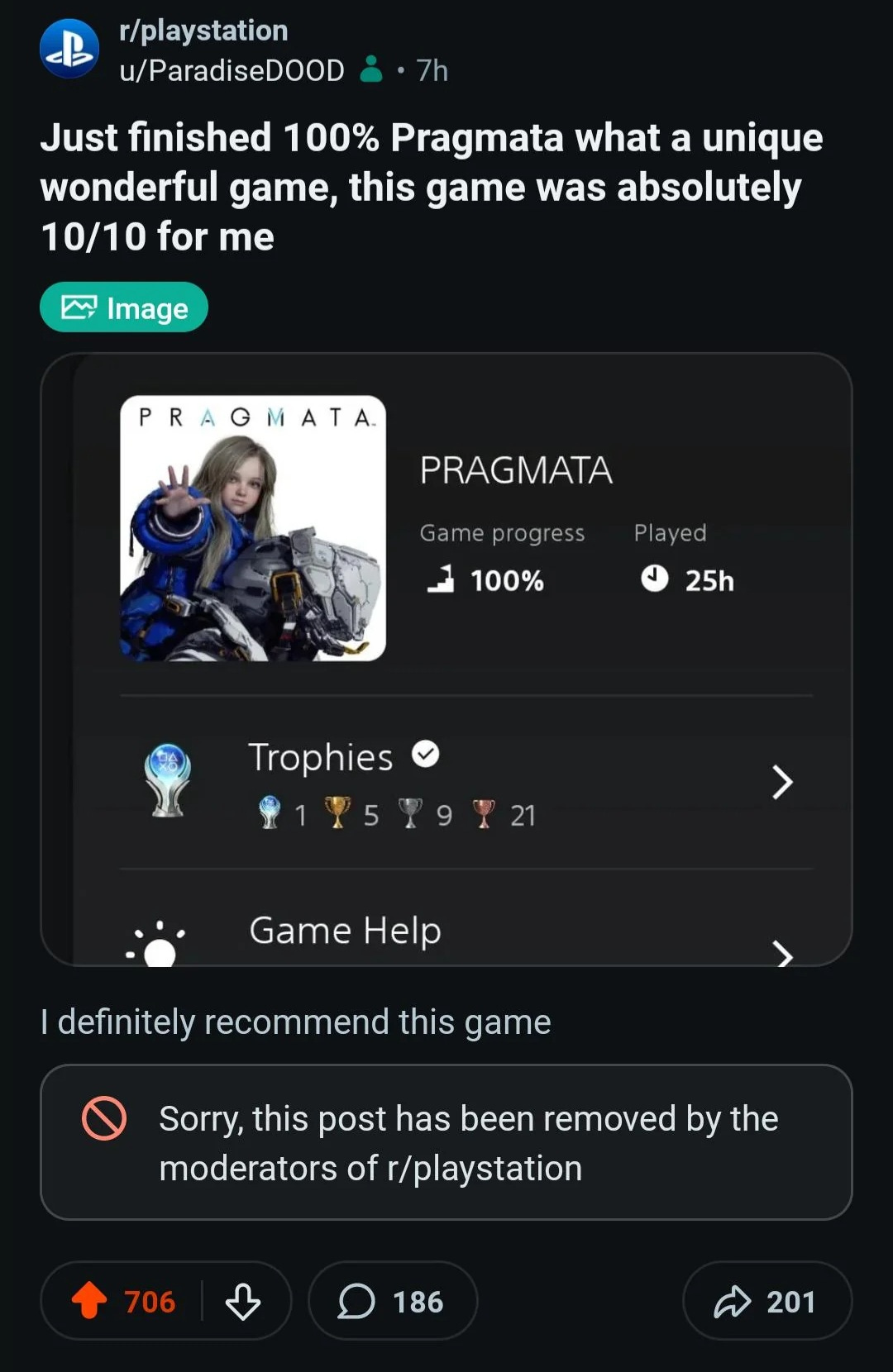
On Reddit, user ParadiseDOOD posted a 100% completion screenshot showing 25 hours played, a platinum trophy, five gold, nine silver, and 21 bronze trophies, rating the game 10/10 and calling it “a unique and wonderful game.” The post generated 706 upvotes, 186 comments, and 201 shares before the moderators of r/playstation removed it. A 100% completion post for a critically acclaimed Capcom game—removed.
The “Controversy”
Kotaku writer Lewis Parker, the same journalist who previously dismissed as “an absurd conspiracy” reporting on Italian government tax funding for a video game, published a piece accusing Capcom’s official Cryana Twitch badge for Pragmata of referencing an obscure online meme associated with certain anime communities.
The badge shows Diana’s face in a crying expression. Capcom and Twitch called it the Cryana badge and offered it to viewers who subscribed to streamers playing Pragmata between launch and April 30th.
Parker’s article, citing “several fans,” suggested the badge was “a dog whistle meme typically associated with those characters.” The overwhelming reaction from the gaming community ranged from bafflement to contempt. Legendary Drops quote-tweeted the piece: “Well, I’m sure it exists. All I’m seeing is people wholesome posting or manifesting an enemy. I saw someone post saying the game is disgusting because it’s made for male audiences, then insinuating they, as in men, are making of the character. The y’all on?”
As one observer noted: “If you look at the little girl in Pragmata and your first thought is something sexual, then maybe you’re the problem, for real, this is not even something that even entered my mind or any normal person’s mind.”
The Kotaku angle is predictable enough. More revealing are the organic reactions from accounts with no apparent industry agenda.
Hasan Piker Explains Himself

Twitch streamer Hasan Piker offered what may be the most self-defeating commentary of the entire controversy. Discussing gamers who care about family-themed content, Piker said:
“So what’s really interesting about this is all of these unfuckable losers in the gaming sphere always talk about starting families, and stuff. And I don’t understand why this has become a thing that they care about. Like, if you are a gamer, you should care about things that you can actually experience. You should care about things that you actually enjoy, right? If you are a fucking lonely gamer who has never been around with a woman and will never have sex with a woman, why do you care? Like, what do you care about, having children or like riding for having children?”
This is a statement from a man with a public platform, telling his audience that men who connect emotionally with paternal themes in fiction are “unfuckable losers” who should stick to content appropriate for their assumed social failures. The argument essentially is: if you’re a male gamer, you shouldn’t be allowed to experience paternal themes in fiction because you probably haven’t earned them biologically.
Beyond its contempt for the audience, the logic is circular and self-refuting. Fiction exists precisely to let people experience things beyond their immediate circumstances. That’s what fiction is for. The argument that male gamers shouldn’t engage with fatherhood themes because they haven’t had children would apply equally to any emotional experience depicted in any medium. War films are off-limits unless you’ve served. Love stories require prior relationships. By Piker’s logic, the entire emotional range of human experience in fiction should be gatekept by biographical checkboxes.
Mary Morgan and the Predator Framing
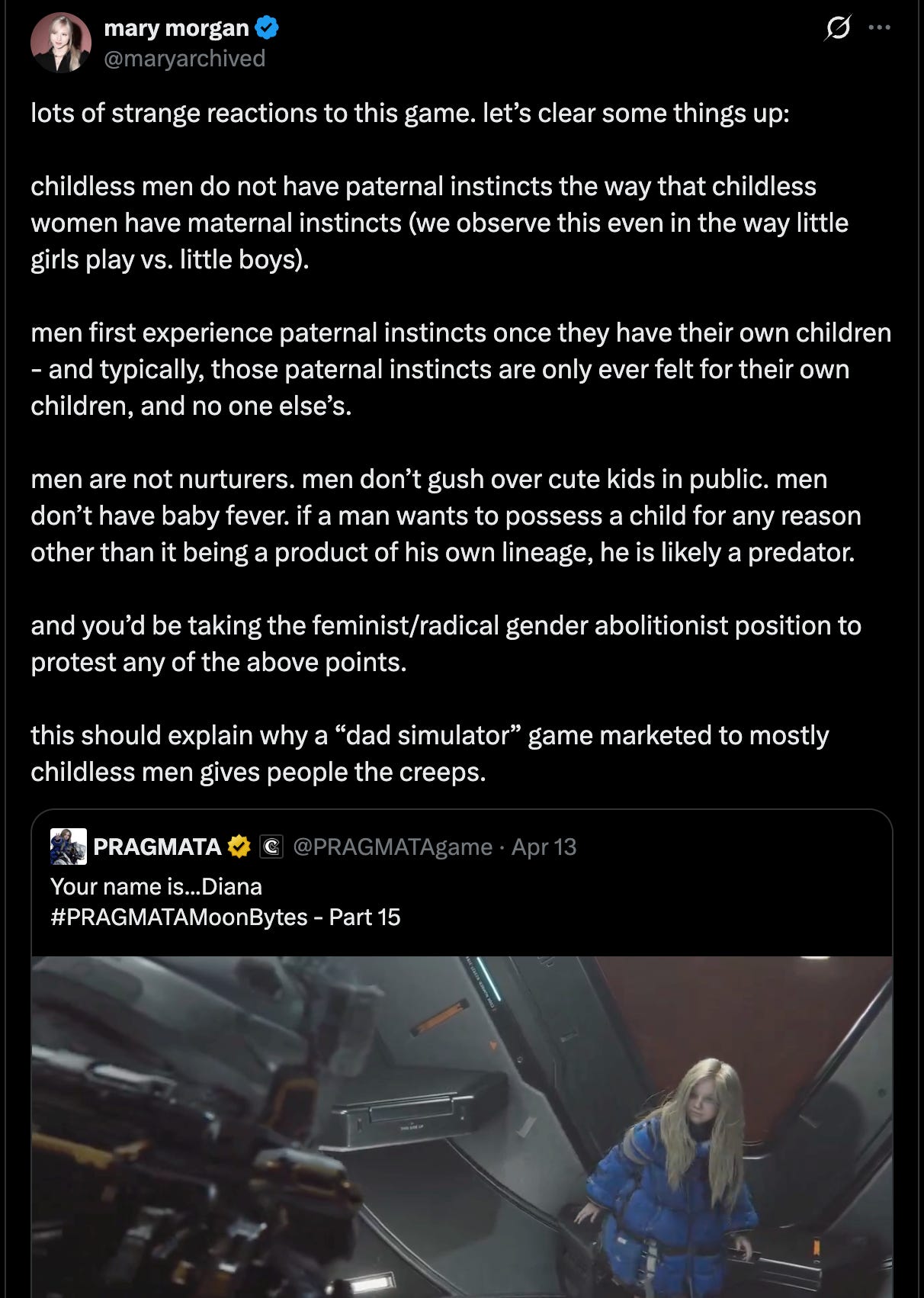
A social media post from Mary Morgan took the argument further into genuinely troubling territory:
“Childless men do not have paternal instincts the way that childless women have maternal instincts. Men are not nurturers. Men don’t gush over cute kids in public. Men don’t have baby fever. If a man wants to possess a child for any reason other than it being a product of his own lineage, he is likely a predator. And you’d be taking the feminist/radical gender abolitionist position to protest any of the above points. This should explain why a ‘dad simulator’ game marketed to mostly childless men gives people the creeps.”
It’s an odd statement from a Catholic commentator. A game where a man protects an android child from danger on the moon is evidence of predatory intent in its male audience. The argument requires accepting that male protectiveness toward children is inherently suspect, that the instinct to shield a child from harm is a pathology unless the man has biological children of his own.
This framing would disqualify every uncle, teacher, coach, godfather, older brother, and male family friend in human history from non-predatory engagement with children in their care.
The community response was appropriately direct. One post read: “There’s something to be said that successful games can tap into the male desire to protect children. Misandry—the word will become just as stale and ineffective as racist, which is really unfortunate—because it’s a very bad thing and you don’t want to devalue that word. But unfortunately that’s exactly what people on the internet do with it.”
Another observer put it plainly: “If you cared about children more than you like insulting men, you’d use the word sparingly and accurately.”
The Birthrate Question
Some commentary frames Pragmata as cultural engineering, a Capcom product designed to stimulate paternal instinct in Japanese men as part of Japan’s ongoing response to its demographic crisis. Japan’s birthrate hit a record low of 1.20 in 2023. Government initiatives to encourage family formation have extended into cultural spheres, and several analysts have suggested that games, anime, and media featuring positive father-child dynamics reflect this broader social emphasis.
Whether Capcom consciously designed Pragmata to serve demographic policy goals is unknowable from the outside. What is observable is that the game depicts a man forming a protective bond with a child and presents that bond as heroic, meaningful, and emotionally resonant. In Japan’s current cultural climate, that framing is countercultural against global entertainment trends toward absent, emasculated, or villainized male figures.
That the game resonated with one million players in 48 hours suggests the countercultural framing found an audience hungry for it—not just in Japan but worldwide.
Grummz and the Selective Memory Problem
Commentator Grummz identified the intellectual inconsistency at the heart of the backlash with characteristic directness: “Everyone screaming about PRAGMATA for wholesome parenting suddenly forgot that last month they were screaming about how you must only be positive about games or STFU. Awfully convenient for them.”
The observation lands because it’s accurate. The same critical infrastructure that labels negative game coverage as toxic harassment weaponizes its platforms to generate negative coverage the moment a game’s thematic content conflicts with progressive priorities. The rules apply selectively, enforced by whoever currently holds the cultural microphone.
What the Game Actually Is
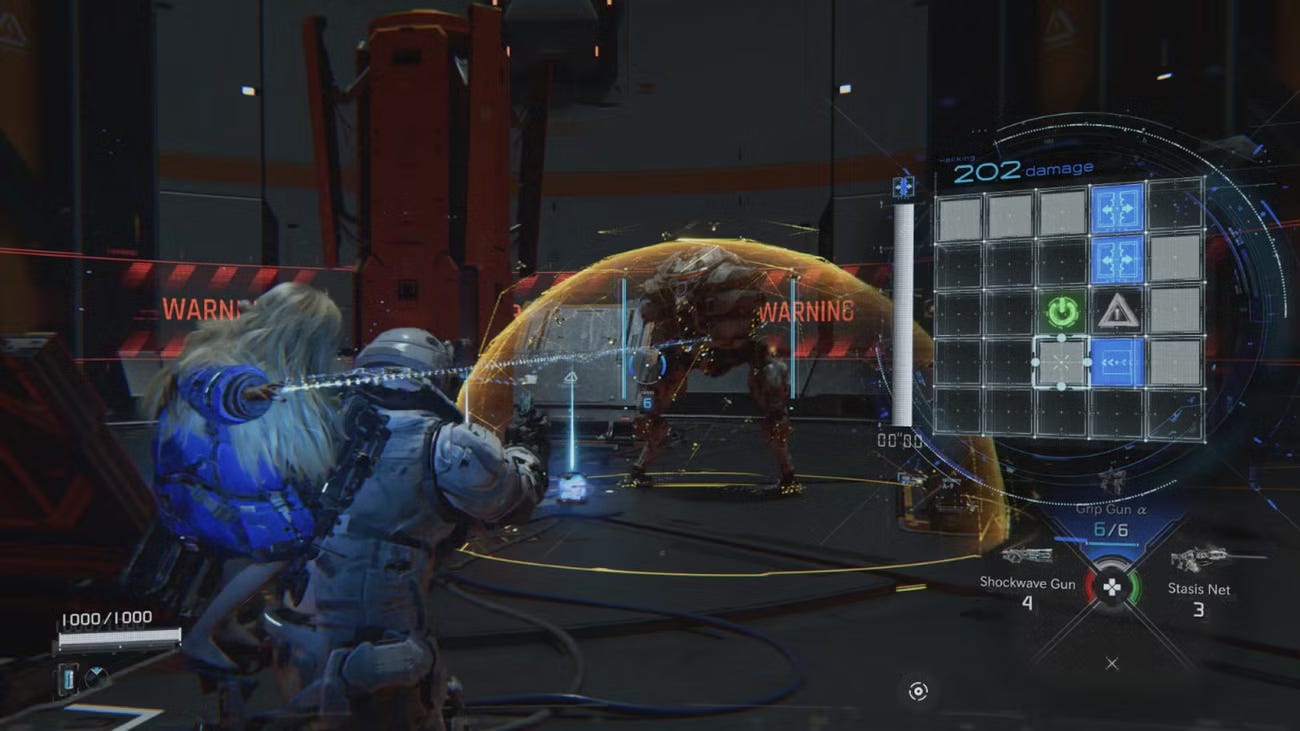
Pragmata is a critically acclaimed, commercially successful action-adventure game where a man and an android girl work together to survive a dangerous world. Diana hacks systems, provides combat support, and navigates terrain. Hugh protects her. They form a bond. The game asks players to care about that relationship and, based on the reviews, they do.
The game scored an 86 on Metacritic, sits at over 91% positive on Steam, sold a million units in two days, and prompted a 100% completion post that Reddit’s own moderators deleted. Capcom cooked. The discourse around it reveals a critical apparatus so thoroughly captured by ideological priorities that a wholesome story about a man protecting a child registers as a threat.
What do you think about the Pragmata controversy and its remarkable launch success?
When genetic engineering nearly doomed the species, humanity made a desperate bargain: let the frontier do what nature intended. In a harsh universe, these cadets have to make impossible decisions. Read Space Fleet Academy today.

NEXT: BAFTA CEO Jane Millichip Expresses Openness To Changing BAFTA Games Awards To Create Gender Parity
I don't sense any ulterior motives from the developers of the game who seemed to want to make a fun and novel game. I think Hasan Piker and Mary Morgan have a profound hatred and contempt for humanity and that their respective audiences hate themselves. If it upsets them that people play a game that happens to be enjoyable, sounds like a win-win situation to me.
If you play a game where a man protects a child and you think sexual thoughts, it might be you...
Truer words were never spoken.
I've watched men of all ages make sure that nothing happens to a child. I've watched men discipline a child without touching her/him. I've watched men tear apart a store and parking lot to find a child's mother.