


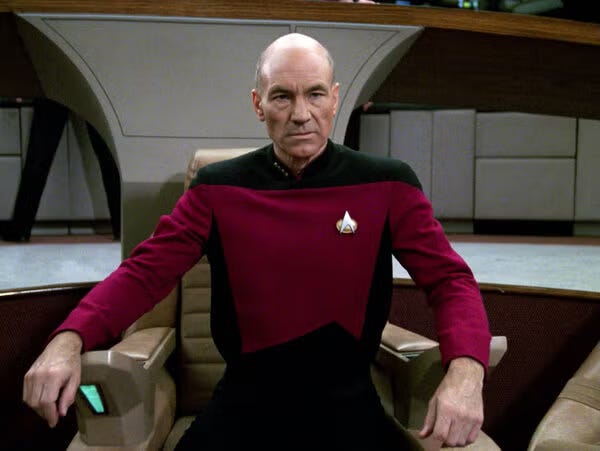
Patrick Stewart has died, and sometime this afternoon it hit me that Star Trek died with him. Paramount will keep producing episodes. The logo will stay on the merchandise. But the man who made this franchise worth taking seriously is gone, and I don’t see anyone on that lot who can replace him.
Star Trek has been in dire straits for a long time. When Enterprise went off the air in 2005, the studio had no idea what to do with the property. The answer was the 2009 reboot and the three films that followed, which looked like what happens when executives decide a brand needs a jolt and forget it also needs a reason to exist.
Then Alex Kurtzman, an Abrams protégé, took over, and he drove the brand into the ground. Under his watch Star Trek went from a tired franchise to a punchline.
When Stewart came back as Picard in 2020, I wanted it to work. It didn’t feel right. The tone was wrong. The man on screen was wrong. Watching Stewart grow old across those three seasons was hard enough. Watching the writers take a man defined by decency and hand him bitterness and a streak of darkness felt like watching a hero lose something he had carried for thirty years.
Today we watched him lose everything, because he lost his life.
As we reflect on that, we have to understand that Star Trek might not have survived the original cast leaving the screen. Shatner, Nimoy, and Kelley formed a trinity: the man of action, the man of logic, and the man of heart. Nobody can manufacture that chemistry twice.
Paramount tried anyway. In the late 1970s, Gene Roddenberry developed Star Trek: Phase II as a revival with a new set of characters, including a Vulcan replacement for Spock. It didn’t take. The new characters rang false, and when the project turned into a motion picture, much of that new material was cut.
By 1987 the lesson was clear. You could not hand the captain’s chair to another Kirk. Kirk was the one everybody pictured when they thought of a Starfleet captain: the swashbuckler, the adventure hero, the man who would solve the problem by the end of the hour with brains or brawn. He had everything and always moved forward. Any copy would be measured against him and lose.
So the new show needed a different captain, and something different behind him. It needed a leader who commanded by listening, who spent the first act of a crisis thinking when Kirk would have been swinging.
That is how Patrick Stewart got the job, and the story is almost funny. He was a Royal Shakespeare Company actor, not a television name. The studio did not like that he was bald, and there was talk of putting him in a wig. Roddenberry did not want him, either. By the usual telling, the man who created Star Trek resisted the casting of the man who would define its second act.
On paper it looked like a miscast. A stage actor with no hair and a creator who doubted him was walking onto a syndicated science fiction show.
Consider what The Next Generation looked like in its early years. The uniforms looked like pajamas. The stories were adventure serials, and Trek was moving into an era when audiences had every reason to laugh at it. This was going to be very hard to take seriously.
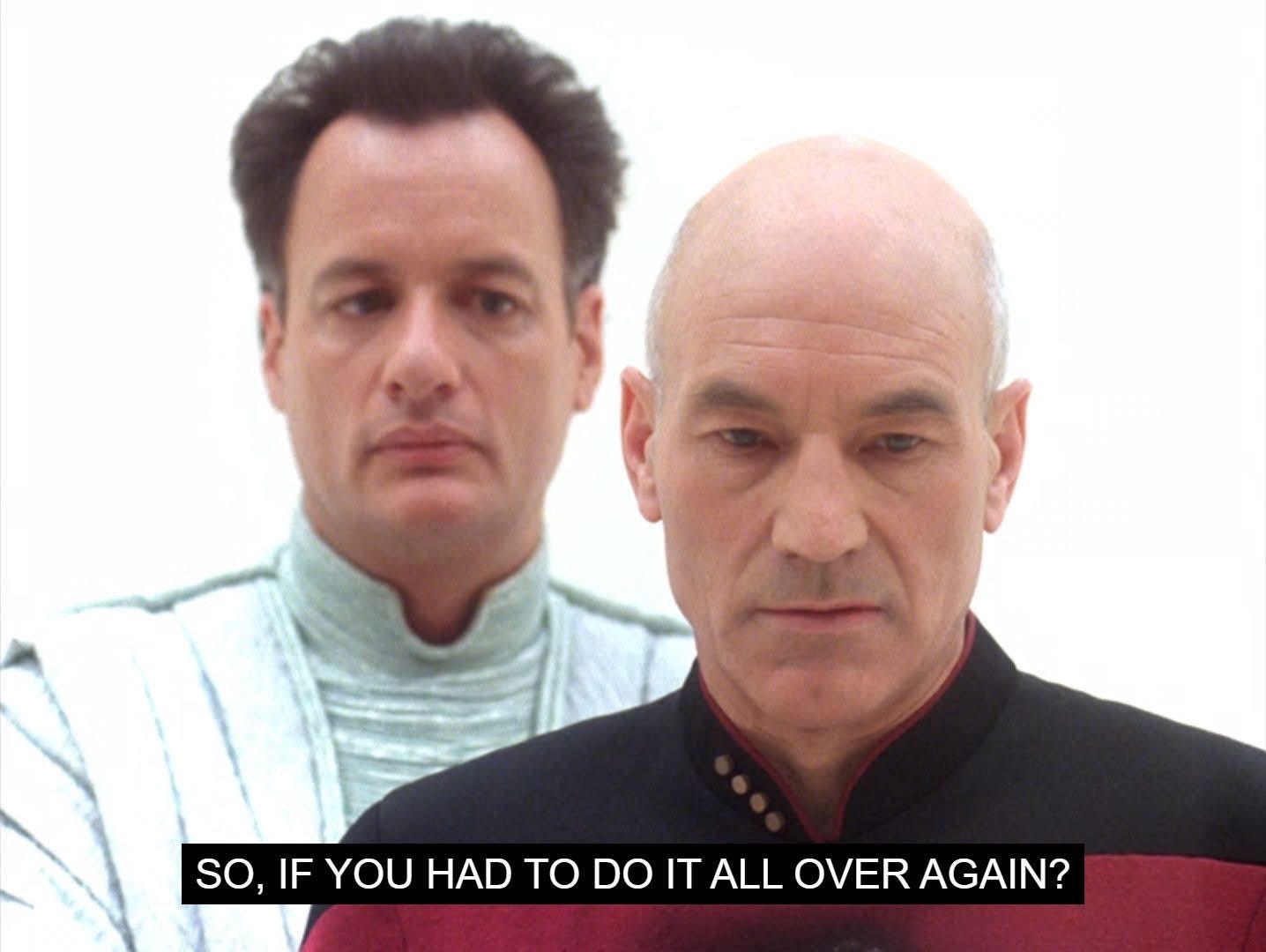
Stewart made everybody take it seriously. His Shakespeare training showed in every scene. When he faced a diplomatic crisis, he played it like Lear facing a storm, and the people around him raised their game to match. He made the audience believe the ship was real, the stakes were real, and the science had depth. He sold it, and that is the reason Star Trek was able to continue.
It is also the reason The Next Generation reached the franchise’s highest popularity, and why Picard carried the cast into four feature films.
Deep Space Nine has beautiful moments. Voyager and Enterprise have theirs. But each of them felt like a cheap copy of The Next Generation, an attempt to cash in on what that show had built. Every one of them was chasing Picard, and Picard was Stewart. The franchise spent decades borrowing credibility from one actor’s performance.
Now the loan has come due. Paramount will make more Star Trek, because the brand is too valuable to shelve. But I do not see a way back to those heights. I don’t think it would matter if the studio handed the keys to the best science fiction writers alive. A franchise is more than its ideas. It needs a man the audience believes, and the last one is gone.
This is the end of an era, and Patrick Stewart meant that much to Star Trek.
Can a franchise survive losing the one performance that gave it credibility, or will it just keep selling his reflection?
If the golden age of Trek and Babylon 5 left a hole in your sci-fi diet, The Stars Entwined fills it — interstellar espionage between two civilizations on the brink of war. Read The Stars Entwined on Amazon!

Picard was first a diplomat and with someone else in the role he could have appeared weak. But Stewart brought such gravitas to it that you felt like were watching one of the great men of history command a starship. Boldy go, Mon Capitan.
Boy that’s good. Beautiful.