


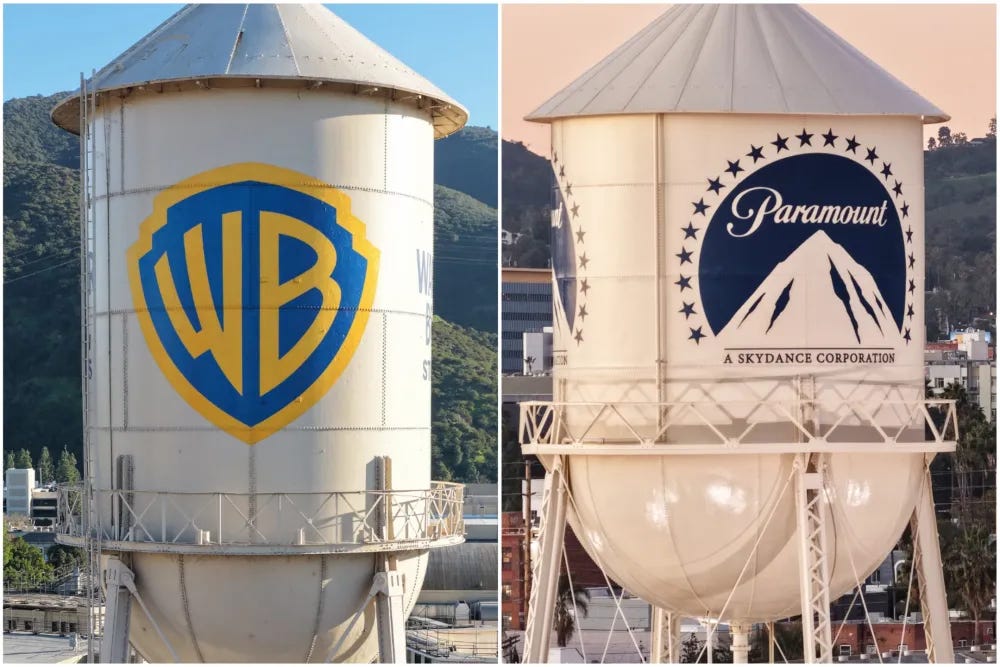
Warner Bros. Discovery, the parent company of DC Studios, HBO, CNN, and Cartoon Network, remains legally frozen inside Paramount Skydance’s $111 billion acquisition attempt after a federal judge scheduled the antitrust trial that will decide the deal’s fate for March 2027. The ruling, issued Tuesday by Judge Araceli Martínez-Olguín of the Northern District of California, pushes final resolution of the biggest media merger in a generation more than a year past its original closing target and leaves DC Studios, Cartoon Network, and every other Warner property under a corporate cloud through at least the middle of next year.
The fight has pulled in Oracle founder Larry Ellison’s personal fortune, a spiked “60 Minutes” segment, twelve state attorneys general defying the Trump administration’s own Department of Justice, and the Writers Guild of America. Here is how it got here.
Paramount Skydance’s pursuit of Warner Bros. Discovery began quietly in September 2025 with an informal offer near $19 a share. Warner’s board rejected it within days, calling the price too low. Paramount came back on September 30 with $22 a share and a $2 billion termination fee attached. Warner kept looking.
In November 2025, Warner’s board passed over both Paramount and a competing bid from Comcast to sign a $72 billion agreement with Netflix, valued at $27.75 a share for Warner’s studio and streaming operations. The cable networks, including CNN, TNT, and Discovery, were slated to spin off into a separate public company called Discovery Global.
Paramount refused to accept the loss. On December 8, the company launched a hostile tender offer straight to Warner shareholders: $108 billion, $30 a share, all cash, for the whole company. Warner’s board unanimously rejected it nine days later, calling the offer “inadequate” and warning it carried “significant risks” for shareholders, largely because the board doubted Paramount’s financing was solid.
Paramount answered the financing question on December 22 by putting Larry Ellison’s personal fortune on the table. The Oracle co-founder, whose net worth then sat near $243 billion, agreed to personally guarantee $40.4 billion of the deal’s equity and raised Paramount’s breakup fee to $5.8 billion, matching Netflix’s offer. The per-share price stayed at $30.
That same weekend, CBS News, which Paramount already owned, pulled a “60 Minutes” segment titled “Inside CECOT” hours before it was set to air. CBS News editor-in-chief Bari Weiss made the call. Correspondent Sharyn Alfonsi, who reported the piece on the El Salvador prison, called the decision political. Weiss had been installed atop CBS News after Paramount bought her outlet, The Free Press, and the incident became a preview of the argument critics would make for the rest of the fight: that David Ellison’s ownership of news organizations comes with an editorial thumb on the scale.
Warner’s board rejected Paramount’s amended bid anyway on January 7, sticking with Netflix for a second time. Paramount kept pushing. On February 24, Warner granted Paramount a seven-day waiver to negotiate under the terms of the Netflix agreement after Paramount filed a new proposal. Three days later, on February 27, Paramount and Warner announced a signed, definitive merger agreement worth $111 billion, or $31 a share, terminating the Netflix deal outright.
Through the spring and summer, the deal cleared more than a dozen national regulators, including the European Commission, which is expected to approve it on condition that Paramount exit its joint venture with Universal Pictures, along with regulators in China and South Africa. The U.S. Department of Justice approved the merger in June.
Twelve Democratic state attorneys general, led by California’s Rob Bonta, filed suit anyway on July 13, arguing the combined company would violate Section 7 of the Clayton Act by controlling roughly 27% of wide-release theatrical distribution and giving one company outsized power over basic cable licensing. Bonta said the merger would put “one company in charge of nearly one-third of all theatrical motion picture and basic cable programming.”
The Writers Guild of America East and West filed a separate suit the next day, arguing the merger would make the combined company the largest buyer of film and television writing in the country, with the power to suppress wages and cut jobs. WGA East president Tom Fontana called the potential damage “an absolute, unmitigated disaster.” Paramount responded that a “stronger Hollywood only means something if it’s stronger for the writers who power it,” pledging more development slates and more greenlights under the merged company.
A federal judge granted a temporary restraining order in late July, and on July 24, Paramount agreed to delay closing the deal until after trial, or until June 1, 2027, whichever comes first. Both companies’ stock slid on the announcement.
While the legal fight played out in court, a separate threat emerged to the deal’s financial foundation. Oracle stock has fallen roughly 34% over the past month amid growing doubts about whether the company’s enormous AI infrastructure spending will pay off. That collapse has erased an estimated $213 billion from Larry Ellison’s net worth, cutting it from a peak near $388 billion to roughly $175 billion and dropping him from the world’s second-richest person to around eighth. Because his personal guarantee behind the Warner deal rests on his Oracle holdings, the stock’s slide has quietly weakened the exact backstop that got Warner’s board to say yes in the first place.
David Ellison stayed mostly quiet on the lawsuits until Tuesday, when he published an op-ed in the New York Times arguing the states’ case is not really about market share but about control of CNN. “I believe this fight is not really about market share,” Ellison wrote. “If it were, it wouldn’t have been reviewed and approved by regulators reflecting 65 countries, including the United States, the European Union and China. I believe a plainer worry sits beneath the briefs and the news releases: the news. The issue is whether I can be trusted as a steward of Warner’s CNN.”
Ellison disclosed that the combined company would account for less than 20% of American watch time, dropping to roughly 13% when YouTube is included, and would represent 18% of the domestic box office over the past twelve months. He also addressed the Bari Weiss speculation directly, writing that he does not “aspire to lead these companies to bend their newsrooms to my views” and that he has voted for candidates of both parties. One commenter on the piece was unconvinced, noting that the lawsuit involves considerably more than one state attorney general and that Ellison’s op-ed said nothing about the unions opposing the deal.
Around the same time, Ellison held his first in-person town hall with Warner Bros. Discovery’s senior leadership, addressing roughly 160 executives at the Steven J. Ross Theater on Warner’s Burbank lot and another 300 by videoconference. He called the process “turbulent” but said that part was “now behind us,” praised HBO as “the gold standard in television,” and cited an expected $6 billion in cost savings from the merger without committing to a specific number of layoffs.
Every property inside Warner Bros. Discovery, including DC Studios, now operates under a corporate parent that will not know its final ownership structure until at least the spring of 2027. Prior reporting on Ellison’s stated plans indicated he intended to keep DC Studios’ existing leadership in place and combine HBO Max with Paramount+ into a single streaming service rather than break up the creative divisions, though those were pre-deal statements made before the current legal fight began and carry no binding weight now.
The trial itself will run twelve court days, from March 2 through March 19, 2027, with a final pretrial conference set for February 24 of that year. Until then, Warner Bros. Discovery operates in the same limbo it has occupied since the lawsuits landed: still legally independent, still facing the possibility of a merger that would fold it into the studio behind CBS, still waiting on a court date more than a year away.
If Paramount wins in March, does the company that inherits DC Studios look anything like the one that exists today, or does a fourteen-month delay give Warner’s board time to find a way out?
First contact with the Oridians was supposed to be humanity’s proudest moment. Instead, their chief engineer is dead, their ship is sabotaged, and an ancient alien technology is stealing souls. Book one of the Valiant Frontiers series delivers exploration, mystery, and the kind of crew you’ll want to follow across the galaxy. Read The Soul Catcher on Amazon and start the adventure.
NEXT: Schreier’s Blizzard “Truth” Video Is Drama Farming, Not Journalism
Let it collapse. WB is worthless, so is Hollywood. Let it burn. Let them sabotage themselves over CNN. Let them bleed out.
If they would rather collapse than compromise, even though it would save them, because of their woke pettiness, LET THEM DIE.
I wonder if it's better for Star Trek's future if the takeover deal fails. A lot of that money that they have allocated for the WB acquisition could then go into Paramount's own productions. Emotionally, though, I believe WB should never be acquired. They've always been the more individualistic and edgier of the big Hollywood studies. Rolling them into a new entity would destroy a really valuable piece of Hollywood history.