


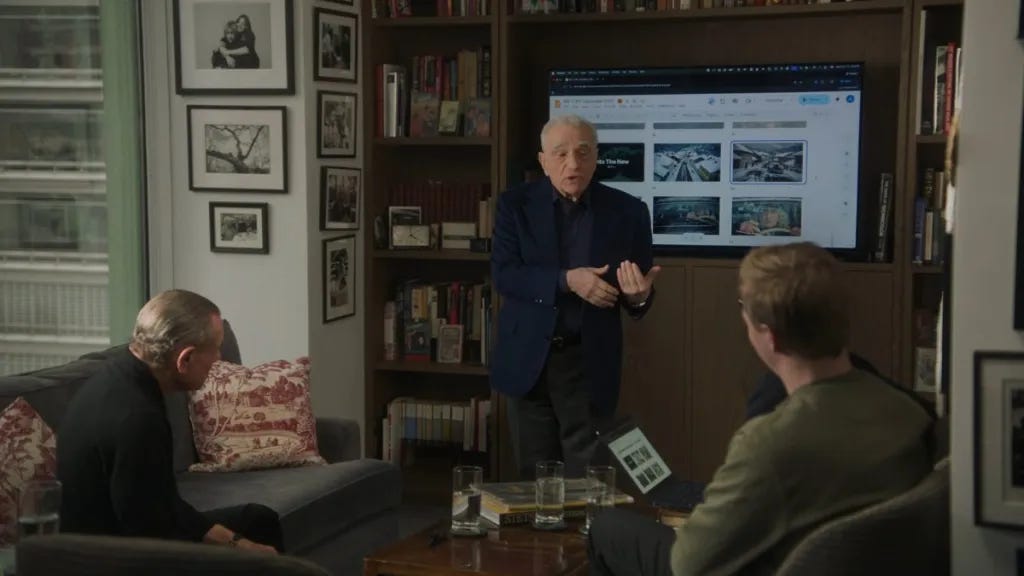
Martin Scorsese announced Tuesday he has signed as a partner and adviser to Black Forest Labs, an AI image-generation startup, and has been using the company’s Flux tool to generate storyboards for his next film, What Happens at Night, starring Leonardo DiCaprio and Jennifer Lawrence.
His statement: “For 70 years, I’ve been creating my own storyboards. There’s always been this problem of how do you communicate what you see in your head to your cast and crew. Now with this tool I can share what I’m visualizing more clearly and efficiently to my creative team — the production designer, art designer and cinematographer.”
The announcement landed as a cultural detonation in the film community. Scorsese spent years as the most prominent voice for the preservation of cinema against corporate encroachment, famously declaring Marvel movies were “not cinema” and repeatedly invoking the importance of the theatrical experience and handcrafted filmmaking. The same man now promoting an AI image generator is carrying different weight than any other director making the same announcement.
But the detail the mainstream press is largely skipping past is the financial one. Scorsese’s talent manager Rick Yorn co-founded BroadLight Capital, one of Black Forest Labs’ investors. Black Forest Labs is valued at $3.25 billion and powers image features inside Adobe, Canva, Microsoft, and Meta. Scorsese did not stumble across this technology independently. His own manager’s investment firm has money in the company he is now publicly endorsing. The announcement reads as a product endorsement until that detail surfaces, at which point it reads as something else.
The film community’s reaction was immediate and became what you might expect. Critics described the announcement as “the opposite of Absolute Cinema,” a direct inversion of Scorsese’s own most famous declaration about filmmaking’s purpose. One commenter wrote: “Cannot stress enough how disappointing it is that Martin Scorsese is collaborating with an AI company.”
The contrast with Guillermo del Toro arrived within twenty-four hours. At Cannes this week, del Toro said: “We live in an age where people think that art can be done with a f***ing app.” Del Toro was not addressing Scorsese directly. The timing made it land that way regardless.
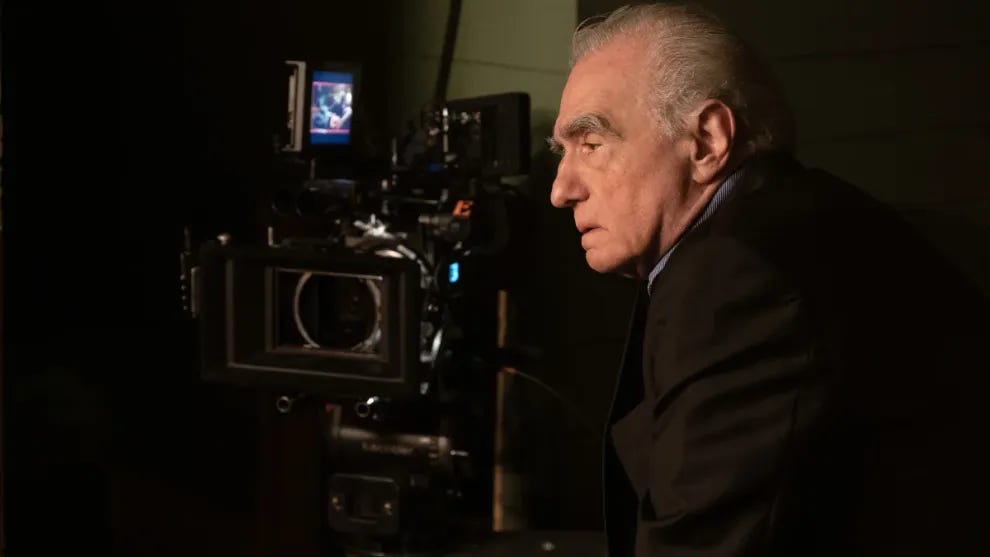
Scorsese, meanwhile, frames the AI use as limited to storyboarding, a pre-production visualization tool rather than a replacement for human performances, cinematography, or editing. He stressed that the tool allows his team to “move faster without sacrificing quality or craft” and called the process “creatively freeing.” He has not argued for AI-generated performances or AI-written scripts.
That distinction matters less than Scorsese’s name on the company’s promotional materials. Black Forest Labs did not announce a partnership with an anonymous director. They announced Martin Scorsese. His credibility is the product being sold. The same credibility he built over fifty years warning audiences about the threats facing cinema is now being used to normalize an AI tool that displaces storyboard artists — a job that has supported working creative professionals throughout the history of film production.
Storyboarding is a job. Scorsese might do it himself, but not every director does, and some of those directors are going to embrace this technology in favor of a more collaborative and human creative process. But as more directors move to embrace technology, a lot more will be outraged as they find that AI can do basic jobs better than they can.
What do you think of Scorsese’s AI partnership? Let us know in the comments.
450 pages of classic superhero storytelling that puts character first. The Flying Sparks Omnibus collects the complete saga of Meta-Girl — the kind of cape comic the mainstream forgot how to make. Sign up to get your copy.

NEXT: Amazon Killed the Stargate Revival Because It Was Too Much Like Stargate
"Black Forest Labs is valued at $3.25 billion"
The AI bubble is ludicrous. How does a startup no one has ever heard of, doing the same thing a hundred, a thousand even, other startups are doing and get to be worth more than half (inflation adjustment estimate) of what Disney paid for Lucasfilm or Marvel?
Generational cultural juggernauts versus Silicon Valley AI con men.
Ludicrous.
Everyone's favorite answer: it depends.
I think people can use "AI"/bots to do good things; the problem is it's heavily used by lowest-common-denominator shady actors for spam, scams, "slop," and influencing people.
This looks like a conflict of interest from Scorsese.
I'd really be curious to see someone use "AI" to make a top-quality item, refusing to compromise on any details of the finished thing but taking the technological assistance.
Overuse of cheap CGI is another thing people justly complain about, but good uses like in the Lion, the Witch, and the Wardrobe, or the LoTR trilogy, or the first Men in Black movie, tend to look amazing and almost seamless. Just another example of something that can be used well or lazily and badly.