


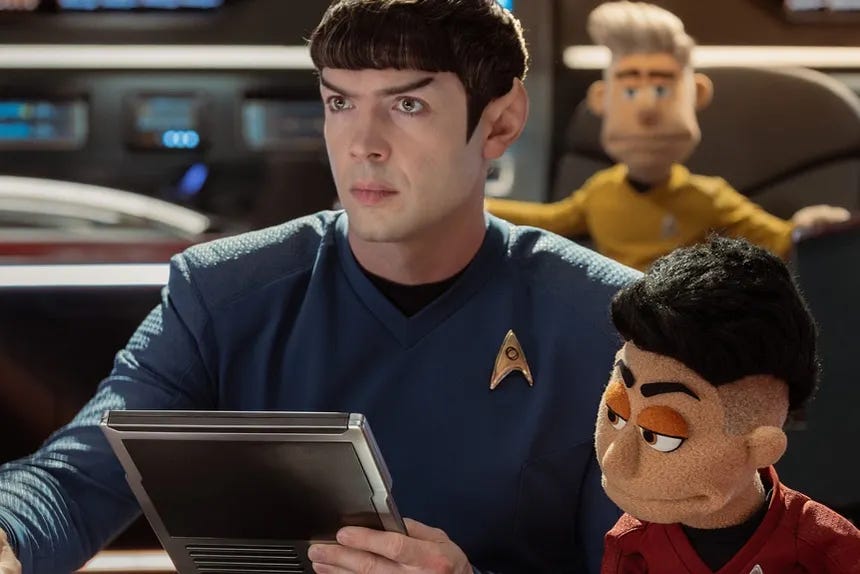
Star Trek: Strange New Worlds aired its long-teased puppet episode on Paramount+ this week, and “Level-Five Transporter Accident” earns the title of the worst hour Star Trek has ever put on screen, including the notoriously bad Starfleet Academy. Written by Henry Alonso Myers and Dana Horgan, directed by Jordan Canning, and built in collaboration with the Jim Henson Company using fourteen puppeteers and months of prep work, the Season 4, Episode 5 installment turns the entire Enterprise crew into puppets and never bothers to make a single piece of it make sense. Worse, the whole thing turns out to be a dream, which means none of it mattered in the first place. This episdoe literally never needed to exist.
The premise: a transporter malfunction during Scotty’s long-range transport experiment with his puppet creation Little Ricky floods the ship with a “Level-Five Transporter Accident” that turns everyone but Spock into a puppet. Orion pirates, led by guest stars Rachael Harris and Joe Lo Truglio, show up to hijack the now-defenseless Enterprise. Spock is the only crew member left standing, so the entire hour rests on him.
Before any of that kicks off, the episode wastes time on Spock’s relationship drama. La’an Noonien-Singh breaks up with him, and he responds by calling his ex, T’Pring, to help him “recenter” on logic. T’Pring agrees to come aboard on the condition that no hijinks occur while she’s there. This is a hallmark of what the Kurtzman-era writers’ room has done to these characters for years now: turning Spock into someone who processes heartbreak through therapy language and emotional neediness instead of the disciplined, controlled figure Leonard Nimoy built. It doesn’t track with who Spock or T’Pring are supposed to be, and the show has leaned on this well so often that it no longer even pretends to justify it.
Once the crew turns to puppets, nobody can operate the ship because every station is locked to individual fingerprints. That breaks with decades of Star Trek precedent. The original series had crew members swap stations constantly, and multiple episodes across the franchise hinge on someone other than the assigned operator taking the conn or working a console. Nothing in Star Trek has ever been locked to a single crewman’s print before, and the show never explains why it suddenly is here. Pike also gets a new captain’s chair this episode, one that the writers mention more than once has voice command functionality built in. Somehow, not a single voice command responds to Pike for the entire hour. The show never explains that either. It’s a convenient plot device that exists only to keep the crew helpless, and it collapses the moment you think about it for five seconds.
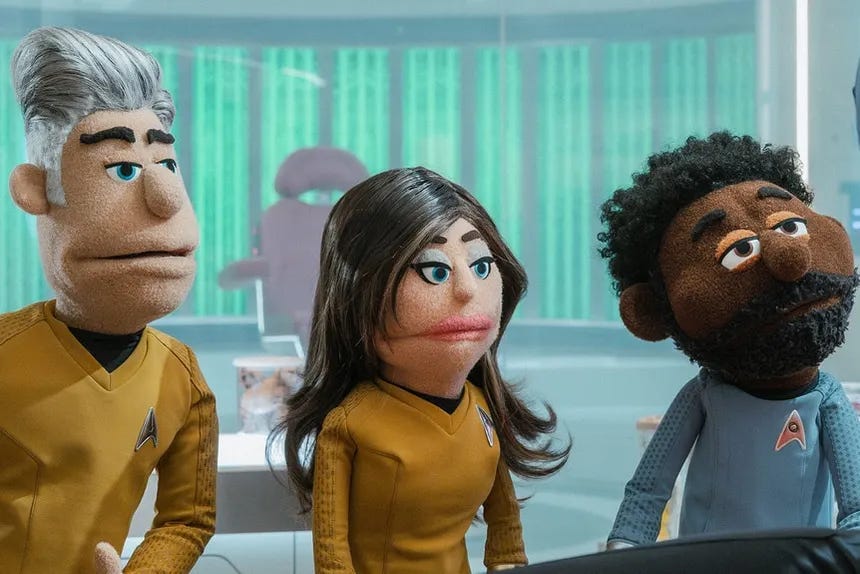
The transporter accident itself gets the same treatment. Nothing about the science behind turning organic crew members into puppets gets explained, not when it happens and not when it reverses at the end. Solving problems through actual reasoning used to be the foundation of what Star Trek was supposed to be about. Here, the writers wave a hand at both ends of the crisis because the real goal is an emotional hour for Spock to process his anxiety, not a story that holds together.
Then comes the twist that undercuts everything: it was all a dream. None of it happened. Spock imagined the whole ordeal, puppets and Orion pirates included, which means an hour of television resolves into nothing. That’s the laziest device available to a writer, and using it here means every unexplained plot hole in the episode was never actually a plot hole to be solved. It was just a dream, so nothing needed to make sense, and nothing did.
The characters spend the whole hour acting stupid so the plot can function. Nobody tries the chair’s voice commands seriously. Nobody thinks to have Spock just disable the fingerprint lock system rather than run the ship solo. Nobody asks what happens with a species that doesn’t have fingerprints in the first place, like the Horta from the original series. The competence Spock is supposed to embody, the single defining trait of the character, gets thrown out so the plot can stall for forty-some minutes.
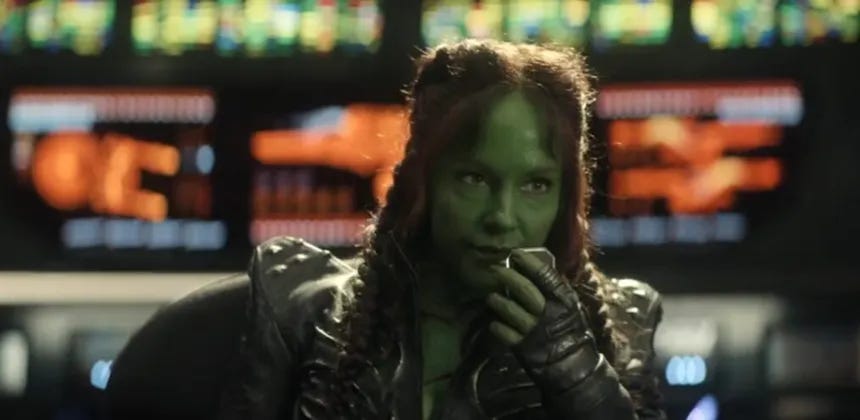
The Orion pirates make it worse. When the puppets first try to fight back, their punches carry no force at all. Later in the same episode, those same puppets are kicking and knocking Orion pirates clean over. The episode can’t stay consistent with its own internal rules from one act to the next. The pirates themselves come across like kids caught playing pretend rather than the intimidating Orion raiders established in the original series, and the female Orion captain is yet another retcon of what that species and culture used to represent on screen. One of her henchmen sits down mid-episode to have a therapy-speak conversation with Spock about relationships, then explains it away as a distraction tactic, except Spock is already captured at that point. There’s no reason left to distract him from anything.
Pike gets ejected out an airlock at one point and presses his puppet hand to the glass for a line lifted straight from Wrath of Khan, “the needs of the many.” It’s a shallow nod meant to satisfy longtime fans, and it lands with the opposite effect: it kills the emotional weight of the scene instead of earning it. That’s the pattern across the whole hour. The episode plays every beat completely straight, like it wants to be taken seriously, while also being packed with gags that are supposed to be funny. It never lands in either place. It’s not funny, and it’s not dramatically effective, so there’s no version of this episode a viewer is meant to actually enjoy.
By the end, Spock has a full anxiety attack, and the resolution leans right back into therapy-speak framing once T’Pring reveals the dream twist. These are Vulcans. The species is built around the total suppression of emotion in favor of logic, and the show keeps forcing both Spock and T’Pring through modern therapy dialogue that has nothing to do with who these characters are supposed to be. It’s insulting to watch, and it’s been a recurring problem with this iteration of Star Trek for years.
“Level-Five Transporter Accident” is the worst episode Star Trek has ever aired, worse than Starfleet Academy, because at least that show’s failures were failures of execution on a story that was trying to be a story. This one invalidates itself in its own final scene. None of it happened. None of it mattered. And the show expects the audience to be fine with that.
None of this is even original. Angel did the puppet transformation gimmick back in 2004 with “Smile Time,” where the title character gets turned into a Henson-style puppet and has to fight his way through a case while stuck that way, using Jim Henson Company puppeteers of its own. Strange New Worlds already pulled this same move once before. Its Season 2 musical episode, “Subspace Rhapsody,” followed the same playbook Buffy the Vampire Slayer set with “Once More, with Feeling” decades earlier. This is a writers’ room that keeps reaching for other shows’ gimmick episodes instead of generating anything of its own.
Star Trek has hung a genre gimmick on nearly every episode of this final season, from a ghost story to a noir mystery to now a puppet show built around a dream sequence. At what point does a franchise built on problem-solving and exploration stop getting credit for “genre-bending” and start getting called out for recycling other shows’ ideas because it has nothing left to say?
First contact with the Oridians was supposed to be humanity’s proudest moment. Instead, their chief engineer is dead, their ship is sabotaged, and an ancient alien technology is stealing souls. Book one of the Valiant Frontiers series delivers exploration, mystery, and the kind of crew you’ll want to follow across the galaxy. Read The Soul Catcher on Amazon and start the adventure.

NEXT: VIDEO: Paramount Exec Confirms Kurtzman Out At Star Trek
If they're going to write Buffy and Angel retreads, they should just hire Joss Whedon as showrunner.
The difference, of course, is that "Once More With Feeling" and "Smile Time" actually worked, within the context of the respective shows. SNW has dropped the ball on BOTH of their attempts to recreate that magic, and painfully so.
I really think SNW needs to just leave the Buffyverse alone, although I guess it really doesn't matter anymore... since Kurtzman - and his destruction of Trek - will be gone soon anyhow.