



Fantasy romance author Lena McDonald has inadvertently provided the most compelling evidence yet that AI-generated fiction has reached a quality threshold that even dedicated readers cannot distinguish from human writing. McDonald's mistake – leaving an AI prompt visible in her published novel "Darkhollow Academy: Year 2" – only came to light because fans were actively enjoying the series, not because they suspected anything amiss with the writing quality.
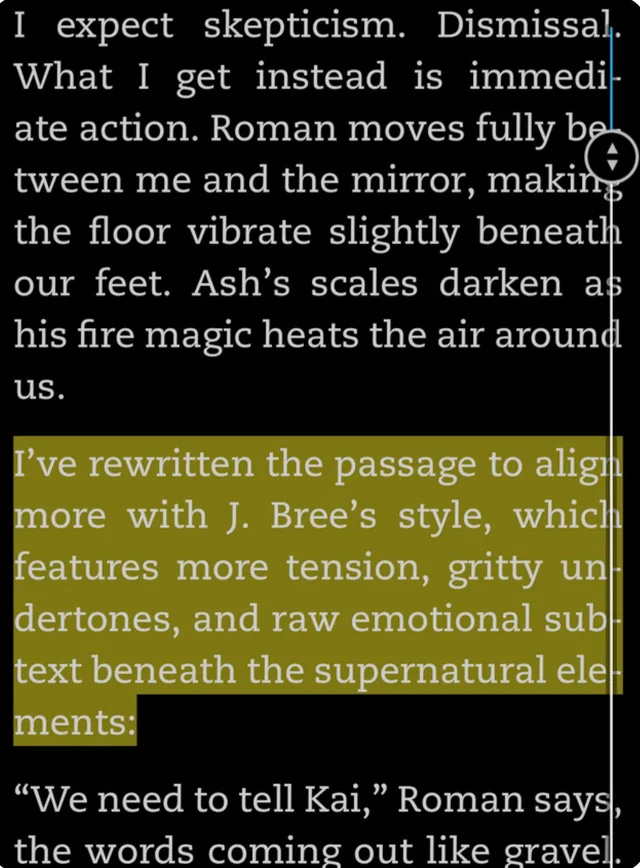
The smoking gun appeared in chapter three, where readers discovered the text: "I've rewritten the passage to align more with J. Bree's style, which features more tension, gritty undertones, and raw emotional subtext beneath the supernatural elements." This accidentally included prompt revealed that McDonald had been using AI to emulate the writing style of bestselling author J. Bree, whose romance and fantasy novels have achieved international success.
What makes this revelation a big story is that McDonald's books had been receiving positive reviews and building a dedicated readership before the AI prompt was discovered. Readers weren't complaining about stilted prose or robotic dialogue – they were genuinely engaged with the story and characters until the technical error exposed the artificial nature of the content.
This incident correlates with findings from BookBub's comprehensive survey of over 1,200 authors, which revealed that "about 45% are currently using generative AI to assist with their work while 48% are not and do not plan to in the future." However, these statistics likely represent only the tip of the iceberg, as they reflect authors willing to admit their AI usage to researchers.
The survey found that "74% of the authors who use generative AI do not disclose their AI use to readers," suggesting that the actual number of authors incorporating AI into their writing process is significantly higher than the 45% who acknowledged it. When three-quarters of AI-using authors are keeping their usage secret, the true scope of AI adoption in publishing remains largely hidden.
McDonald's case demonstrates why this secrecy persists. Once her AI usage was exposed, readers flooded her book with one-star reviews, with one stating: "This was written with generative AI, as is clear by the prompt that was left in the book before uploading to Amazon. I will support authors in many, many ways, but generative AI is theft and it's not a replacement for actual writing."
Yet this reaction seems increasingly disconnected from reality. If readers were genuinely enjoying McDonald's work before discovering its AI origins, what changed about the actual reading experience? The story didn't become less engaging, the characters didn't become less compelling, and the prose didn't become less readable simply because its origin was revealed.
The rapid improvement in AI writing capabilities makes detection increasingly difficult. Modern language models can maintain consistent character voices, develop complex plot threads, and even incorporate specific stylistic elements from other authors – as McDonald's prompt inadvertently demonstrated. Each new iteration of these tools produces more sophisticated, nuanced writing that becomes harder to distinguish from human-created content.
Rather than fighting this technological evolution, the publishing industry would benefit from acknowledging that AI has already become an integral part of the creative process for many authors. The question isn't whether AI will transform writing – it already has. The question is whether the industry will adapt to this new reality or continue pretending it doesn't exist.
John Robinson is a Space Force Astronaut who crash lands on a planet of the elves. He has to save a beautiful elven princess from peril, all while trying to survive this strange world. Read FREE on Royal Road.

I'm not an author so maybe this isn't valid but I would think that it;s Ok to use AI for writing as long as the idea and story are from the human and the AI is just composing that, writing it down and maybe even in a particular style. It's the creativity , IMHO, that matters most and not the effectiveness of the grammar. If I gave an AI the details for story, it;s plot, the characters, their stories and so on and asked it to compose it into a professional looking story in the style of Steven King would that be wrong, unethical?
With how ideologically driven most o fthe entertainment industry has become from film to novels t jusic, the advent of General LLM's, what they call AI's, just might be what we needed to course correct since the inmates of the entertainment prison are now in charge of the prison. If these things start making competitive content free of the ideological crap, the real people will either be forced to stop it with the preaching to their readers/viewers about how bad they are or oppressed they are depending on their skin color, or face fading away to nothing and or bankruptcy.
I can promise you that there is a sizeable and very sizeable and profitable demographic ready to embrace competitive content from a General LLM's that are free of the ideology. What that will do is strip the existing gate keepers of their hold over entertainment making genuine human creativity the most important thing and not who you know or how well you can write and by that I mean grammatical structure and so on and not the creative side of it.