


Lanterns co-creator Tom King says the HBO series’ writers debated whether Sheriff Kerry Kane should face justice for murdering Hal Jordan, and that the answer they reached was no. King made the case on the official Lanterns podcast for the finale. A clip of it began circulating on X on Tuesday morning and was closing in on 370,000 views, with more replies than likes. The same finale has John Stewart reciting a rewritten Green Lantern oath that drops the vow about evil. The writers knew what they were handling. Damon Lindelof used the word heresy to describe the change.
Together the two decisions form a pattern. The murderer leaves Rushville free, the oath loses its enemy, and a series about the Green Lantern Corps ends its season with neither justice nor a vow to pursue it.
Kerry Kane Murders Hal Jordan and Walks
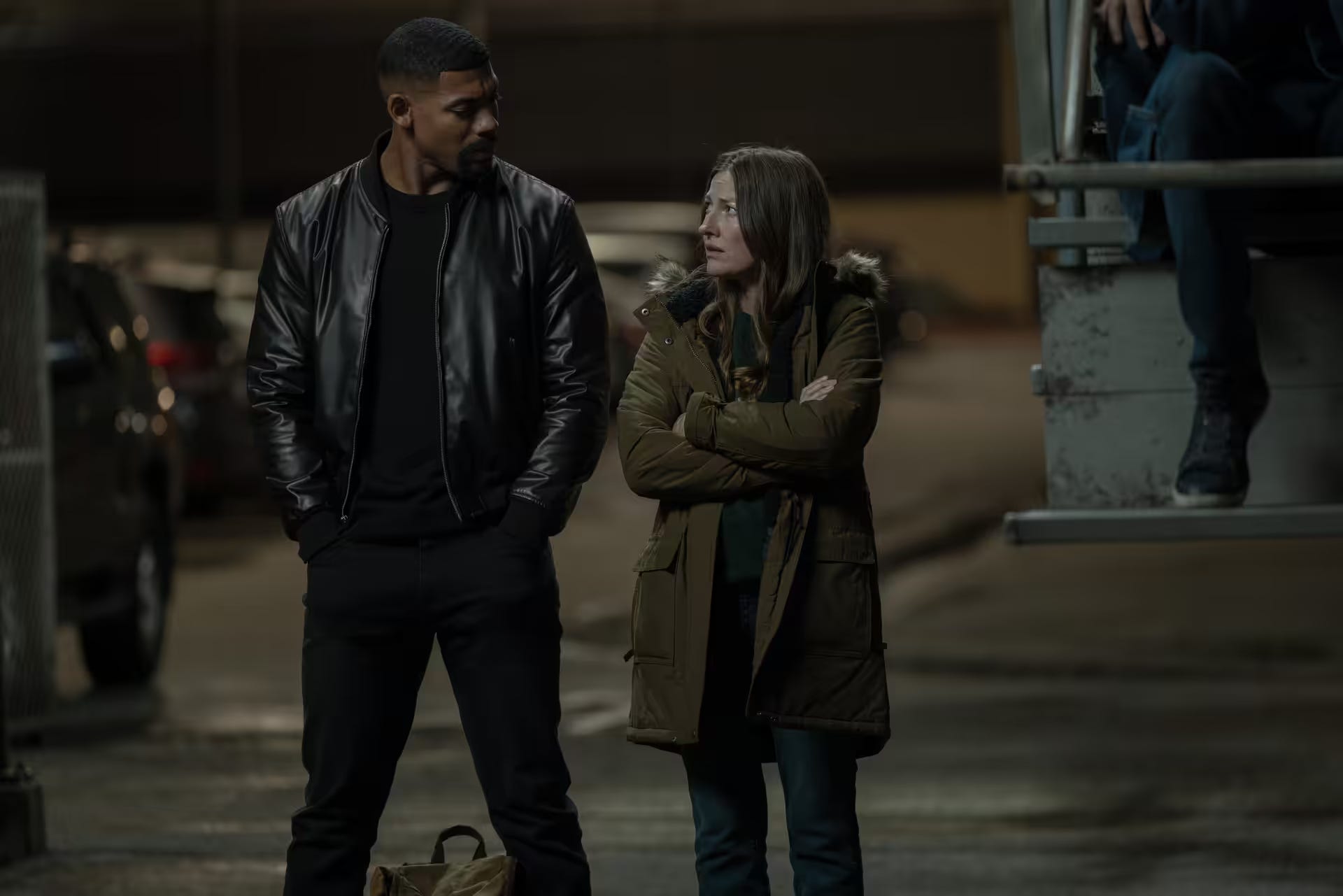
The finale reveals that Sheriff Kerry Kane, played by Kelly Macdonald, shot and killed Hal after he confronted her about her son Noah being a Manhunter. Hal had come to get both of them out of Rushville and keep them safe. Kerry shot him in the head. John Stewart eventually learns the truth and lets her go. There is no arrest and there are no charges.
John had already let Noah walk. Noah had assaulted John, stolen Hal’s ring, helped free Sinestro and had Sinestro forge an unauthorized power battery for him. In one episode John learns who is responsible for Hal’s death and for the trouble around it, and he sends both of them home.
King’s account of the decision begins with a writers room argument. On the podcast he says the writers asked themselves, “Does Kerry get punished?” His answer is that living with the act is punishment enough: “jail isn’t worse than that.”
King also reached for film history. He points to the film noir code of the 1950s, under which “If you committed a murder, you had to go to jail by the end.” In his telling, audiences still carry that expectation in the way they watch, and the writers chose to defy it.
He admits the story gave the writers trouble. A conventional drama, King says, draws a straight line from the killing to a plan to hide it, the way Columbo does. Kerry’s plan does not follow that line. “Her plan doesn’t make sense,” King says. He recalls the writers room being bothered that she called John in at all and then hid the truth from him. After seeing the finished episode, King says it reads as more human to him, with Kerry making mistakes and regretting them in real time.
Showrunner Chris Mundy defended the reveal on the same podcast: “She loved Hal, and this is a tragedy for her as well.”
Viewers have not accepted the reasoning. One fan calling for a Clayface boycott pointed out that Kerry gets a happy life while Hal spent ten years in prison. A Reddit commenter called the killing “completely nonsensical and out of character,” and another poster wrote that Kerry “deserves jail time at least.”
The Oath Loses Its Enemy
The traditional Green Lantern oath makes two promises about evil. The first is that “no evil shall escape my sight.” The second is a warning to those who worship evil’s might. John Stewart’s new oath keeps the rhyme and the light but turns the subject inward: “I’ll embrace my fear, I’ll do what’s right.” It says nothing about evil at all.
On Lanterns: The Official Podcast, Lindelof was frank about the stakes. Describing the moment as holding a hand close to the flame of the canon, he said, “it is heresy to f**k with the oath.” He compared the significance to changing the Pledge of Allegiance. His reason for doing it was that John needed to accept the ring on his own terms.
Mundy took a lighter line on the same podcast. “We approached it like a remix,” he said, adding that the writers were not changing the oath, only remixing the original. Asked separately by the Los Angeles Times, he said, “We wanted John to take [the role] on his terms.”
King supplied the in-story rationale. John’s unsanctioned battery carries green willpower and yellow fear, and so, King said, “John is not a hundred percent a Green Lantern anymore.” He called John an utterly unique creation.
The remix defense runs into the text. A remix keeps the song. This version deletes the line that gave the oath its purpose, the promise that evil will not escape a Lantern’s sight, and replaces it with a promise about the Lantern’s own feelings. The original tells the universe what a Green Lantern promises. John’s tells John what John promises himself.
The timing sharpens the point. The oath changes in the same episode in which John lets a Manhunter hybrid and a murderer go free.
Blackest Night Becomes Darkest Night
One change in the oath has nothing to do with evil or fear. “In blackest night” became “in darkest night.” The phrase is among the best known in Green Lantern lore, and it gave DC one of its largest Green Lantern events its title. The line would rhyme just as well with the old word. The writers could have kept it.
No writer has said why they did not. Without a direct statement from Lindelof, Mundy, King or another writer, the motive remains a matter of inference. The record around the change points in one direction.
On the finale podcast, host Juju Green told the creators, “The Hood’s gonna love John Stewart’s new oath.” He compared the reaction he expected to the way Black audiences embraced Sam Wilson as Captain America and added, “That’s ours, you know?” Mundy answered, “That would be cool.” Racial and cultural identification with this version of John Stewart was part of the conversation about his oath while the writers were discussing it.
The week before, clips from The Ringer’s Midnight Boys podcast circulated showing Lanterns writer Vanessa Baden Kelly saying Hal Jordan has “racist tendencies.” In the same clips she says John Stewart’s backstory was changed over Aaron Pierre’s skin tone and credits the 2024 election with shaping the story of Hal and John.
In the Green Lantern oath, black and light are used in their oldest senses: the dark against the illumination the oath ends by naming, “Green Lantern’s light.” The original phrase carries no racial meaning. A writers room that treats a single murder subplot as a “big debate,” in King’s words, did not swap the most recognized line in the mythology by accident. When a show’s own writers discuss race this openly and then rewrite a famous phrase around the word black, viewers are right to ask whether the change was the point.
What a Green Lantern Is Supposed to Be
The Green Lantern Corps has always been a police force. Its members take an oath, carry a ring powered by willpower and answer for a sector of space. The ring runs on the wearer’s ability to master fear, and the yellow power of fear belongs to the villains, Sinestro among them. The oath is where the job is stated: find evil, stand against it, and answer to the Corps.
The writers of Lanterns reversed each part of that. Their hero pledges to embrace fear, and King confirms his battery carries the yellow side of the spectrum alongside the green. Their hero’s oath is private, written on his own terms, and the writers say he is no longer entirely a Green Lantern. Their hero then closes the season by deciding that neither the Manhunter hybrid nor the sheriff who shot Hal should answer for anything.
King’s defense makes the problem plainer. He says the punishment for murder is that the killer has to live with it. That is a view about conscience, and it can work in a story about conscience. It fits poorly with a character whose premise is that someone must act when wrong is done. A Green Lantern who identifies a killer and sees only a person to be pitied has set the Corps’ purpose aside. Mercy that costs the killer nothing, and gives the victim no justice, is impunity.
Hal Jordan takes the worst of it. In the finale’s telling he confronts Kerry, offers to get her and her son out of town, and she shoots him. His killer then walks, and the character the oath was built around receives no justice in a series that bears his corps’ name. King’s own words show how far the ending departs from the genre. He says the old noir code demanded a jail cell for a killer, and that the writers chose a different ending knowing audiences still expect one.
The finale also arrives at an uncertain moment. Mundy said Monday that there is “nothing official” on a second season, and DC’s Clayface opens October 23 under a boycott campaign built around this finale.
If a Green Lantern no longer vows that evil will not escape his sight, and lets the woman who killed Hal Jordan go free, what is the ring for?
Sign up for the Ayla Rin: Gateway to Doom Crowdfund, coming soon for great cosmic comic books with a cover by legendary Green Lantern artist, Ethan Van Sciver:

Slaves of Satan explaining why they serve Satan.
This morally confused show presents a worldview that the only form of evil is for white people to be self-serving; if a person’s skin is brown, then the struggle itself is morally self-justifying even if the struggle is self-serving. Any act in service is justified - theft, dishonesty, murder, mass murder.