


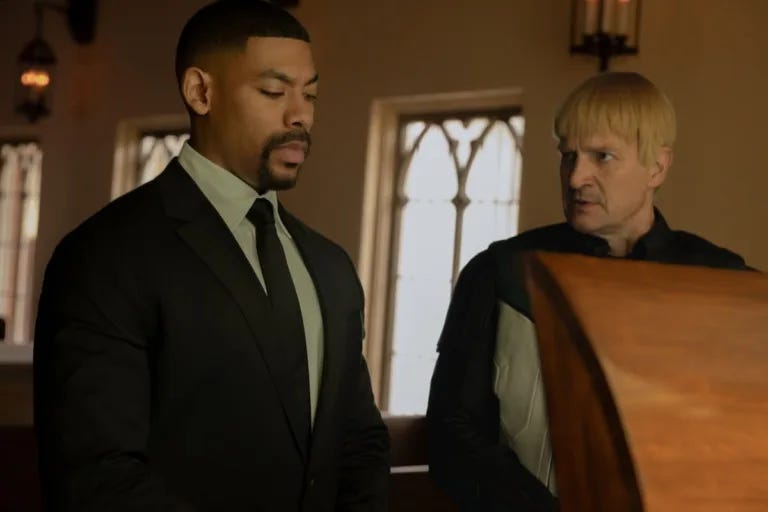
Lanterns finally got back to its modern-day murder mystery with episode six, “Bad Optics,” four episodes after the season premiere left Hal Jordan dead in a lawn chair on a football field. That gap has become the show’s default move: burn an episode on backstory, like the John Stewart flashback hour in episode three, then burn another on present-day table setting where almost nothing happens. “Bad Optics” is the second kind, and it confirms what episode one only teased: Hal Jordan is not coming back. There was no twist like many speculated. He is simply dead, and the show spends an hour proving it by having John Stewart bury him.
The episode opens a decade after the Rushville disaster. John now runs Stewart Brothers with his brother Marcus, an architecture firm building underground “arks,” bunkers the size of football stadiums meant to shelter twenty thousand people from the next Starro or superhuman disaster. He is pitching the concept to Midway City officials and a colonel when the deal closes and his mother Bernadette calls with a lie: Hal wants to apologize. John doesn’t believe it, but he goes anyway, and finds Hal back in Rushville after ten years in federal prison for the destruction of the town. Hal took the fall alone and considers the debt paid. John doesn’t. He tells Hal he “fell” and got people killed, and Hal responds by mocking his own replacement, Guy Gardner, the “gym teacher” who copied Batman’s spotlight trick and put a beacon in the middle of town. Hal then accuses John of taking the ring out of fear rather than readiness, and John punches him in the face.
That beacon becomes the plot engine. On his way to dinner with Sheriff Kerry Kane, John activates it to summon Guy Gardner, and gets jumped by five locals led by Kerry’s ex-husband Billy first. John beats all five without much trouble, eats meatloaf, and has his first drink in a decade, only for Kerry to arrest him anyway once she hears about the fight. Guy Gardner shows up at the jail the next morning, and this is where the episode finally does something. John asks Guy to help investigate who killed Hal. Guy refuses outright, saying involvement would be “bad optics,” a line that gives the episode its title and its clearest statement of character: Earth’s current Green Lantern will not lift a finger for his own predecessor because it might look bad. John has to guilt him into even fetching Hal’s decommissioned ring and uniform for the funeral, reminding Guy that he only has the job because John turned it down. Guy also mentions, almost as an aside, that Sinestro has broken out of his prison somewhere in space, a thread the show clearly plans to pick up later while doing nothing with it here.
The funeral itself is small and bitter. Only Kerry, John, Guy, and Hal’s old flame Carol Ferris show up, which the episode treats as the tragic final punchline on a man it has spent six episodes tearing down. Carol hands John a eulogy Hal wrote for himself, and he reads it over a grave that barely anyone bothered to visit. That night, John comes back alone, digs the coffin up by headlight, and pulls the ring off Hal’s dead finger before putting it on his own hand and summoning the ghostly Halogram to answer questions over the open casket. That’s the episode.
Somewhere in the middle of all this, John explains to Kerry why he never told anyone about his last confrontation with Hal before he died: he’s a Black man in rural Nebraska, and it wasn’t safe to say anything. The show has run this exact beat since episode one, through Hal calling the Stewarts “the midwest Huxtables,” through an entire flashback episode built around a mother explaining that fear works differently for a Black man in America, and now here it is again in episode six, offered as the explanation for basically anything John chooses not to do. At some point repetition stops reading as theme and starts reading as the only card the writers know how to play. It is also worth noting that John, once he leaves the Green Lantern life behind, becomes a self-made architecture mogul closing billion-dollar government contracts inside a decade, because apparently the character can’t just be competent, he has to be the smartest man in every room he walks into.
To its credit, this episode carries less overt ideological baggage than the ones stacked around it. There’s no gratuitous nudity, no lecture disguised as a joke. But the show traded one problem for another: “Bad Optics” is simply dull. Six episodes in, the dialogue still leans on the same F-word-every-other-line crutch that flattened the cast back in episode four, and an hour built around a funeral, a jail cell, and a grave-robbing doesn’t have enough plot in it to justify a full runtime. It plays like the writers had eight episodes to fill and needed one to get from the Rushville finale to whatever comes next, so they spent it here.
Guy Gardner’s introduction is the one genuine bright spot, if only because Nathan Fillion plays him as exactly the kind of self-interested company man who would leave his own predecessor’s murder uninvestigated rather than risk his own standing, and the show lets that cowardice sit there instead of dressing it up as complexity. Whether that was intentional commentary or just Fillion being Fillion is a fair question. Either way, John Stewart is once again the only person in the DCU actually willing to do the hard thing, while the guy who inherited the ring he refused won’t even show up for the funeral prep without being shamed into it.
Is Lanterns still building toward something worth eight episodes of investment, or has it settled into a pattern of one strong hour followed by two hours spent circling back to the same handful of themes?
Sign up for the Ayla Rin: Gateway to Doom Crowdfund, coming soon for great cosmic comic books with a cover by legendary Green Lantern artist, Ethan Van Sciver:

NEXT: Heather Antos Is Officially Off Star Trek Comics, Her Successors Raise Their Own Questions