


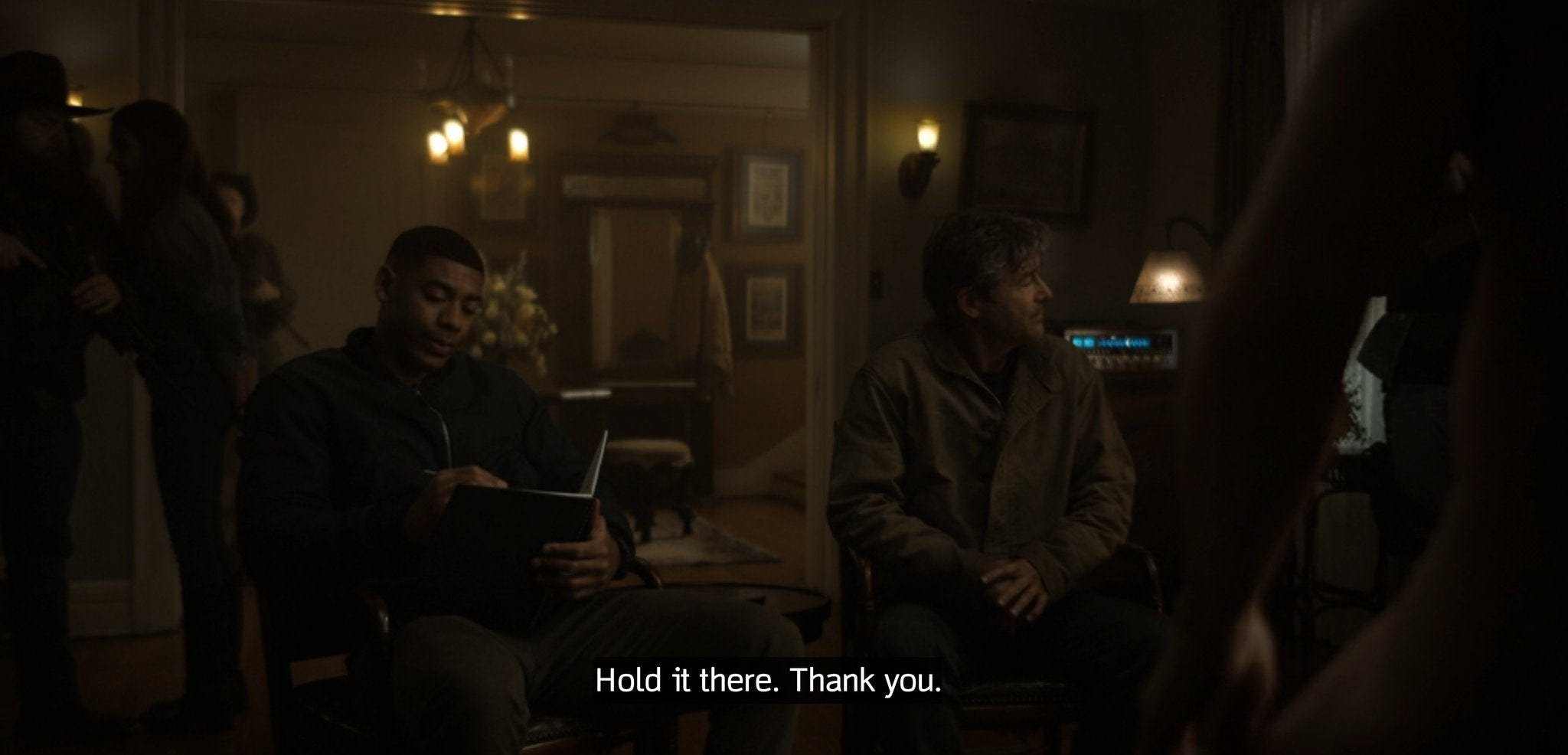
Lanterns hit its high point with episode four, “The Weenie,” an hour that finally locks into a straightforward investigation plot instead of the detours that slowed down earlier episodes. The hour opens with Hal Jordan visiting his imprisoned former mentor Sinestro, who needles Hal about grooming John Stewart as his replacement and lays out a plan to use John’s fearlessness against him. Hal refuses to kill John outright, but the seed is planted that Sinestro used the same manipulation on Hal decades earlier.
Back on Earth, John buys a rifle and scope from a local gun store that won’t sell him a scope alone, strips the rifle down, and hands the gun back so he can stake out the Macon ranch from a water tower. Hal finds him there, and John lays out his theory: a hidden structure at the center of William Macon’s compound, ringed by guard towers, functions as what Disney imagineers call a “weenie,” a landmark built to draw the eye and pull people toward it from every angle. A helicopter lands there daily at 9:17, and John and Hal both suspect it is tied to William Macon’s mysterious benefactor.
The two loop in Sheriff Kerry Kane at a bar owned by Kerry’s husband, laying out the whole conspiracy including the Manhunter threat. That night, the Guardian Lianna appears to John and needles him for failing to report Hal’s oath violation, then goads him by claiming his father’s weakness runs in him and that Hal has called him too soft for the ring. John turns that anger into a plan instead of a confession: he convinces Hal to let him build a massive drill so they can tunnel under the Macon compound rather than smash in with a fist made of green energy. Digging in together gives the two men their best scene of the series, including Hal admitting his mother died of cancer and that he prefers to keep no attachments.
They break into the compound’s central silo, find advanced alien weapons but no Manhunter, and trip a pressure alarm that brings guards firing dark-energy weapons built specifically to take down Green Lanterns. Captured and brought to William Macon, Macon strips naked and asks John to sketch him nude while his wife Zoe watches, then all but confirms he has a benefactor protecting the ranch in exchange for loyalty. Kerry arrives and hauls the two men out before things escalate further.
That night, Zoe shows up at John’s motel room against Macon’s orders, they sleep together again, and as she drives off afterward a laser beam from orbit obliterates her truck in front of him. Hal retrieves the satellite responsible and traces it to a company called Atlas, owned by a man posing as classic Green Lantern villain Hector Hammond. Hal and John track him to a slaughterhouse, where he threatens to blow up John’s parents’ house unless John cooperates, only to fold once Hal calls his bluff. The man turns out to be a human engineer named Hector Gutierrez, not Hammond at all, and he points the finger at William Macon as the real Manhunter.
Driving back, Hal and John piece together what actually happened: Zoe never died. A body doesn’t survive an orbital laser strike and then vanish, which means she staged it, which means she is the Manhunter Macon’s benefactor all along. John admits he suspected this and didn’t say so. The argument escalates until Hal rolls out of the moving car mid-sentence, leaving John alone at the wheel seconds before it slams into a telephone pole with no ring left to protect him.
That plot has real teeth, and the episode wisely drops the racial material that bogged down earlier hours in favor of letting Hal and John’s rivalry breathe as two professionals who don’t trust each other yet.
Then the show does what it did in episode two and steps on its own momentum. The Macon nude-sketch scene lingers on his bare backside in close shots, then lingers again on the finished drawing, and none of it does anything the scene couldn’t have accomplished with him in a robe. It reads like the writer wanted the moment more than the story did, the same instinct that has DC written a wife openly cheating on her husband with his blessing elsewhere in the franchise, and that turned Peacemaker season two’s orgy scene into a black mark on an otherwise solid show. Lanterns has the bones of a PG-13 blockbuster property and keeps reaching for HBO shock value it doesn’t need. The script leans just as hard on the f-word in nearly every scene, and it flattens a sheriff, a rancher’s wife, a Green Lantern legend and a rookie into one interchangeable voice instead of four distinct ones.
Does Lanterns need the gratuitous nudity and the nonstop profanity to read as prestige television, or is HBO defaulting to the only register it knows how to sell?
Sign up for the Ayla Rin: Gateway to Doom Crowdfund, coming soon for great cosmic comic books with a cover by legendary Green Lantern artist, Ethan Van Sciver:

NEXT: Lanterns’ Writer and DC’s Podcast Host Are Now Openly Arguing the Franchise Is Sexist and Racist
Excessive profanity is a huge "tell." The writers are simply lazy.
The “Dad, put your dick away.” scene is classic overwrought Hollyweird.