


John Byrne gave a rare interview to the New York Times this week, timed to the release of X-Men: Elsewhen — the 31-issue alternate timeline story he spent three years drawing as unpublished fan fiction before Abrams ComicArts and Marvel brought it to print. The first printing of 25,000 copies sold out before a single copy reached a shelf. The second printing is already moving.
Byrne, who turns 76 this month and has described Elsewhen as “my leaving in a blaze of glory,” took the opportunity to address one of the most persistent retroactive reframings in comics history, the claim that the X-Men were always a metaphor for gay and queer identity. He pushed back with characteristic directness.
“We’ve seen a pretty major cultural shift in terms of understanding and accepting people with differences. The X-Men were created in a more conservative time, when difference was still a bugaboo. Stan said that the X-Men were his metaphor for racism, that Xavier was Martin Luther King, and Magneto was Malcolm X. And I go, no, actually, go look at the earliest issues. Xavier is F.D.R. and Magneto is Hitler. You know, he’s even using Nazi trappings. But people persuaded Stan that he was doing something else, and Stan said, ‘Sure, why not?’”
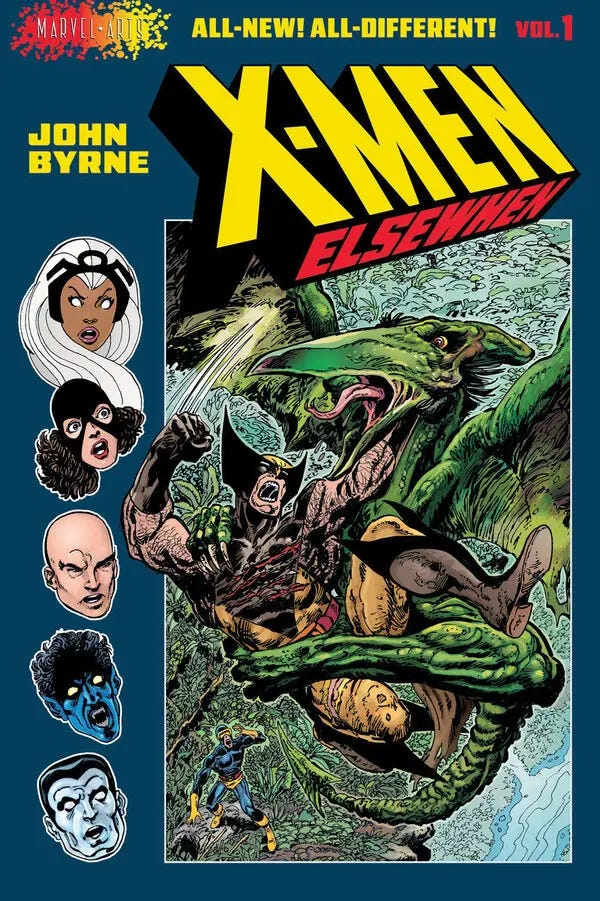
That last sentence is the one the comics press has been reluctant to engage with. Stan Lee was famously agreeable about interpretations of his work. If a reader found a meaning he hadn’t consciously intended, Lee’s typical response was some version of “absolutely, that’s what I meant.” It was generous, charming, and historically inconvenient. The Xavier-as-MLK, Magneto-as-Malcolm-X framing became gospel in subsequent decades of academic and fan analysis, cited so often it calcified into fact. Byrne, who drew the book during its defining era alongside Chris Claremont and knows those original issues with an intimacy few people alive can match, is saying that interpretation came after the fact — and that the textual evidence doesn’t support it.
He is correct. The 1963 X-Men, created by Lee and Jack Kirby, placed Xavier in a mansion, sent his students to a private school called the Xavier Institute for Higher Learning, and positioned Magneto as a costumed villain in the mold of every other 1960s Marvel supervillain. Magneto wore a helmet. He commanded an army. The Holocaust backstory that gave the character his moral complexity arrived substantially later, as subsequent writers built on what Kirby and Lee had sketched. Xavier as FDR — the wheelchair-bound leader of a coalition fighting existential evil through institutional means — is visible in those earliest issues in a way that Xavier as MLK is not.
The LGBTQ reading of the X-Men grew from the later comics themselves, particularly through Claremont’s writing in the late 1970s and early 1980s. Claremont has said in multiple interviews that the mutant metaphor was intentionally expansive, intended to encompass any group that experienced systematic exclusion. The “coming out” language surrounding mutant revelation, particularly in stories about Iceman and Northstar gave the queer reading textual grounding in that era. But that is Claremont’s authorial intent during the run Byrne co-created, not Lee and Kirby’s original 1963 design. Byrne is drawing a distinction that matters: what the creators intended at origin versus what subsequent writers developed the metaphor to encompass. Those are different things.
Claremont himself addressed the question directly at Flame Con in 2012 — an LGBTQ-themed convention where, while clearly trying to be generous to that audience, he acknowledged he did not always intend the X-Men as a stand-in for the LGBTQ community. His answer: "You know there's a space between every panel. You can go wherever you want. And who am I to get in the way?" That is a diplomat's answer from a writer speaking to a room that wanted validation, and it is still, even in its diplomatic framing, a confirmation that the LGBTQ reading was something readers brought to the material — not something the creators built into the foundation. Claremont gave them the space. He did not claim the intent.
The interview contains one passage that serves a different purpose. Byrne, 75 and in what he calls the epilogue of his career, told the Times: “It feels like evil has won. I look at Washington and go, oh my God, this is the guy who I modeled my Lex Luthor in part on, back when he was just a big noise in business in New York.”
The reference to modeling Lex Luthor on Trump is something Byrne has mentioned before in interviews, he has described drawing on New York business figures of the 1980s for the character’s aesthetic, and Trump was among the most visible of them. Identifying him as the model for one of DC Comics’ defining villains is a choice Byrne is making consciously, in a major newspaper, as part of the promotional tour for his farewell book. That is Byrne’s prerogative. It does not invalidate his reading of the X-Men’s origins, which stands on its own scholarly merits regardless of his current politics.
What the interview as a whole confirms is that X-Men: Elsewhen succeeded because Byrne made something readers wanted, and it sold out before the people trying to stop it could do anything about it. Heather Antos, IDW’s head of licensing, posted “During PRIDE MONTH. REALLY, MARVEL?! Do not buy this comic” and called Byrne “a transphobe” who has been “spewing transphobic ideology for decades.” The first printing of 25,000 copies was already sold out when she posted it. A second printing is underway. The audience did not consult Antos before deciding whether to spend their money.
Three free books. No spam. Just new releases, deals, and the occasional update from the front lines of independent publishing. Sign up for the Jon Del Arroz newsletter and start reading today.
NEXT: Jim Shooter, One Year Gone: The Editor Who Rebuilt Marvel and Then Built Valiant From Nothing
It's the reason why they hate and try to silence Byrne.
He's from the before time, and he speaks a truth they have tried for decades to bury and/or rewrite.
Go look at the 90s designs for Jean Grey, Rogue, Psylocke, Storm, Mystique, and many others. Marvel was selling the female form to teenage boys just as much as they were selling action, adventure, and heroism. Only a willfully ignorant fool looks at that and sees gay allegory.
I find it glorious that Elsewhen is well on its way to selling out a second printing less than a week after release.
Meanwhile, you can find stacks of unsold Marvel trades at Ollie's or Fanaticals on eBay, trades that often have a notoriously low print run because Marvel has no warehousing capacity for evergreen titles for some inexplicable reason. (Some stuff, like Claremont era X-Men, sells out in weeks/months and takes years for a reprint while modern crap hangs around on clearance, unwanted, for years.)
Lee was first and foremost a showman; if he thought 'serious' interpretations of comic book stories would help sell comics to college kids and differentiate himself from the at-the-time-for-kids-and-more-conservative Distinguished Competition, he'd go along with it. Then of course it winds up affecting the people who write it in later years--Claremont brought in the whole Holocaust plot to give Magneto moral complexity.
That's actually not entirely a criticism; the arts always depend on hype men like Lee to balance out reclusive creators like Steve Ditko or stubborn visionaries like Jack Kirby to make stuff marketable.