



Jack Posobiec posted this week on a clip of the classroom scene from Paul Verhoeven’s 1997 Starship Troopers, where Johnny Rico asks his teacher Mr. Rasczak whether he should join the Federal Service despite his parents’ objections. Posobiec’s comment: “The libs will never understand Starship Troopers. The right understood it at first glance.”
Another account on the thread noted the specific irony: “It’s funny the teacher in Starship Troopers said something that not even the most liberal teacher would say to a student now.”
The line in question comes from Rico telling Rasczak he wants to join up, that his parents are against it, and asking what Rasczak would do in his position. Rasczak’s answer: “Figuring things out for yourself is the only freedom anyone really has. Use that freedom. Make up your own mind, Rico.”
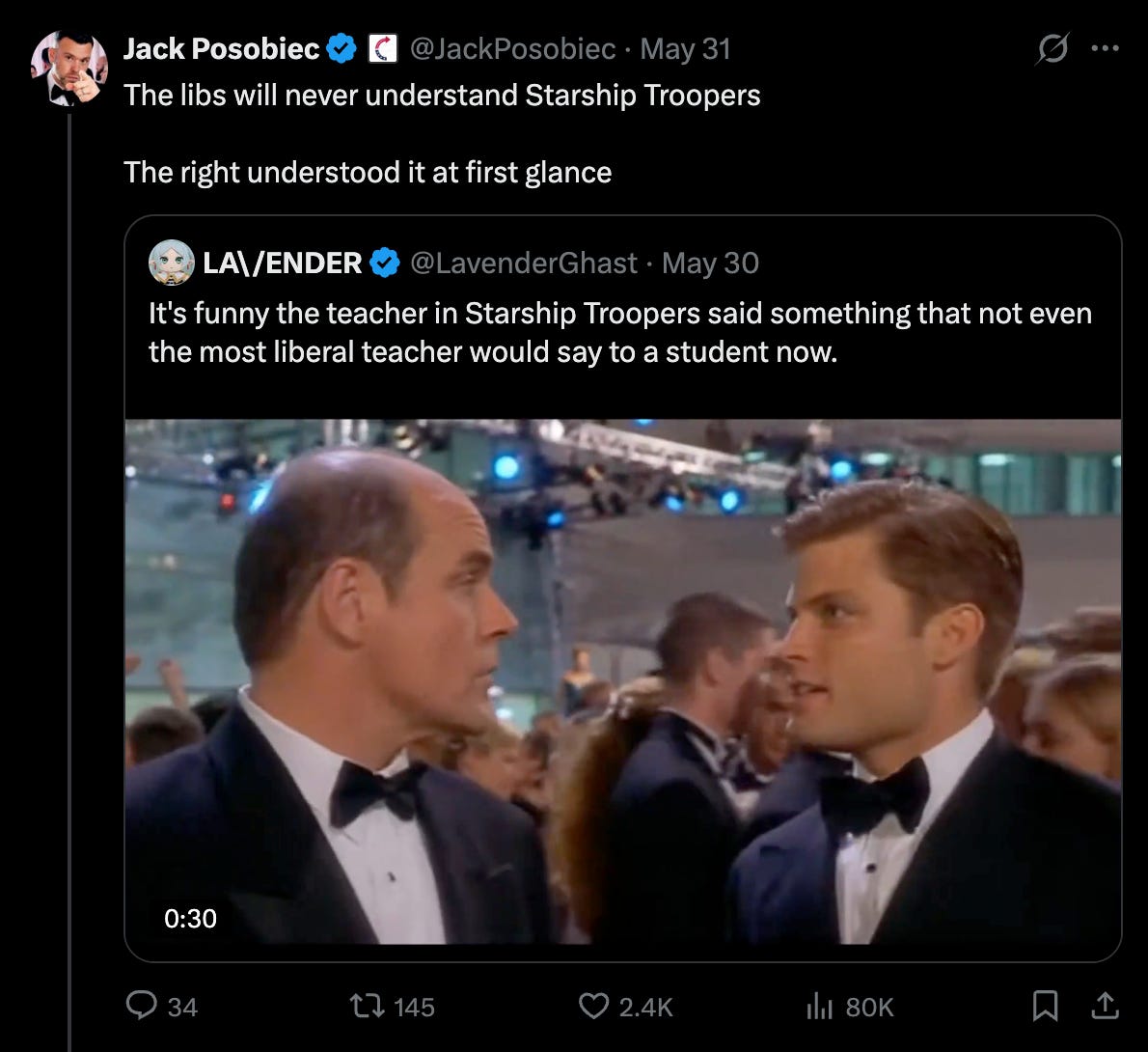
In 2026, that line is a culture war artifact. A teacher in an American public school who told a student to figure things out for themselves rather than defer to authority would face scrutiny from the same progressive education establishment that has spent twenty years building mandatory affirmation practices, preferred pronoun policies, and social-emotional learning frameworks into the curriculum. The irony is the point. The most conservative sentiment in the film is expressed by a teacher in a classroom, and the left cannot claim it without acknowledging what it actually means.
Verhoeven intended Starship Troopers as a savage satire of militarism, fascism, and the kind of civic mythology he associated with American nationalism. He grew up in Nazi-occupied Netherlands and explicitly designed the film’s aesthetic to echo Third Reich propaganda aesthetics with the uniforms, the rallies, the cheerful newsreel framing. The satirical intent is real and documented. In multiple interviews Verhoeven confirmed he wanted the film to expose the fascist underpinnings of Robert Heinlein’s source novel by making the fascism glamorous and then asking the audience to notice they had been seduced by it.
The plan failed for a reason captured perfectly in another tweet in the Posobiec thread: “We were lucky Paul Verhoeven didn’t know how to direct a satire movie properly so most of Starship Troopers comes off as a straight action flick instead of a comedy.”
Verhoeven made the fascism look cool and forgot to make it look bad. The bugs are genuinely terrifying. The Mobile Infantry are genuinely heroic. Neil Patrick Harris in a black SS-style uniform reading Bug minds at the end is unsettling but the film does not contextualize it as horror — it frames it as victory. The audience Verhoeven wanted to disturb walked out of the theater wanting to join the Mobile Infantry.

The deeper problem for Verhoeven’s project is that Heinlein’s novel is not what he thought it was. Robert Heinlein was a libertarian who spent his career resisting the political simplifications others imposed on his work. The novel’s central philosophical argument, delivered through the character of Rasczak across multiple classroom lectures, is that moral sense is not innate, but rather it is acquired through training, experience, and hard mental effort. The book argues for civic virtue built on personal sacrifice and earned responsibility rather than entitlement. The franchise’s central question of what is the difference between a citizen and a civilian is answered in the film with the same precision as the novel.
“Rico, what’s the moral difference, if any, between a civilian and a citizen?” Rasczak asks in the film. Rico answers: “A citizen accepts personal responsibility for the safety of the body politic, defending it with his life. A civilian does not.” Rasczak’s response: “The exact words of the text. But do you understand it? Do you believe it?”
That exchange is not fascism. It is the philosophical tradition of civic republicanism that runs from the Roman Republic through the American founding. The idea that full participation in the governance of a society should come with demonstrated commitment to its defense is older than the Third Reich by two thousand years. Verhoeven read it as proto-Nazi because he brought that interpretive lens to the material. The right read it as common sense because they brought a different lens.

Heinlein was a complicated political figure who resisted categorization throughout his life. He began as a New Deal Democrat, shifted toward libertarianism in the 1950s, and ended his career with works like The Moon is a Harsh Mistress and Time Enough for Love that defied any single political taxonomy. But Starship Troopers specifically, published in 1959, is a book about duty, sacrifice, personal responsibility, and the moral foundations of civic life, values the American right has consistently identified as its own and the progressive left has spent the last two decades actively dismantling in education, media, and culture.
Posobiec’s observation is correct: the right understood the film at first glance because the film’s actual values are legible to the right in a way they are not to the left. Verhoeven’s satire required the audience to recognize the heroism as fake and the ideology as dangerous. The right watched the same film and recognized the heroism as real and the ideology as familiar. The satire bounced off.
What is your read on Starship Troopers? Let us know in the comments.
If the golden age of Trek and Babylon 5 left a hole in your sci-fi diet, The Stars Entwined fills it — interstellar espionage between two civilizations on the brink of war. Read The Stars Entwined on Amazon!

I disagree.
The satire is readily apparent, but it's entertaining. There's inspiration in their heroism, respect in their sacrifices, glory in their victories. The over the top nature of everything adds to its charm.
In order for the satire to turn the audience against the Terrans, they needed to make them evil, hypocritical aggressors, which they weren't. The bugs attacked, wiped out the characters' family, friends, and home.
Not to mention, the enemy were gross, violent, terrifying bugs.
Were the audience SUPPOSED to side with the murderous bugs over humanity?
Well, some Democrats just might, but that's not satire, and it's not funny, but horrifying and very telling of their values.
My favorite Heinlein, out of several I like quite a bit. The movie is corny and yes he clearly meant to mock the text - he clearly did not understand it. His mockery is inept because the actual philosophical underpinnings of the book shine through anyway.