


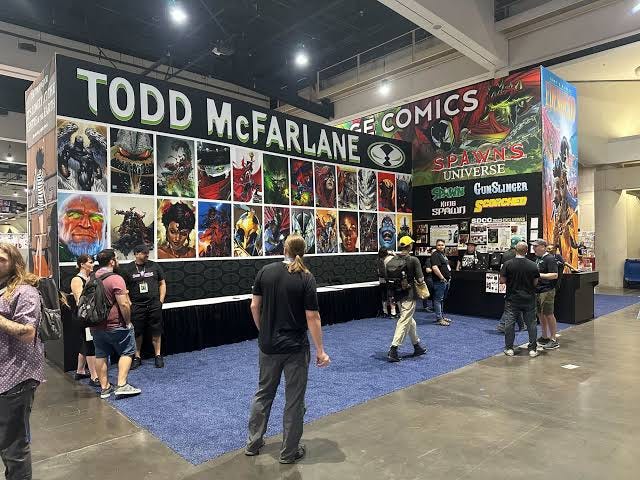
Todd McFarlane, Rob Liefeld, Marc Silvestri, Robert Kirkman, and Eric Stephenson are sharing a single stage at SDCC today for “Image Comics Legends Together on One Stage,” billed as a look back at how they “revolutionized the comic book industry.” The panel description doesn’t mention that this same group of men spent the 1990s pushing one of their own out of the company, watching a founding partner sell his entire imprint to their industry’s other biggest publisher, and burning through a market collapse that Image itself helped fuel.
The founding and the bubble
Image was born in February 1992 out of what the industry nicknamed the “X-odus”: Todd McFarlane, Jim Lee, Rob Liefeld, Marc Silvestri, Erik Larsen, Jim Valentino, and Whilce Portacio all walked out of Marvel together, joined briefly by longtime Uncanny X-Men writer Chris Claremont. Their complaint was simple and, for the era, radical: Marvel owned everything these artists created, no matter how much merchandise or spinoff success a character generated, and the creators saw a fraction of it in page rates and modest royalties. Image’s founding structure solved that by refusing to be a single company at all. Each founder ran his own independent studio under the Image banner, McFarlane’s Todd McFarlane Productions, Liefeld’s Extreme Studios, Lee’s WildStorm (originally named Aegis Entertainment), Silvestri’s Top Cow, and so on, keeping full ownership and creative control while sharing a distribution and marketing umbrella.
The launch was one of the biggest commercial explosions in comics history. Image’s initial titles were published through Malibu Comics, which handled distribution and production while Image built its own infrastructure. Liefeld’s Youngblood #1 hit stores in April 1992 with pre-orders around 930,000 copies, a record for both creator-owned and independent comics at the time. McFarlane’s Spawn #1 followed a month later with a print run exceeding 1.7 million copies. Within months, Malibu’s distribution deal with Image alone had captured close to 10% of the entire North American comics market, briefly outpacing DC Comics. By early 1993, Image had grown enough to cut ties with Malibu entirely and open its own central publishing office.
That explosive growth was built on sand. The early 1990s comics market was in the grip of a genuine speculator bubble: variant covers, foil embossing, and “collector’s item” marketing convinced buyers that first issues were investments rather than reading material, and retailers over-ordered accordingly. Total industry sales peaked above $1 billion in 1993. The bubble burst starting in mid-1993, as speculator demand evaporated overnight, unsold inventory piled up in warehouses, and industry-wide sales fell roughly 70% by 1996. Image, having helped drive that same speculative frenzy with its own foil-cover and variant strategy, took the collapse hard right alongside everyone else.
The Liefeld ouster
The company’s founders didn’t survive the decade intact either. By 1996, Marc Silvestri had grown frustrated enough with Liefeld’s conduct within the partnership that he pulled his own studio, Top Cow, out of Image entirely in protest. That move pushed the remaining founders to formally move toward ousting Liefeld from the company outright. Liefeld got ahead of it: he announced his own resignation minutes before the partners would have officially removed him. Silvestri brought Top Cow back into the Image fold once the dust settled. It’s a genuinely remarkable footnote sitting underneath today’s panel: Liefeld is one of five men on stage celebrating Image’s legacy despite having been pushed out of the company by the very people standing next to him.
The Jim Lee exit
Jim Lee’s departure was quieter but arguably more consequential. WildStorm had become Image’s most consistently successful studio through the mid-90s, built on WildC.A.T.s, Stormwatch, and Gen13. But as industry-wide sales kept declining through the late 1990s, Lee decided to get out of the publishing business side entirely. In 1998, he sold WildStorm outright to DC Comics, a deal that took effect in January 1999, reportedly motivated by a desire to step back from running a company and refocus purely on drawing. DC’s own later accounting of the deal suggested the company primarily wanted three things out of the purchase: WildStorm’s respected color separation studio, Lee himself as a working artist, and the ongoing relationship with Alan Moore, who was writing for the imprint at the time. Lee went on to become DC’s co-publisher in 2010 and its sole publisher in 2020, meaning one of Image’s seven founders has spent the last quarter-century running the very company Image was founded to compete with.
Portacio’s exit was the quietest of all. He never became a full partner in the first place, withdrawing before the partnership fully solidified due to his sister’s illness, and later dealt with his own serious health crisis, a near-fatal pancreatic illness in 2000. He’s never held a board seat at the company he helped found.
What’s left, and what never got finished
What survived is a much smaller core than the original seven: McFarlane, Silvestri, Larsen, and Valentino held the company together through the leanest years, joined by Robert Kirkman as a partner in 2008 on the strength of The Walking Dead’s runaway success, and Eric Stephenson, who’d joined back in 2001 as marketing director, rising to publisher that same year. Today’s board runs six seats deep, with McFarlane as president, Silvestri as CEO, Kirkman as COO, Larsen as CFO, Valentino as VP, and Stephenson as publisher and chief creative officer.
The clearest unfinished business from that entire era is Image United. Announced in 2009 as a full reunion crossover, Kirkman scripting, McFarlane, Liefeld, Silvestri, Larsen, and Portacio all drawing characters from their own imprints together in one story, Youngblood, Spawn, Savage Dragon, Cyberforce, and more sharing a page for the first time, it was meant to be the definitive proof that Image’s founders could still function as a unit two decades on. It shipped exactly two of its planned four issues before collapsing, undone by the same fractures baked into the company from day one: Portacio had already stepped back from the partnership before the project even started, Liefeld left partway through production, and Lee was long gone to DC before any of it wrapped. It’s sat unfinished for over fifteen years.
With McFarlane, Liefeld, Silvestri, Kirkman, and Stephenson sharing a stage today, and Kirkman, the writer who scripted Image United in the first place, sitting right there among them, it’s a fair question whether this is finally the moment someone brings it back up. Jim Lee is still one phone call away at DC, Larsen never left the board, and Portacio, health permitting, remains the one true loose thread. Thirty-four years after seven artists walked out of Marvel together, the company they built has outlasted every one of the fractures that nearly ended it. Whether it ever finishes the one project built specifically to prove that is still an open question.
First contact with the Oridians was supposed to be humanity’s proudest moment. Instead, their chief engineer is dead, their ship is sabotaged, and an ancient alien technology is stealing souls. Book one of the Valiant Frontiers series delivers exploration, mystery, and the kind of crew you’ll want to follow across the galaxy. Read The Soul Catcher on Amazon and start the adventure.
Fun bit of comic book history!
Anyway, they fought the Big Two for the artists' right to control their own destinies. And unlike Neal Adams a decade earlier, they succeeded. So...some of them decided that destiny including selling out! (Though it's not like Jim Lee has been incompetent at DC, they may have pulled ahead of Marvel for the first time in 30 years. The whole H2sh thing strikes me as a guy with a big ego trying to be publisher and artist at the same time and finding, unlike the characters he draws, he is merely human.)
I buy secondhand trade paperbacks mostly, and when I walk over to look at stuff there's as much indie as there is DC and Marvel. That would not have been the case in the 80s (of course there were no trade paperbacks either). So, I'd say the Image Seven did a good thing.
Even the Rippaverse probably wouldn't have gotten as far as it did without Image breaking the Big Two monopoly.
Image is what really got me out of comics, after about five years in. I got all of MacFarlane’s Spawn and Lee’s couple a’ handful of WildCats and just missed the Marvel Universe that I was cemented in. The only thing I ever cared about was the Marvel Comics “Universe” and that unceremoniously died almost 20 years ago, for me in 2008..
I still have a mess of late Silver & Bronze Age classics. The actual books too.