


Rob Liefeld is bringing back Avengelyne this October, and the version he’s using to launch it at San Diego Comic-Con this week says something about where comics marketing has landed in 2026.
Avengelyne #1 arrives with seven different covers. Six are standard artist variants from names like Diógenes Neves, Shannon Maer, and Andy Park. The seventh, Cover B, is Liefeld’s own work: a polybagged, explicitly labeled “NSFW” variant. Liefeld has built hypersexualized characters before, Avengelyne herself was co-created in 1995 as a “bad girl” superheroine based on a former Vampirella model, and her original run already carried nude photo-variant covers. What’s different this time is the packaging. This is the first time Liefeld has slapped an explicit NSFW label and a polybag on a mainline release rather than letting the cheesecake speak for itself the way it always has.
That choice lands in the middle of a much bigger shift across the industry. Kickstarter tightened its adult-content rules as of May 2026, banning implied nudity, lingerie, fetish wear, and “very tight” clothing on campaign pages, a policy serious enough that creators immediately started listing which mainstream, non-comics properties would get flagged under the same rules. As one Kickstarter creator put it to Bluesky, “Just for context, here is some award-winning media that’d be banned on Kickstarter now: The Witcher, Game of Thrones, Cyberpunk 2077, Castlevania, Baldur’s Gate 3, God of War, Dragon Age, Mass Effect.” Pat Shand, publisher of Cheeky Comics and one of Kickstarter’s largest NSFW-adjacent labels, made a similar point to The Beat: “Many of the largest IPs in the world outside of comics, Game of Thrones, Euphoria, The Boys, and certainly any of the romance novels dominating traditional publishing sales, the list goes on and on, would be considered ‘NSFW’ if presented on the platform as a comic.” Some campaigns got pulled mid-run over the new rules. Creators who built entire businesses on cover nudity started migrating to less-regulated platforms like Indiecrowdfund.com just to keep selling.
The pattern underneath all of it is the same one showing up in Liefeld’s Avengelyne launch: when a comic needs to cut through a crowded market, cover nudity has become one of the most reliable levers left to pull, reliable enough that Kickstarter’s own payment processor forced a crackdown, and reliable enough that a 30-year industry veteran with an established, recognizable brand still reached for it this week to launch a character he could have sold on nostalgia and name recognition alone.
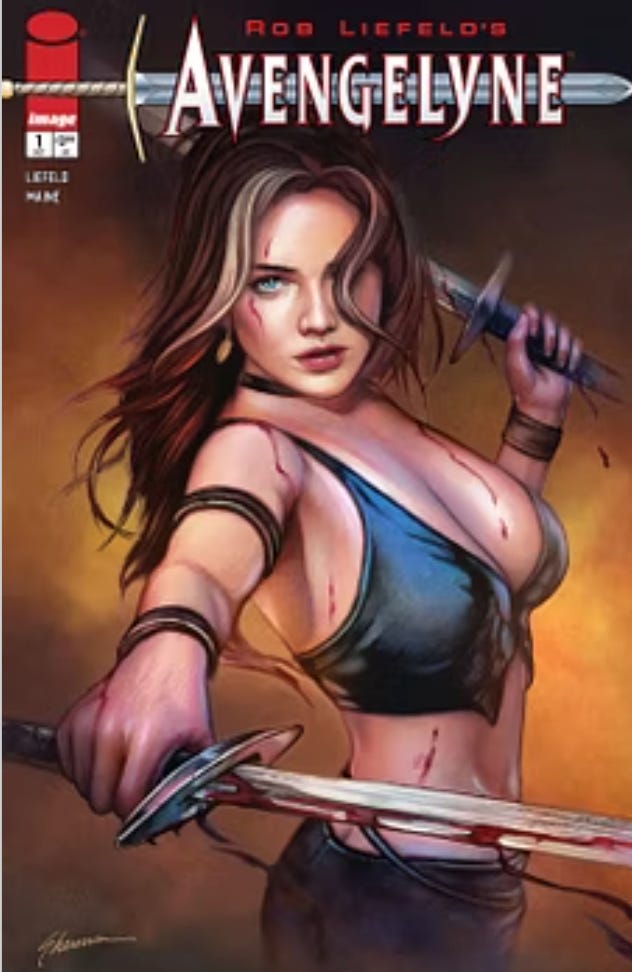
None of this is really about Liefeld specifically. It’s about what the broader market currently rewards. A polybagged NSFW variant generates buzz, drives pre-orders, and gets written up by every outlet covering SDCC exclusives, functions a strong story and a good creative pitch used to handle on their own. When even veterans with built-in audiences feel the pull toward the same mechanism struggling small publishers are fighting Kickstarter to keep using, it’s worth asking what that says about how comics currently sell books versus how they used to.
Can't we just PLEASE be normal?
Why does it have to be all of one thing or all of another?
I don't want NSFW comics anymore than I want dumpy, blue-haired femlets lecturing me on "hetero-normativity."
And EEEEFFFF poly-bagged blind covers. F them from orbit.
Mammaries move magazines.