


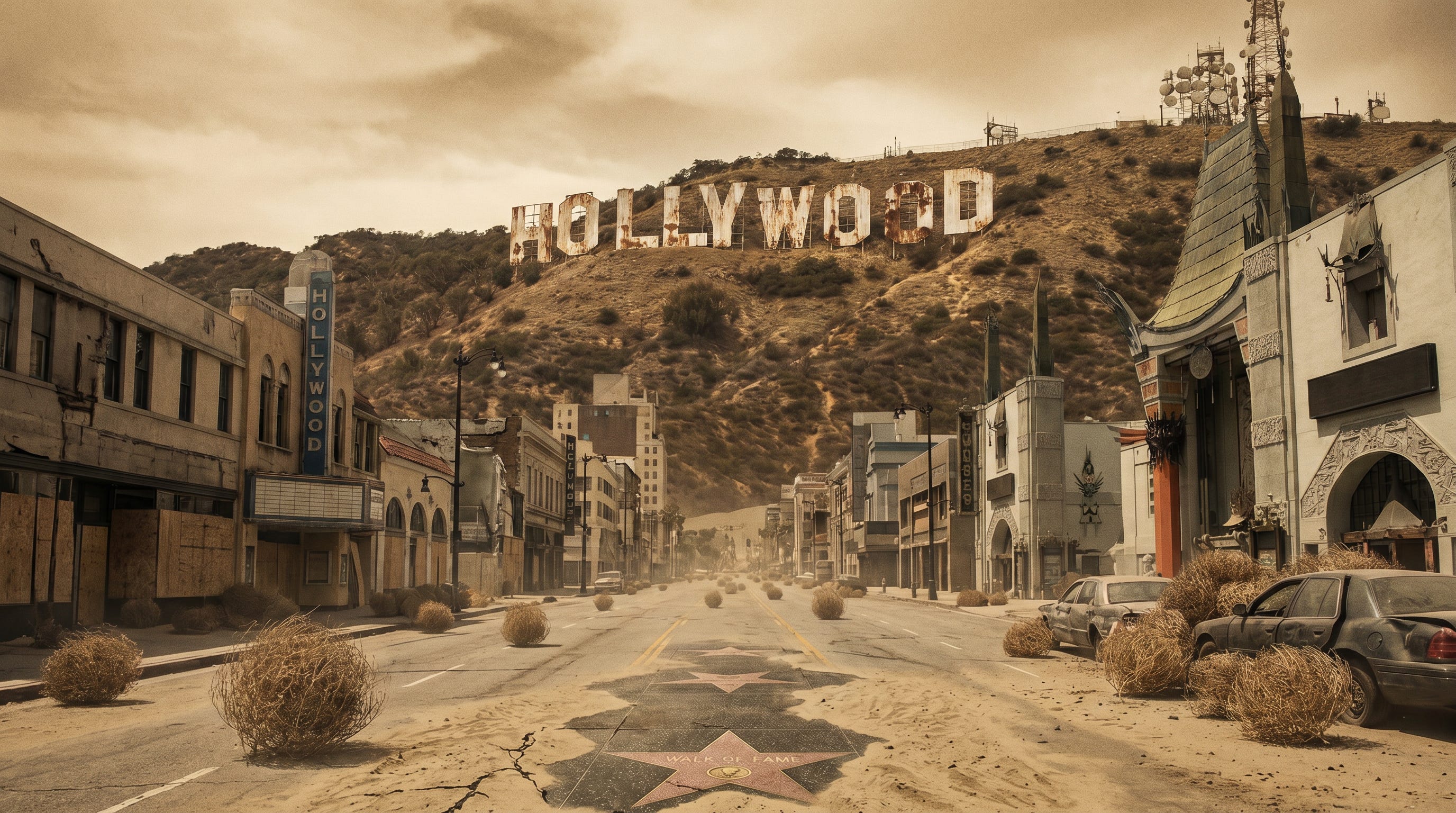
Variety published a long piece today on the collapse of Los Angeles as the center of American film and television production. The numbers are real. Since the streaming bubble burst in 2022, the U.S. has lost 73,000 production jobs, two-thirds of them in Los Angeles. Filming permits are down. Restaurants that fed crews are closing. A florist who supplies silk flowers to film sets told Variety she is down 50% in revenue. The LA Mayor’s race has turned partly on who lost Hollywood. The gubernatorial candidates are running on competing incentive packages.
Everyone quoted in the piece is in a panic. The question the piece does not ask is whether the rest of America should be.
The Variety piece frames the exodus as a tragedy, a Detroit-style deindustrialization of a great American industry. “This is supposed to be the film capital of the world,” said Noelle Stehman of the grassroots group Stay in L.A. “It should be the cheapest and easiest place to film. In fact, it is the most cumbersome and the most expensive. That cannot continue.”
She is right that it cannot continue but is not asking why it got this expensive and this cumbersome in the first place. California built its regulatory and tax environment over decades of progressive governance, and now it is surprised to discover that the people who write checks for $200 million productions have done the math. The U.K. alone spent $2.2 billion on film and TV subsidies in 2024, and national incentives there can be stacked on top of local ones. California, which had one of the weakest incentive programs in the developed world for twenty years, went into what one gubernatorial candidate called “a knife fight without a weapon.”
Gavin Newsom doubled California’s program to $750 million in 2025 and bragged that Baywatch was back “where it belongs.” Then the Baywatch producers tried to park their trucks overnight on a beach and were stopped by the county Beaches and Harbors Department and the California Coastal Commission. Co-creator Greg Bonann’s summary of the meeting that followed: “After a while, you have to sit down with the right people and say, ‘Guys, do we want to have this show here or not?’” A lifeguard show negotiated with city officials for the right to drive on a beach in Los Angeles.
That is the regulatory environment Hollywood built, in the city and state it controls politically, and it is now eating their lunch. The sympathy available for this situation has natural limits.
But the economic dysfunction is only part of the story. The more interesting question is cultural.
Hollywood has spent the last decade telling roughly half of America, the half that lives between the coasts, that their values are backward, their faith is a punchline, their politics are fascism, and their taste in entertainment is toxic. The industry that calls itself the storytelling soul of the nation has spent years making content for a progressive urban audience and then being baffled when the broader market fails to show up.
Look at the data from this session alone. The Mandalorian and Grogu opened to $81 million on a $165 million budget, the lowest Star Wars theatrical gross in franchise history. Brendan Wayne, a cast member, called the fans who stayed home “toxic” the same week. Masters of the Universe opened to $29 million against a $200 million budget while a $10 million YouTube horror film opened to $82 million the prior weekend. Supergirl tracks below The Flash in pre-sales after the lead actress spent the spring mocking “Dad of four, Christian” audience profiles in Variety. The Acolyte was canceled after one season. Doctor Who shed 60% of its audience under a showrunner who called critics bots running propaganda and declared X a “hate site.”
These are the cumulative cost of an industry that decided its audience was an obstacle rather than a constituency.
Sen. Adam Schiff told Variety that federal film incentives matter because “we have a lot of our influence around the world as a result of American film and TV. We don’t want to lose that soft power.” Actor Zachary Levi, who voted for Trump and is one of the few Hollywood figures willing to say so publicly, made the same case more directly: “This is good for the economy. This is not a handout. We want to be able to lead the world in telling great stories, and I think the president does too.”
Levi is right that stories matter. The question is which stories, told by whom, for whom. An industry that has spent years producing content engineered around progressive identity politics, then calling the audience who declined to watch them bigots, has squandered its claim to represent American storytelling. The soft power argument assumes the content is actually winning hearts and minds. Mandalorian and Grogu opened below Captain America: Brave New World. Rings of Power cost a billion dollars. The Acolyte is gone after eight episodes.
“Scrubs” creator Bill Lawrence, who is now shooting the “Scrubs” revival in Vancouver because Los Angeles is too expensive, put it plainly: “It is an absolute creative bummer to me that I’m shooting that show in Vancouver. It was a shock to my system. I wasn’t prepared for a show that existed, first and foremost, here to be cost prohibitive here.”
Lawrence did not build the cost structure that made his show impossible to shoot at home. Neither did the flower shop owner or the restaurant that closed. The workers who are down 50% in revenue did not decide that California would be the most expensive and cumbersome state to film in, or that Star Wars would spend eight years alienating its audience, or that the industry’s awards circuit would spend the 2010s turning into a progressive political rally. The real human cost of Hollywood’s decline lands on people who had no part in the cultural decisions that accelerated it.
The production workers deserve better than that. They also deserve an honest accounting of why things got this way, which neither Variety’s piece nor the gubernatorial candidates running on incentive packages are interested in providing.
The answer is not only high taxes and bad regulations, though those are real. It is also an industry that spent a decade making product its own audience did not want, telling that audience the problem was them, and is now asking the federal government to subsidize the operation while the ticket buyers stay home.
Charles Roven, producer of Oppenheimer and Wonder Woman, told Variety: “In my understanding, California’s rebate is one of the least beneficial for anybody who is financing motion pictures and television. It’s capped and it has no above-the-line.” He is right. He is also the producer of Wonder Woman, a franchise that generated more than $1.6 billion in theatrical revenue and then watched its sequel make $166 million on the same budget while critics and fans debated whether the politics got in the way of the movie.
Hollywood is not dying because it ran out of talent or because other countries have better beaches. It is dying in Los Angeles because it built an environment where good craft became secondary to political signaling, where half the potential audience was told to leave, and where the regulatory capture of the city and state it calls home made the economics of production impossible without government intervention.
The federal incentive that Schiff is pushing might work. It worked for the auto industry in Michigan. But Michigan’s auto industry did not spend twenty years making cars that half its customers didn’t want and then call those customers racist when they bought Japanese. Hollywood did something like that. The incentive is not going to fix the part that the Variety piece is not willing to name.
First contact with the Oridians was supposed to be humanity’s proudest moment. Instead, their chief engineer is dead, their ship is sabotaged, and an ancient alien technology is stealing souls. Book one of the Valiant Frontiers series delivers exploration, mystery, and the kind of crew you’ll want to follow across the galaxy. Read The Soul Catcher on Amazon and start the adventure.

NEXT: Before You Miss the Finale: Widow’s Bay Is the Best Show on Television Right Now
Another important factor is that the studios have become essentially a vanity cartel.
They were bought up by larger companies with only a tangential interest in filmmaking, and consolidated into so few players that authority is hyper concentrated, nepotistic, and risk-averse.
This, along with cheap interest rates, produced both identity politics' dominance and the studios' apparent indifference to whether their products actually made money.
Simply put, Hollywood is not a functional market anymore.
Bill Lawrence has added a lot of pathetic woke crap to his Scrubs revival. Sassy nurse Laverne was replaced by two black nurses and one of them is an over the top, annoyingly cliched gay guy.