


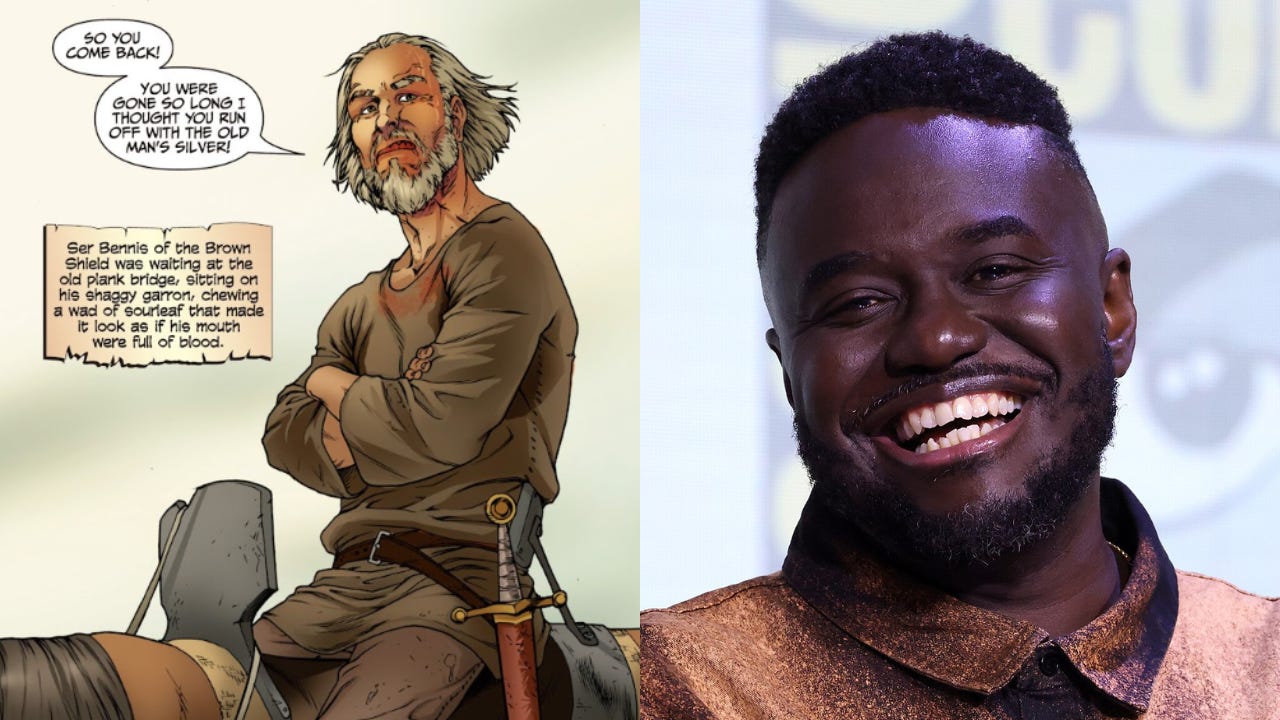
HBO announced it will race swap Ser Bennis of the Brown Shield in the upcoming second season of A Knight of the Seven Kingdoms.
Deadline reported that actor Babou Ceesay will play the character in the second season of the Game of Thrones spinoff, which plans to adapt George R.R. Martin’s The Sworn Sword story, which was collected in A Knight of the Seven Kingdoms.
While the original story made no mention of Ser Bennis’ race, a graphic novel adaptation clearly depicts him as white.
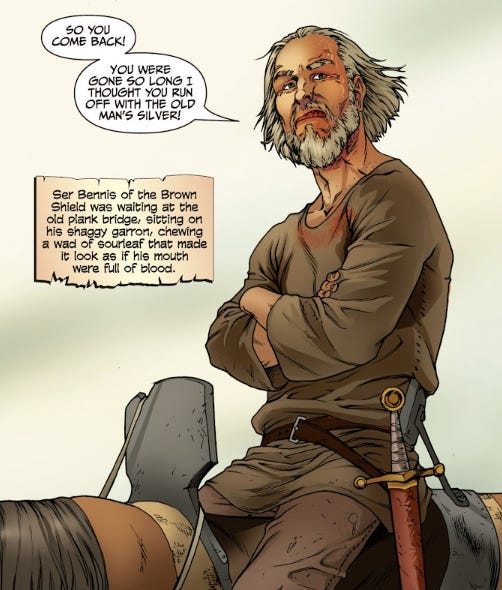
While the character’s race is not described in the original novella, Martin does note he is a very dirty individual. He wrote:
The brown knight looked just as he had when they left; worse, he smelled the same as well. He wore the same garb everyy day: brown breeches, a shapeless roughspewn tunic, horsehide boots. When armored he donned a loose brown surcout over a shirt of rusted mail.
His sword belt was a cord of boiled leather, and his seamed face might have been made of the same thing. His head looks like one of those shriveled melons that we passed. Even his teeth were brown, under the red stains left by the sourleaf he liked to chew. Amidst all that brownness, his eyes stood out; they were a pale green, squinty small, close set, and shiny bright with malice.
The casting is not surprising given that Warner Bros. has an entire department dedicated to Inclusion, which is lead by Asif Sadiq. The company’s website also declares, “We strive to ensure our content advances the inclusion of all voices and perspectives so that it resonates with increasingly diverse and global audiences. Our team of experts offer a range of resources including advice on content such as casting breakdowns, scripts, key art, storyboards and rough cuts; responsible character development and on-screen depictions; working with external partners and community groups to support authentic content; production accessibility guidance; and safety on set.”
Ironically, Sadiq previously admitted that his division was a failure. During an appearance at Royal Russel School Croydon, Sadiq discussed Diversity, Equity, and Inclusion departments and revealed companies in the United States spend over $8 billion on them.
He said, “Every organization trying to drive change, trying to create a workplace that’s more inclusive, a society that’s more inclusive. In the US alone $8 billion were spent on diversity training and many more billions globally to try and create that equity that everyone wants to see, feel in the workplace.”
“It’s not driving the change that we want to see,” he admitted. “We are not achieving the success that people want to feel in the workplace.”
As for why they’ve failed he explained, “Why is that? Well, I argue that very training is biased. It’s built with stereotypes. It has assumptions. It’s not always diverse or inclusive. And many times it does the very opposite of inclusion.”
Despite admitting his entire division is a failure and a giant money sink, he admitted that he worked to remove people opposed to his woke ideology from the company.
He said during an appearance on the Aspen Institute webinar titled The Future of DEI in Corporate America in 2024, “Even beyond leaders, there’s always those few people who will never change. You will never convince them. You can try up until the end of eternity and it will still not happen. We waste so much energy doing that sometimes as individuals whether you’re in a leadership position or in a team and so on.”
“Focus on the ones who want to change because that way you start changing culture,” he continued. “And if you change culture often those people who don’t come around will start saying this place isn’t the way it used to be and they’ll leave themselves, which is great!”
He also stated, “I think this is a moment where people have to show up as actively being anti-racist.”
“And that requires going a bit further than saying, ‘That’s not me, so I’m just going to sit back.’ That requires you using your power, privilege and the positions you hold to try to create equity for marginalized groups, for historically marginalized groups and groups who haven’t had access, but that requires really stepping up,” he said. “And it’s showing up as well, showing up internally, showing up to even to the structures that DEI has put in place, whether its business resource groups, employee resource groups, events, showing up during this period of time for a leader is critical, because it shows that you care and you are willing to learn.”
Fandom Pulse is reader-supported independent journalism. Paid subscribers get exclusive scoops and investigative reporting daily.
Dive into A Throne of Bones, the gripping first installment of Vox Day’s Arts of Dark and Light series, where epic fantasy meets unflinching military realism in a world on the brink of chaos. In the ascendant human empire of Amorr—modeled on a fantasy Roman Republic infused with a four-century-old faith—rival noble houses teeter toward civil war, provincial rebellions ignite, and otherworldly threats from goblins, orcs, and darker forces loom ever closer.
Follow legionaries, tribunes, battlemages, and reavers across richly detailed cultures as intricate political intrigue, brutal battlefield tactics, and profound moral questions collide in a multi-POV saga that delivers deep world-building, more authentic warfare, and characters who wrestle with faith, loyalty, and power without pulling punches.
If you’re craving a smarter, more disciplined alternative to conventional epic fantasy—one that combines the grand scale of Rome’s struggles with genuine magic and high-stakes drama—this massive, unapologetic tome will seize your imagination and refuse to let go. Grab A Throne of Bones today and experience fantasy at its most ambitious and uncompromising.

NEXT: RazörFist Trashes Prime Video’s ‘Fallout’ As The “ESG-iest Show I’ve Seen In A Minute”
I would say less than 13% of the population wants this. Likely 8%. Four percent is POC and the other four % is liberal white women.
Reggin madness strikes again!!!