


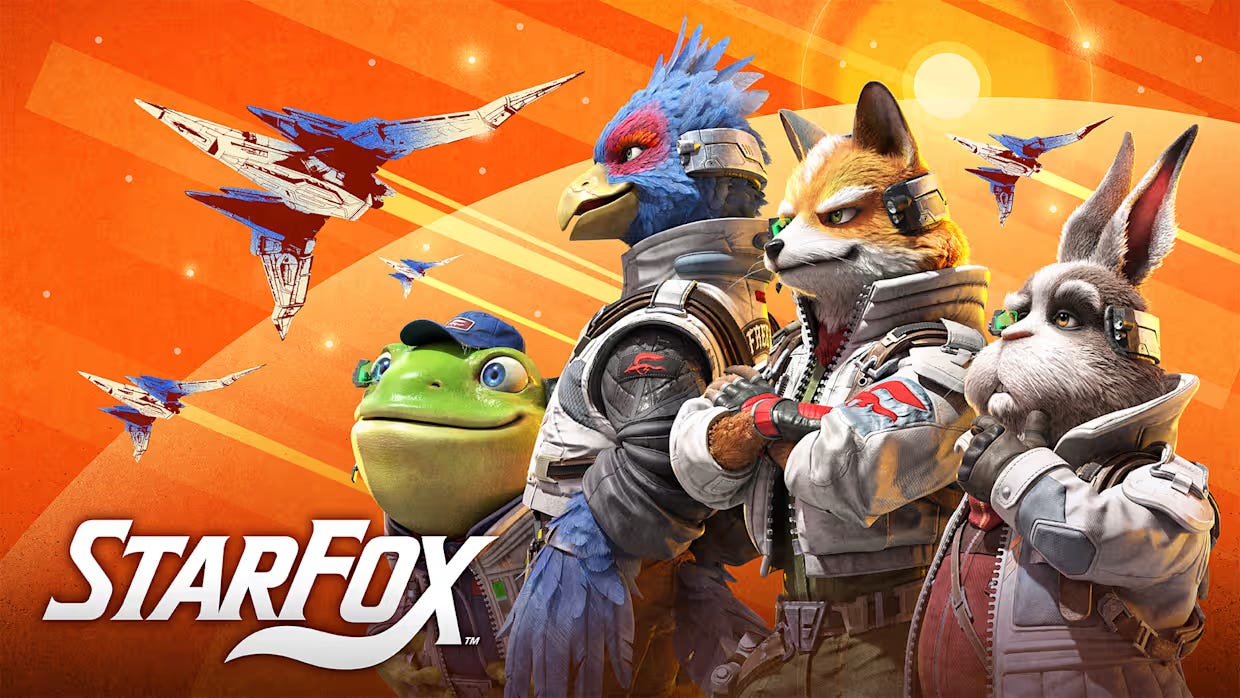
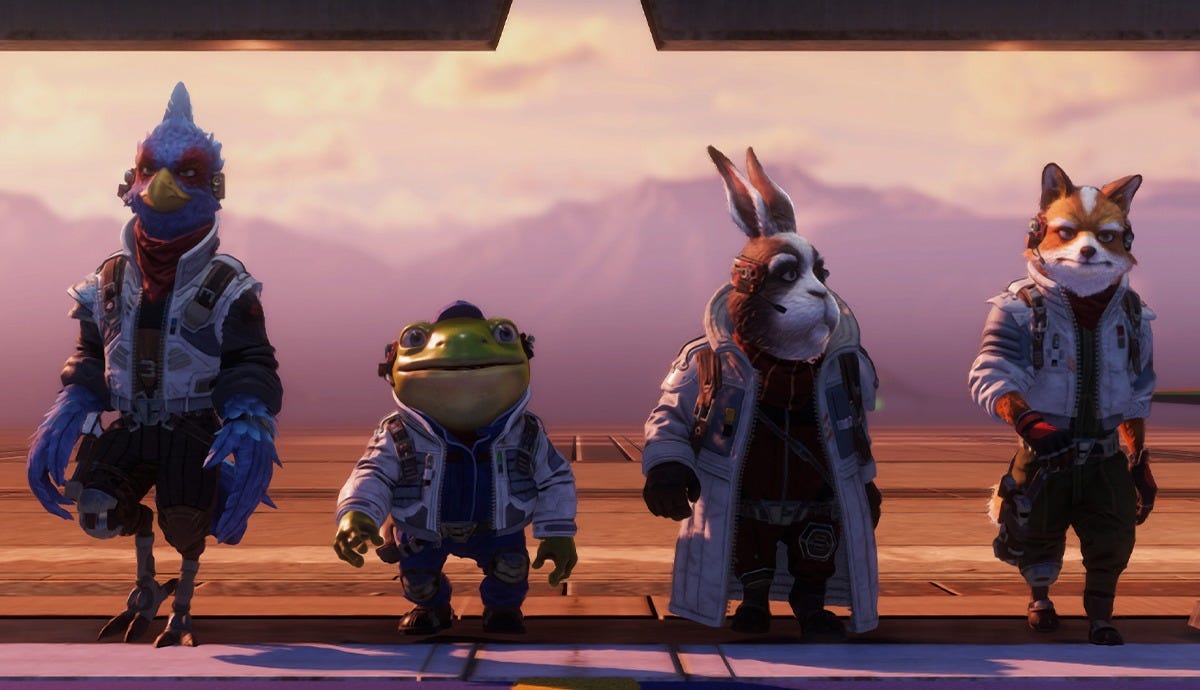
What we witness today in the shimmering trailer of Nintendo’s Star Fox for the Switch 2 is far more than updated pixels. What we have here is a small but piercing cry from the soul of our age, which joins the deluge of other piercing cries. This is an age in which the accountants have seized the scepter and the artists have been sent into exile. The fox who once soared through space beyond the stars with cartoonish defiance now stares back at us from the uncanny valley, his fur rendered with the meticulous cruelty of high-fidelity shaders, his eyes too knowing, and his muzzle too anatomically correct. And those legs! Those newly revealed digitigrade stalks have been planted upon the earth like the afterthought of a half-committed taxidermist.
I remember that, for decades, the faithful had joked that the pilots of the Great Fox kept their legs forever hidden beneath flight suits and armored boots because they were, in truth, glorious metallic prosthetics. Some indeed believed Star Fox was some half-robotic marvel of Cornerian engineering, the very reason these daring aviators could barrel-roll through the cosmos without a second thought.
Now the veil is lifted, and what do we behold? Not proud adamantium limbs forged in the fires of legend, but awkward, toe-standing animal haunches that make poor Falco look as though he wandered in from a rejected poultry farm. The old jest has been answered with a punchline no one asked for.
Takaya Imamura, the very man who first gave form and fire to Fox McCloud in the distant days of Nintendo’s 90s, has stepped forward like an elder prophet. “I prefer the movie version,” he confessed, speaking of the more stylized, soulful Fox who appeared in The Super Mario Galaxy Movie. The new design, he grants, has “a clear direction.” Yet the preference stands. The father of the tribe has looked upon the offspring of his loins and found it wanting. This isn’t even a question of craft, but of fidelity to the original calling — which is why so many honest and true Star Fox fans will have also found it wanting. For every true creation is a calling, a speech-act hurled into the future, binding generations in a common vision. When that speech is diluted by new tongues untutored in the original grammar, the tribe feels the fracture.
This is not the first such fracture. Recall the lamentations that greeted Warcraft III: Reforged. Cheap outsourcing to distant studios, models that no longer sang in the old tongue, a remaster that somehow diminished the soul of the original. The pattern repeats here. For even a corporation as great as Nintendo is not immune to the gravitational pull of quarterly reports and has seemingly fallen under the dominion of what we may call the Managerial Revolution. The engineers of cost-efficiency now direct the artists. The ledger has become the new scripture. “Spend the least possible,” it commands, “and the fans will devour whatever we place before them.” And devour they often do, with a loyalty that borders on the tragic.
Yet here, in this minor drama of anthropomorphic pilots and barrel rolls, we glimpse a larger historical motion. Man no longer creates worlds out of the living word of imagination spoken in love for the craft and the audience. Instead, he renders them according to the demands of hardware cycles and shareholder value. The result is a proliferation of the uncanny: things that look almost right, yet are spiritually askew. Fox McCloud’s new face is a symptom. The soul recoils because it recognizes a familiar betrayal — we have seen it turn all art into “content.”
Nintendo’s own EPD division, the modern successor to the legendary EAD, has wrought this. Unlike Warcraft III: Reforged, this is not some anonymous studio in Southeast Asia, though such hands have labored on many projects. This is the house itself, chasing the siren song of “cinematic” realism on new silicon.
Here, then, lies the deeper riddle: Nintendo possessed a perfectly realized, soulful Fox in The Super Mario Galaxy Movie. There, his design held true to the living spirit of the character as utilized in Star Fox 64 and its faithful 3DS remake. The 3DS version had already carried forward that friendlier, cartoonish grammar of wonder. Yet the current stewards, unsupervised by the father Imamura, reached backward — deliberately and almost archaeologically — toward the original SNES-era promotional puppets of 1993 that once graced box art and advertisements, with their uncanny animal anatomy and puppet vitality.
While the intention was to harness the raw power of Switch 2 hardware to elevate this primal, weirder origin into a high-fidelity spectacle, we must mark a heavy blind spot toward the living community of fans. Consider the beloved A Fox In Space series on YouTube — a gritty, noir-infused fan animation which has outshone official shorts in viewership and captured the hearts of thousands through its stylized anthropomorphic charm. Consider Krystal, the vixen whose very popularity exploded precisely because of her expressive, anthropomorphic allure. Her design spoke directly to the playful, charismatic animal spirit that binds the tribe. To revert to the puppet source in this manner is to cross many channels at once. Fox’s cameo in The Super Mario Galaxy Movie also confirms the strange theory that the movies are crafted for one audience — warm, stylized, accessible — while the games pursue another, more hyper-realistic path, even as both are supposed to reinforce one another in the grand marketing symphony of the brand.
It is also worth noting that The Game Awards Show continually summons Muppet cameos. The show’s creator Geoff Keighley utilizes them with an unapologetic elder-millennial passion, infusing the show with some measure of safe, chaotic, nostalgic entertainment energy. Perhaps it is just a coincidence that Nintendo excavates its own 1993 puppet archive at the very moment the industry’s biggest awards show leans on Muppets for levity. Or perhaps this is an almost subconscious confession that authentic wonder has grown scarce, and so we must revive the oldest forms of childhood joy in order to induce any life in anything at all.
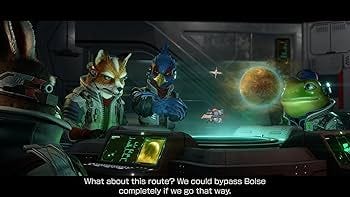
The current team, under Miyamoto and Koizumi’s oversight, made a conscious artistic decision: push for a more mature, high-fidelity, animal-realistic look to showcase the new hardware’s capabilities in a big launch title. They explicitly drew inspiration from the original promotional puppets and box art of the very first Star Fox on SNES, which had a weirder, more literal animal vibe, rather than the friendlier, cartoon-stylized versions that evolved later and appeared in the Illumination movie. Imamura, retired since 2021, was not consulted. The original grammar of the characters was filtered through newer artists prioritizing technical polish, fur-shaders, and a cinematic mandate over continuity with previous incarnations. In other words, they killed what Star Fox used to look like in exchange for flexing new hardware. The accountants and tech-demo instincts won the day, even at Nintendo. The movie Fox succeeded because Illumination had its own external vision. The game team wanted something distinctly Nintendo-game-realistic.
The revolution of the accountants is not yet totalizing. Nintendo remains, in many respects, more resistant than most other companies. Kirby’s Air Riders shows Nintendo is still capable of miracles of delight. Yet the drift is palpable.
We stand, dear readers, at a crossroads. Shall we love the living speech of the original creators and that playful defiance of the fox who barrels through the cosmos with his comrades? Or shall we resign ourselves to the smooth, expensive, soulless renderings produced by those who know the price of everything and the value of nothing?

Accountants and lawyers began destroying the music business in the 70's, mainly thanks to the success of the album Frampton Comes Alive. Once businessmen are involved, creativity is doomed.