


Independence Day reading lists tend to reach for science fiction where America wins because it is America. These five don’t. Robert A. Heinlein’s “The Moon Is a Harsh Mistress,” Eric Flint’s “1632,” L. Neil Smith’s “The Probability Broach,” Michael Z. Williamson’s “Freehold,” and S.M. Stirling’s “Island in the Sea of Time” all treat liberty as something a specific group of people has to build, defend, and sometimes die for, not something a nation gets by default. Here’s why each one fits the shelf this Fourth of July.

1. The Moon Is a Harsh Mistress (1966), by Robert A. Heinlein
Heinlein’s novel follows a 2075 revolt by the lunar penal colony of Luna against the Federated Nations of Earth. Computer technician Manuel “Mannie” O’Kelly-Davis narrates the story. He recruits agitator Wyoming Knott and exiled revolutionary Professor Bernardo de la Paz, then brings in a self-aware supercomputer named Mike to plan an independence movement timed to culminate on July 4, 2076.
Heinlein built the parallel to 1776 on purpose. He owned a brass cannon he fired every Fourth of July for nearly thirty years, and the flag his rebels adopt in the novel comes from the Battle of Gonzales, the fight that started the Texas Revolution. The book won the 1967 Hugo Award. The revolution costs the Professor his life before he sees the republic finished, and Mike goes silent once the fighting ends. Nobody in the book gets independence as a reward for existing. They rig elections and run propaganda campaigns to get it.

2. 1632 (2000), by Eric Flint
Flint dropped the dying coal town of Grantville, West Virginia into Germany’s Thirty Years’ War in this novel. The story opens in 1631. The town’s roughly 3,500 residents bring their guns and their tools. More than either, they bring knowledge no one else in 1631 has.
Flint’s own politics were left of center, but Grantville survives by importing the U.S. Constitution and Bill of Rights into a continent that has never seen either one, and the town pays for that decision in dead miners and burned farms. The Ring of Fire series that grew out of the book has since run to dozens of novels and anthologies. Nothing about Grantville’s survival was guaranteed at the start.

3. The Probability Broach (1980), by L. Neil Smith
One added word in the Declaration of Independence changes everything in this novel. In Smith’s version, government’s power derives from the “unanimous consent” of the governed. That single addition lets Albert Gallatin side with the farmers during the Whiskey Rebellion of 1794 instead of with the government, and the rebellion becomes a second American Revolution that ends with the execution of George Washington.
Denver police detective Win Bear falls through a dimensional rift into the resulting North American Confederacy and has to decide whether to stay. Smith won the Prometheus Award for the book in 1982, an award he created himself for the Libertarian Futurist Society. The Confederacy in the novel is wealthier and more advanced than our own history, but it gets there through civil war and the death of the first president.

4. Freehold (2004), by Michael Z. Williamson
Kendra Pacelli is a UN Protection Force sergeant framed for a crime she did not commit in this novel, released by Baen Books. She flees Earth’s authoritarian government for the libertarian colony of Grainne. Williamson served twenty-five years in the U.S. Army and Air Force, with deployments for Operation Iraqi Freedom and Operation Desert Fox, and that service shows in the novel’s military detail.
Pacelli spends much of the book relearning what self-reliance costs before the UN invades Grainne outright and she has to fight in the war that follows. “Freehold” reached #3 on the Locus bestseller list for science fiction and fantasy paperbacks the month it came out and spawned an eight-novel series plus two anthologies. Grainne’s freedom survives the invasion because its people fight to keep it.
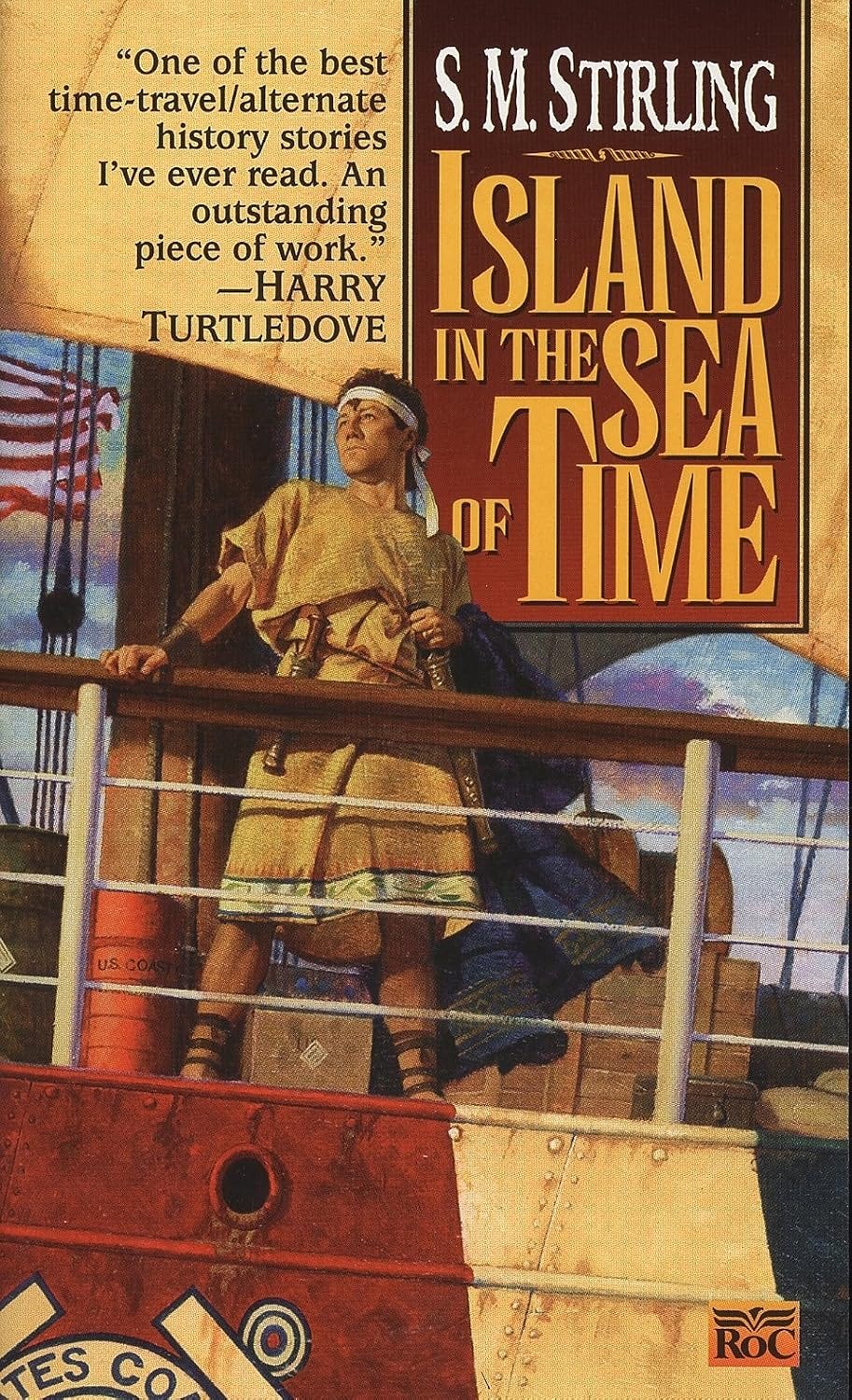
5. Island in the Sea of Time (1998), by S.M. Stirling
A single unexplained event sends the entire island of Nantucket and a Coast Guard training ship back to 1250 B.C. in this novel. Police Chief Jared Cofflin takes emergency authority and organizes the islanders to grow food and hold the Bronze Age at bay. Renegade Coast Guard lieutenant William Walker uses the same knowledge and technology to build a kingdom of his own among the tribes of Britain.
Both sides start from the same modern toolkit. One builds a republic. The other builds a tyranny. Stirling’s trilogy was nominated for the Sidewise Award for Alternate History, and the series has run to multiple sequels and a connected Emberverse. Nantucket survives on farming and diplomacy conducted by people with no army and no government beyond what they build for themselves.
The Common Thread
These five books share a structure more than a flag. Liberty in each one is contested, expensive, and never guaranteed to the people who want it, which puts them closer to July 4, 1776 than most of what gets marketed as patriotic science fiction. Which of these five reads closest to how the American Revolution itself would play out as a novel: the lunar rebellion timed to the Fourth, the coal town importing a Constitution into the Thirty Years’ War, or the colony fighting off the empire that raised it?
Happy July 4th everyone!
Space marines on a holy crusade across the galaxy. If that sentence got your attention, Justified: Saga of the Nano Templar is your next read. Three books of relentless action Read Justified: Saga of the Nano Templar on Amazon!

NEXT: Elizabeth Moon Returns With New Paksenarrion Trilogy: First Book Drops October 6
Also: Birth of Fire by Jerry Pournelle - The American Revolution on a penal colony on Mars.