


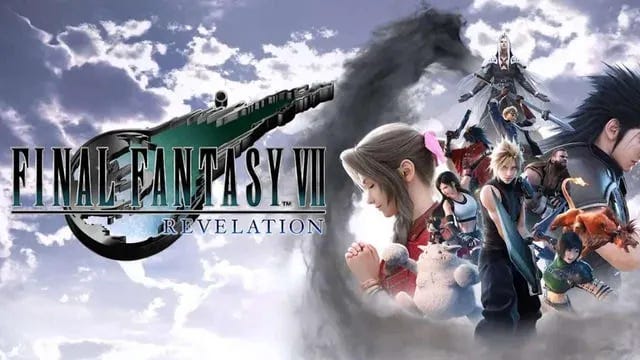
Final Fantasy VII Revelation, the third and final chapter in Square Enix’s decade-long remake trilogy, is shipping April 8, 2027 with a disc in the box and a catch buried in the fine print: that disc alone won’t run the game. Square Enix confirmed at Sony’s September State of Play that Revelation will ship on a single Blu-ray across PS5 and Xbox, but a mandatory download is required before the game will launch at all. Every physical buyer needs a live internet connection just to play for the first time, regardless of whether they bought a disc specifically to avoid exactly that requirement.
The reversal stings because of how loudly Square Enix marketed the opposite decision just eighteen months ago. Final Fantasy VII Rebirth, the trilogy’s second entry, shipped across two full physical PS5 discs in early 2024, and the studio treated that as a genuine selling point, proof the game could be played disc-to-disc without eating into a buyer’s hard drive or requiring an internet connection at all. Revelation is reportedly a larger game than Rebirth, which already ran around 145GB. Rather than expand to two or three discs to match that growth the way Rebirth had, Square Enix went the opposite direction: one disc, plus a required download estimated around 130GB to fill in the rest.
Fan reaction has been exactly as pointed as you’d expect from an audience that remembers the marketing. A ResetEra thread captured the whiplash in real time: “From ‘On Two Discs!’ with Rebirth to this, oof,” one user wrote. Another called it “worst of both worlds. Digital only future cannot come soon enough to save people from this nonsense.” A third didn’t bother softening it: “Made the cut to release on disc only to do this. What a f***ing waste.” Reports indicate some fans have already cancelled pre-orders for the game’s collector’s edition specifically over the change, a real signal that this isn’t just forum noise but actual lost sales on a title that hasn’t even entered its marketing push yet.
There’s a specific irony sitting underneath all of this. FFVII Remake Part 3 director Naoki Hamaguchi has been publicly vocal about game preservation as a value he personally holds, and reporting around Revelation’s announcement indicates he specifically pushed to keep any physical release option alive for the game at all, rather than the trilogy’s finale going fully digital-only. That advocacy produced a real, physical disc in the box. It just doesn’t function the way physical media has historically been understood to function. A disc that can’t run its own game without an active internet connection isn’t preserving anything in the way that phrase usually implies, it’s a download code wrapped in nicer packaging, sold under the same “physical edition” label that used to mean something more concrete.
This didn’t happen in isolation, and treating it as a one-off Square Enix decision misses the bigger picture. It’s the latest data point in a fight that’s consumed the entire console industry for months. Sony announced in July that it will stop manufacturing PlayStation discs entirely starting January 2028, ending an era of physical console gaming that stretches back to 1994. That announcement produced a Change.org petition, “Don’t Kill the Disc,” that grew from roughly 12,800 signatures to over 200,000 within a single week. Organizer Jade Pearce, CEO of a small Canadian retailer, wrote in the petition text: “A disc is a real game you own. You can lend it, trade it, resell it, gift it, collect it, or pass it down to your kids. A box with only a download code is not the same thing. It is a digital license in plastic packaging. You do not own it. You are renting access that can be revoked.” Sony’s response to 200,000 signatures has been total silence, and the company’s own disc-manufacturing facility in Austria has already begun shifting staff and equipment toward other production lines, suggesting the 2028 date isn’t remotely up for negotiation.
Grand Theft Auto VI became the highest-profile flashpoint for this exact fight earlier this year. Rockstar’s “physical” edition of the game ships as a download code in a box with no disc inside at all, a decision multiple petitions specifically called out as “corporate greed” wearing a physical-media costume. That controversy hasn’t put a dent in demand: GTA VI is tracking toward the strongest pre-order campaign ever recorded in gaming history, with estimates as high as $4.5 billion in week-one sales. But strong sales haven’t translated into industry-wide comfort with the direction things are heading. Reporting from Digital Foundry’s John Linneman indicates publishers and developers he’s spoken with are “largely very upset” about Sony’s disc phase-out specifically, telling his audience there’s “a lot of resentment for what Sony’s doing” building behind the scenes, even as consumers keep buying anyway.
Nintendo hasn’t escaped this fight either, despite marketing itself as the physical-media holdout of the current console generation. The Switch 2’s Game-Key Cards, physical cartridges that still require a mandatory download before the game will run, drew heavy criticism at launch for functioning as exactly the kind of hybrid non-solution FFVII Revelation is now bringing to PlayStation and Xbox. One ResetEra commenter framed the situation as vindication for Switch 2 skeptics turned inside out: “Looks like GKCs got the last laugh for owning this collection physically,” while another pointed out the joke cuts both ways, since Switch 2 owners will still need an internet connection to play all three remake trilogy entries, not just the one Xbox and PS5 owners are stuck with.
Put all of it together and a clear pattern emerges across every major platform simultaneously: Sony killing discs outright by 2028, Rockstar shipping a code in a box and calling it physical, Nintendo’s cartridges requiring downloads anyway, and now Square Enix, a publisher whose own director has publicly championed preservation, quietly walking back the one recent release that actually delivered on the physical-ownership promise its predecessor made. Each individual decision has its own technical justification, file sizes, storage costs, manufacturing margins. Taken together, they describe an industry that’s decided “physical edition” can mean almost anything now, right down to a piece of plastic that can’t function without permission from a server somewhere else. Gamers who bought Rebirth on two real discs eighteen months ago are the ones best positioned to notice exactly what quietly disappeared in the time since.
The embiggening of games needs to stop. At ~130 GB per game, you'd need half a console's usable memory just to play three stupid parts of the stupid game.
No one asked for a half a terabyte version of FFVII. Point of fact, no one asked for a bloated, unnecessary, "multiverse" version of FFVII either. All they wanted was a game whose 3d graphics hadn't aged like milk left in a locked car over a hot summer.*
They couldn't just remake the game with decent graphics and some QoL changes--that's all the vast majority wanted. This remake trilogy is an ill-conceived abomination that proves modern studios have no intention of giving gamers what they want. Instead, they all try to "fix" everything and show how much better they could have done it.
Well, you can't cupcake. You crawled up your own rear with multiverse madness and wholesale character "reimagining" and it sucked.
IT SUCKED OUT LOUD.
A modder, in his spare time, could have thrown in some hi rez textures, juggled some code, and produced a better product than whatever THIS is.
*FFVII looked like crap the day it was released--almost every PS One 3D game did. I'm not being a modern graphics snob--I was there at the time and the push for 3d games came one generation too early.
There's a reason Castlevania, one of the best looking 2D games on the system, continues to shine and rise even more as a classic while most 3D titles from the time need remade to be playable without people's eyes bleeding out of their skulls.
Screw these people. I don't need their games that badly. GTA may be able to get away with it, but younger gamers don't care about FF nearly that much, and a lot of older gamers are abandoning the series anyway, after the "Boy Band Road Trip" that was XV and the "Gay Bahamut" from XVI.