


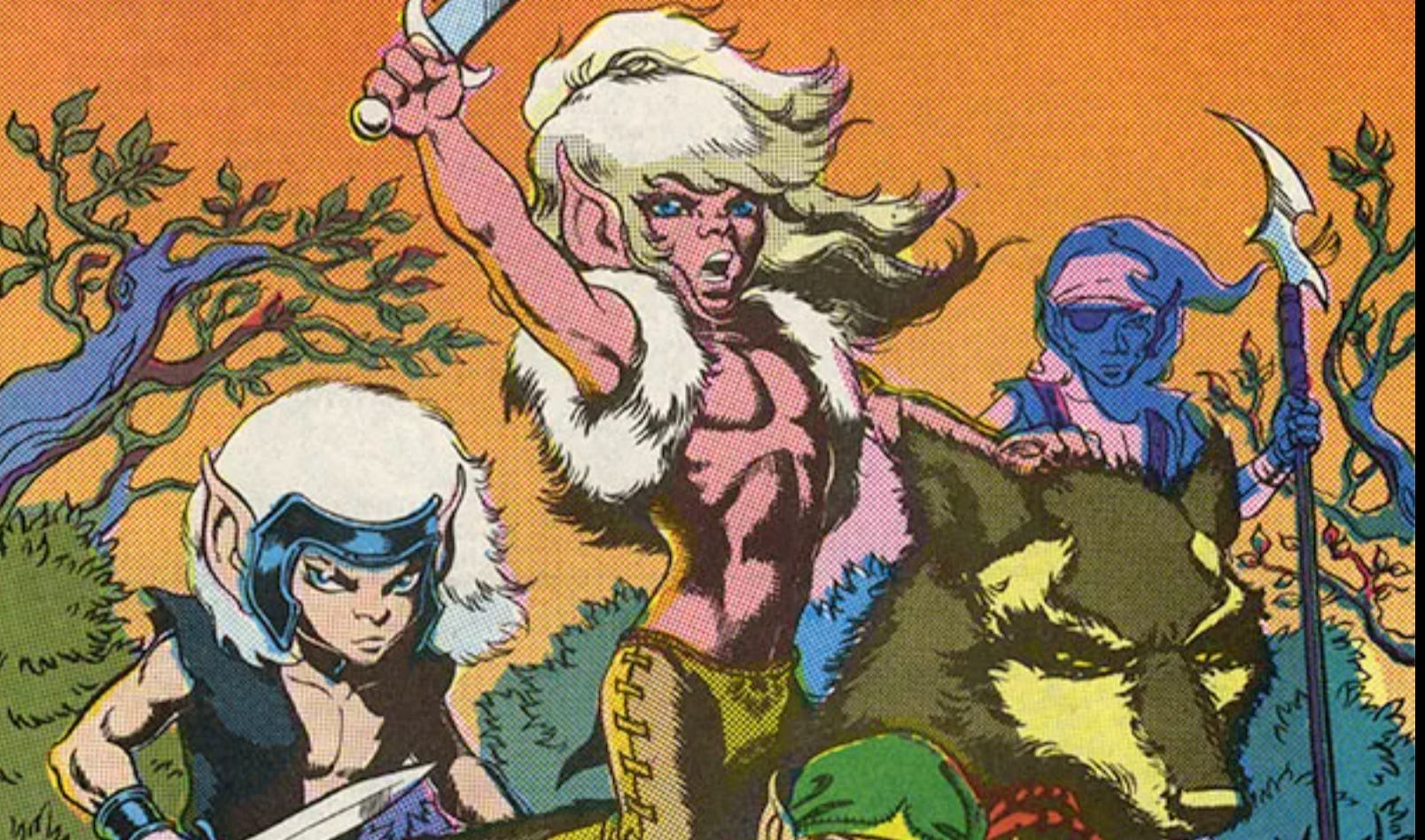
Wendy and Richard Pini launched ElfQuest in 1978, at the height of the cultural revolution’s long tail, when free love and the rejection of tradition were still the dominant artistic modes. The comic they produced contains both artifacts of that era and, more powerfully, something that cuts against it, even if the results were unintentional on their part. Beneath the surface aesthetics, the Original Quest is one of the most quietly conservative epics in American comics: a story about identity rooted in ancestry, the binding power of vows, the limits of progress, and the endurance of tradition against every force that would dissolve it.
The argument starts with Cutter himself. His chosen path is to live by the Wolfriders’ traditional Way, and in his maturity he is described as confident, decisive, and notably more conservative than he was in his youth. The entire twenty-issue quest is his attempt to understand who he is by tracing where he came from. His sword, New Moon, was passed down to him by his father Bearclaw when he died and Cutter became chief of the Wolfriders. The inheritance is literal. He carries his father’s blade into every battle, and the key hidden in its hilt turns out to be the key to the Wolfriders’ entire ancestral home. You cannot separate who Cutter is from what was handed to him. It truly is the thesis of the series.
The revelation the quest drives toward is disorienting. The High Ones were aliens from a foreign planet who, upon realizing they had expended their planet’s resources, began exploring other worlds. They reshaped their bodies into elfin form and their spaceship into a medieval-style palace, but their troll servants rebelled and hurled the vessel back in time to the planet’s paleolithic era. Staggering out from the crash-landing, the High Ones found their psychic powers greatly weakened, leaving them unable to defend themselves from primitive cave-dwelling humans who attacked them. The ancestors the Wolfriders have been searching for were refugees who failed. Their home is a crashed spaceship buried in ice.

That revelation could have been played as liberation, but the series treats it as a responsibility. After the elves defeat the trolls and recover the palace, Cutter decides to look to the future rather than the past in order to lead the Wolfriders, but the other elves return to their homes, leaving only Rayek behind as keeper of the palace. The Wolfriders do not abandon their Way to live in the ancestral palace. They return to the forest. They take the knowledge of where they came from and fold it into what they already are, rather than replacing who they are with what they learned.
This is the structural argument the series makes, and it is explicitly conservative. Progress here means accumulation, not replacement. The Wolfriders’ identity survives every revelation intact because it rests on something the palace cannot provide: the living practice of tradition, the pack, the holt, the hunt.
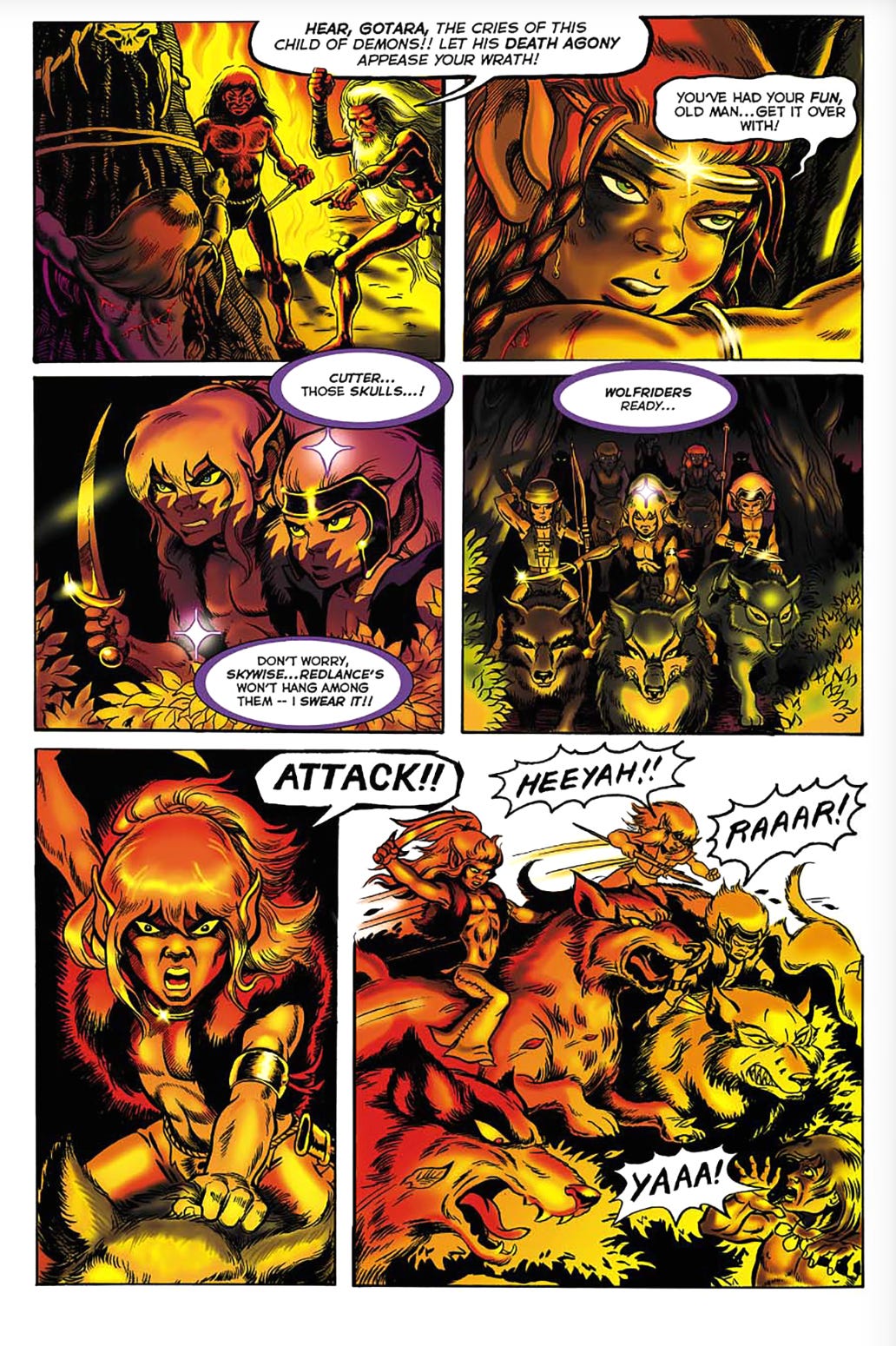
No element of the series illustrates this more sharply than Recognition. The comic was made in the era of “do what feels good,” and does not pretend the Wolfriders are celibate. But Recognition, the bond that matters most, operates on an entirely different principle. When a female and a male elf of exceptionally compatible qualities meet, they experience a sudden and immediate compulsion to mate, their souls bared to each other, with the phenomenon producing children of greater physical, mental, and magical gifts than those conceived outside the bond. Recognition is beyond attraction as something closer to vocation. It selects the man and the woman and binds them at the level of identity itself.
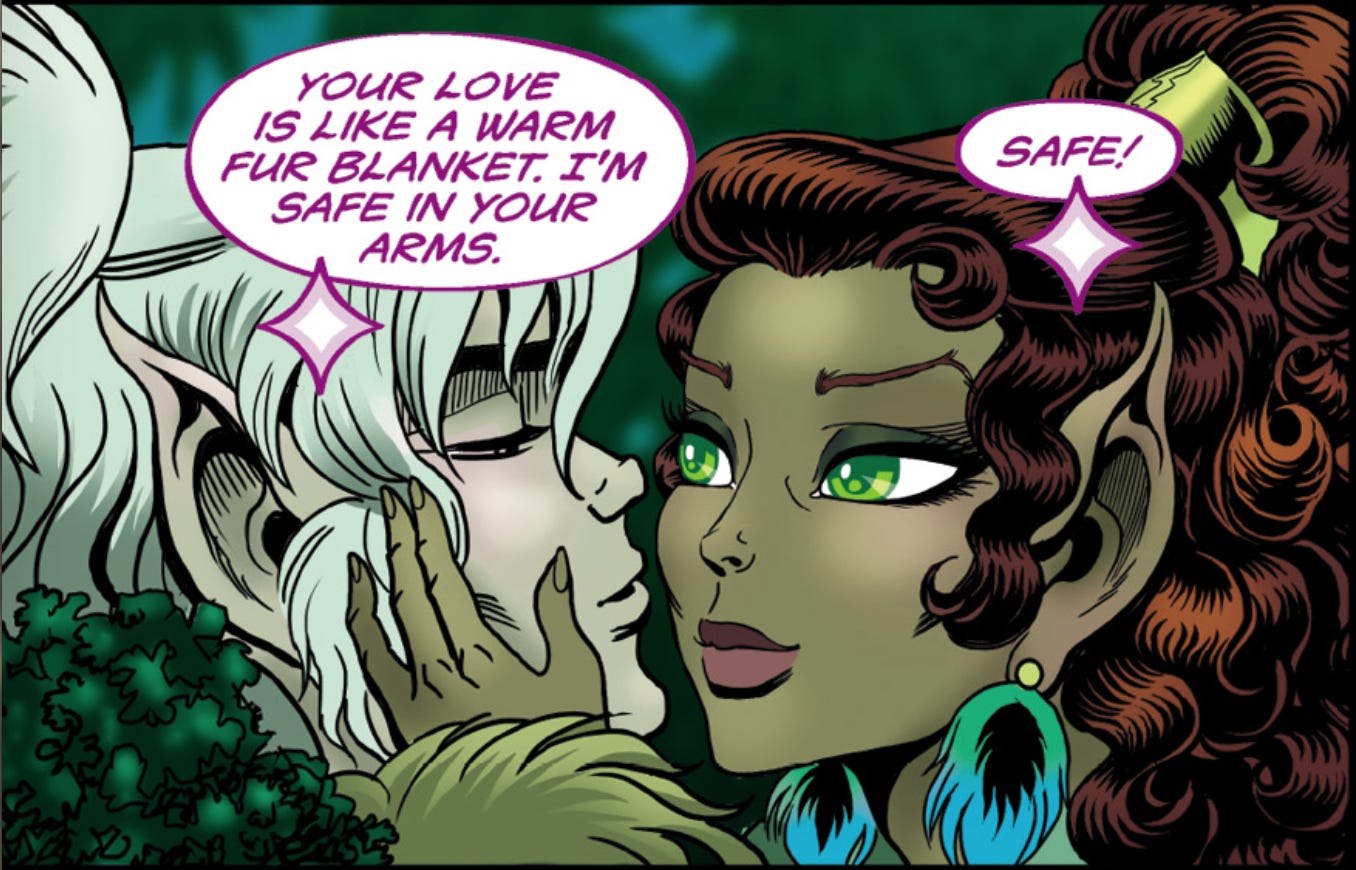
Leetah tries to resist it. She has real reasons to resist. Cutter is a stranger to her culture, volatile and unyielding. Literally swept off her feet, feeling her very soul bared to a complete stranger, Leetah rejected the bond and the loss of control it represented. Her refusal is treated with sympathy. The series does not punish her for it. But the text is clear: the couple’s submission to the demands of Recognition eventually gave way to a deep mutual love, to the point that Leetah later told Rayek “He was my SOUL.” The free love framework says desire is sufficient justification for any bond. Recognition says the bond precedes desire and that submission to it, not resistance to it, produces the deepest love. Leetah’s freedom is not abolished by Recognition. It is redirected by it, toward something more durable than preference.
The Gliders serve as the series’ warning about what happens when tradition is abandoned in the name of transcendence. Lord Voll withdrew his people into Blue Mountain, cut them off from the world, and eventually came to believe that the elves were doomed to wither and that there would never be any children born. Only the arrival of the Wolfriders with their children could wake him up. The tribe that fled the world to preserve itself in amber died. The tribe that kept hunting, kept bonding with wolves, kept passing swords from father to son, kept living the Way, produced children. Tradition kept the Wolfriders alive. The rejection of tradition quietly killed the Gliders.
After the quest to recover the Shards of the Palace, Cutter, Leetah, Suntop, and most of the older Wolfriders returned to live at the site of the original Father Tree Holt, the place of his birth. The quest ends where it began. The elves know what they are now. They know what they came from. They go home.
That is the conservatism at the heart of ElfQuest. Not reactionary denial, not willful ignorance of the past. The quest demanded Cutter look directly at uncomfortable truths about his ancestors and accept them without flinching. He did. And then he walked back into the forest, carried his father’s sword, and kept the Way.
The Pinis made that choice across twenty issues without explaining it as a lesson, without editorializing. They just showed what endured. What endured was the tradition.
What do you think: does ElfQuest hold up as a story about the value of tradition, or does the series’ more countercultural elements cut against that reading? Let us know in the comments.
Three free books. No spam. Just new releases, deals, and the occasional update from the front lines of independent publishing. Sign up for the Jon Del Arroz newsletter and start reading today.
NEXT: Legendary Comic Creator Howard Chaykin On His Career, New Zorro Project, And More!