


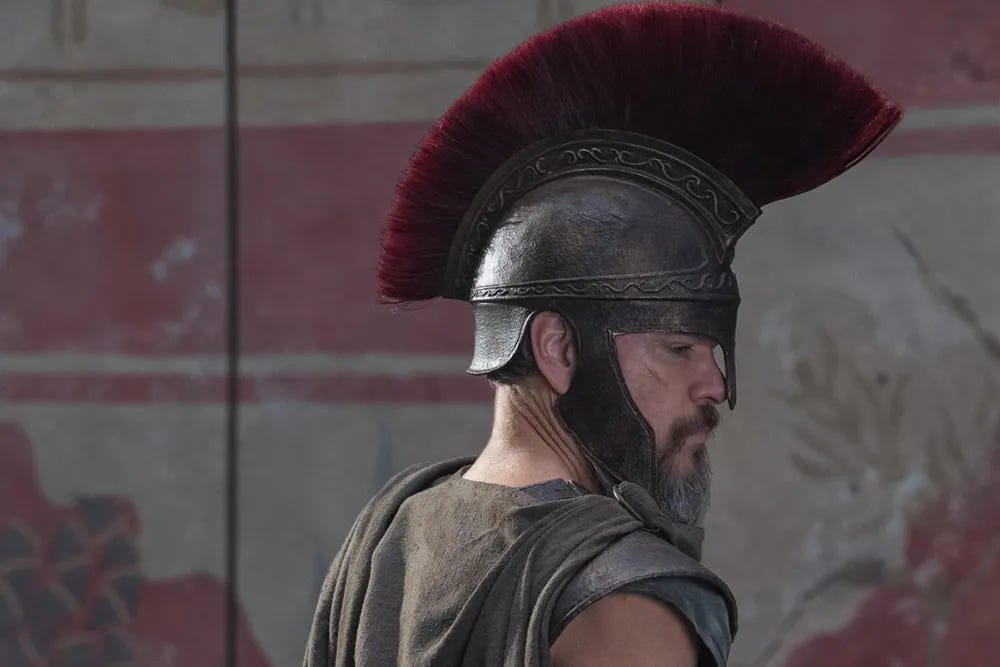
Christopher Nolan’s “The Odyssey” arrived in theaters this week carrying two million feet of shot film, an all-star cast, and the built-in name recognition of the oldest adventure story in Western literature. What it does not carry is Homer’s actual story. Nolan borrows the shape of the epic (the ten-year voyage, the suitors, the bow contest, the slaughter) and empties out the values that made it endure for twenty-eight centuries, replacing them with a modern trauma narrative that ends in regret instead of restoration.
For a full account of all the changes, make sure to read my separate article with a literary analysis.
The Craft Holds Up When the Script Does Not
Pacing carries a three-hour-plus runtime better than expected. The Trojan War flashbacks are woven throughout and eating up a large portion of that time. They land as some of the strongest material in the film, gripping enough at points that the picture never drags despite constantly cutting away from the present-day Ithaca plot to get to them. The Cyclops sequence plays as a real horror set piece, complete with jump scares, and it is the one monster encounter in the film that earns its reputation rather than coasting on name recognition.
Robert Pattinson is the film’s standout performance. His Antinous is not in Homer (the suitors are a faceless mass in the text, distinguished mostly by Antinous and Eurymachus getting the most lines), but the invented material here works as entertainment on its own terms: a villain scheming to woo Penelope and maneuver his way into the kingship through deception rather than honest courtship, driving a large share of the plot’s tension. It is one of the few additions in the film that earns its place instead of just replacing something the text already did better.
The score is the film’s oddest swing. There is no symphonic backbone to speak of, and large stretches lean on rhythmic, percussive cues instead. Sometimes that choice generates real tension, particularly in the action sequences. Other times it just pulls attention away from the scene, a strange enough choice that it is hard not to notice it doing that in the moment.
Visuals Recycled from Other Films
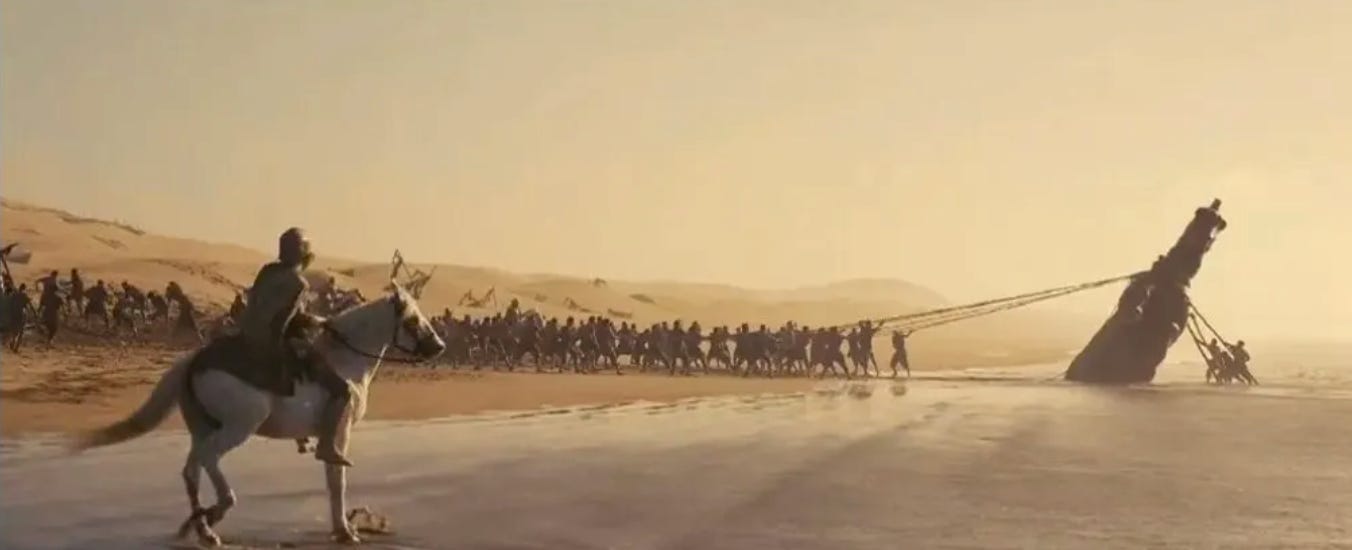
A handful of the film’s signature images are lifted wholesale from other franchises rather than built from the source material. The buried Trojan Horse, half-swallowed by sand in one of the film’s flashback sequences, plays like a direct restaging of the Statue of Liberty half-buried on the beach in “Planet of the Apes.” It is the same composition: a monument to a fallen civilization, jutting out of a desert coastline, meant to land as a gut-punch reveal.
The giant, armor-plated warriors Odysseus’s crew encounters on their voyage (Homer’s Laestrygonians, the cannibal giants who destroy most of his fleet) are redesigned here as towering, faceless figures in matched plate armor. The effect on screen is not Homeric giants. It is Cylons from “Battlestar Galactica,” marching in identical armor with the same blank uniformity that show used to make its robotic soldiers unsettling. A production this well-funded, with access to production designers capable of inventing something new, had no need to borrow another franchise’s silhouette.
The John Wick Problem
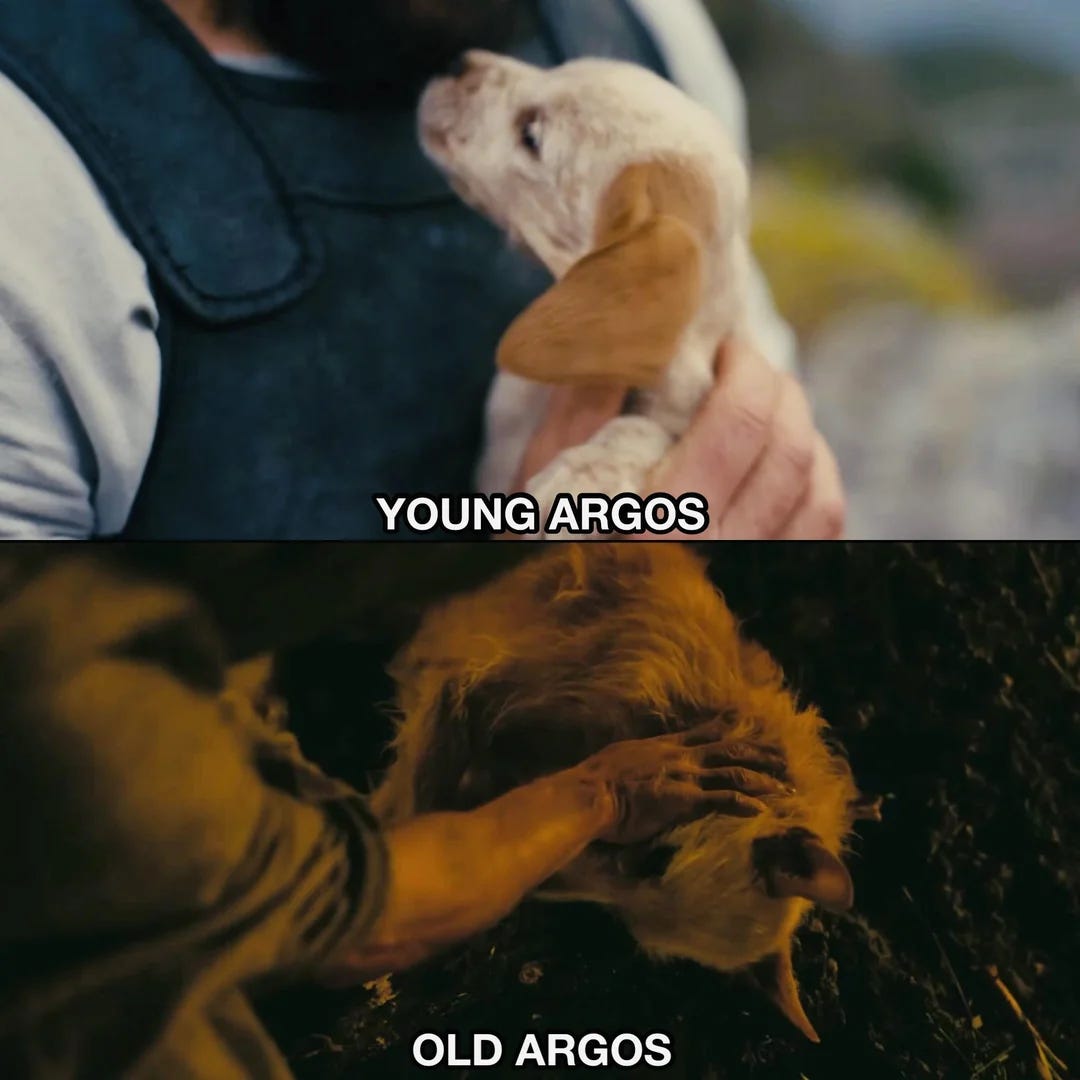
Homer’s Argos is one of the most restrained moments in the entire poem. Odysseus’s old hunting dog, abandoned and neglected for twenty years, recognizes his master through the beggar disguise, wags his tail once, and dies. Odysseus cannot acknowledge him without blowing his cover, so he wipes away a single tear and walks on. The power of the scene comes entirely from what Odysseus does not do.
Nolan cannot leave that alone. The film adds cruelty: suitors torment the aging dog across the years Odysseus is missing, and that mistreatment becomes part of the justification for killing them in the final act. That is not an adaptation choice. That is “John Wick.” Homer’s scene is about a man swallowing his grief to protect a plan. Nolan’s version turns a dog’s suffering into a revenge trigger, the exact mechanism that launched an entire franchise about a hitman avenging a puppy.
An Ending That Cheapens Everything Before It
The ending does the most damage in the entire film. Homer’s Odyssey builds toward homecoming: the return of a rightful king to his household, his marriage, and his throne, with the killing of the suitors vindicated rather than punished. Nolan’s Odysseus instead abdicates the throne to Telemachus and sails into the “unknown west” with Penelope, framed as punishment and self-imposed exile for killing the suitors under his own roof. Twenty years of suffering, a home overrun by parasitic invaders, and a king reclaiming what is his becomes a crime requiring penance instead of a homecoming worth celebrating. Homer wrote a triumph. Nolan wrote a man who cannot live with what winning required, and calls that the truer ending.
A Guilt Arc Homer Never Wrote
None of this happens in isolation. The film gives Odysseus PTSD-style flashbacks and has him reflect that the sack of Troy involved unforgivable brutality against innocents, a guilt complex about the war that the actual text does not support. The real Odysseus narrates the sack of Troy and the horse to the Phaeacian court with open pride, his signature achievement. The poem’s Odysseus wins through cunning and is rewarded for it. The film’s Odysseus wins through the same cunning and is punished for it.
The Gods Quietly Removed from a Story That Still Has Monsters
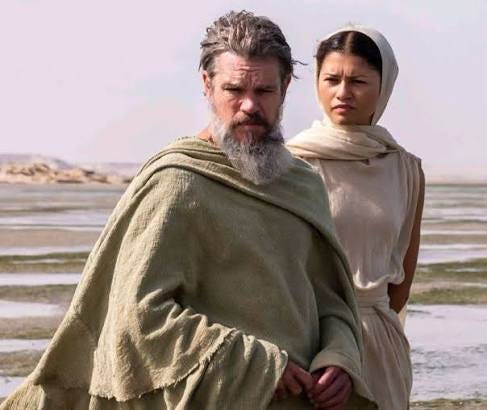
One of the strangest choices in the film is the near-total removal of the gods as active participants, even as the film keeps every monster the gods are responsible for. Athena, played by Zendaya, is reduced to an occasional vision, present but rarely intervening the way she does in the text. The film reaches for a “realistic” register, stripping away the machinery of divine cause and effect that explains why any of this is happening to Odysseus in the first place, while a man-eating Cyclops, a witch who turns men into pigs, and a tentacled sea monster stay fully intact. A film can be a myth with active gods, or it can be a grounded war drama with human causation. Trying to be both at once leaves the monsters floating free of any explanation for why they exist.
Too Much Troy, Too Little Odyssey
The film leans heavily on Trojan War flashbacks, more heavily than the poem itself does, which spends its time on the voyage home and the state of Ithaca rather than the siege. It plays like a film made for an audience that only knows the wooden horse and the ten-year siege from cultural osmosis, reassuring that reference point early and often before venturing into material audiences know less well. Travis Scott appears as a bard delivering sparse, portentous lines as though he were reciting verse in the opening, and it lands as an awkward, self-conscious framing device rather than an earned piece of world-building.
Dialogue That Cannot Decide What Century It Is In
The script’s dialogue swings between attempts at classical register and flat, modern American phrasing, and the seams show throughout. The most glaring example is the cursing. Multiple uses of the same profanity land in a story that has survived twenty-eight centuries without needing it, and the effect is not authenticity. It reads like an attempt to rough up a classic that did not require roughing up.
Who This Movie Is For
Taken purely as a movie, with no knowledge of the source material, this lands as a 6 out of 10. Pacing holds up, the suspense sequences work, and the overall production quality is there across the board. Audiences who walk in without having read Homer will likely come away entertained, and that is the audience this film is built for. Awards season is clearly the other target.
Knowing the actual text changes the calculation entirely. What plays as a competent modern epic to an unfamiliar audience plays as a wholesale replacement of the poem’s own values to anyone who knows what “The Odyssey” says. It is not a film that trusted Homer’s ending, Homer’s Odysseus, or Homer’s gods to carry the weight on their own.
What does it say about the state of literacy in Hollywood that a film needs to keep reassuring its audience with the one detail everyone already knows, the Trojan Horse, rather than trusting the actual story to hold their attention?
If the golden age of Trek and Babylon 5 left a hole in your sci-fi diet, The Stars Entwined fills it — interstellar espionage between two civilizations on the brink of war. Read The Stars Entwined on Amazon!
NEXT: Where Christopher Nolan’s “The Odyssey” Departs From Homer, Book by Book
Can’t wait to never see this. 😄
I'll be the 1st in line for something else.