


Archbishop Fulton Sheen explained that there are two false definitions of freedom that have infected America.
In his lecture “What is Freedom,” he noted the two false definitions are: “freedom means the right to do whatever you please” and “it is the right to do whatever you must.”
He then noted that two books have been written about these false definitions, “One was Aldous Huxley’s Brave New World written in 1932 and the other George Orwell’s 1984 published in 1949.”
READ: Mike Lee Introduces Bill To Ban Pornography And Clearly Define Obscenity
He then went on to explain why these are false definitions, “First, freedom is the right to do whatever you please. That makes freedom a physical power. Certainly, one can do whatever he pleases. He can stuff Aunt Lizzy’s mattress with old razor blades. He can turn a machine gun on his neighbor’s chickens. Is that what freedom means? No limits. No boundaries.”
“Those who accept this definition say, ‘Well, who’s going to stop me? I can do whatever I please,’” he said. “Suppose parents put that into practice with their children and gave them no pot training. Suppose you let every child growing up doing what he pleased. When they grew up they would hate themselves. And they would hate you for not training them.”
“So this definition of freedom has been called that which makes the Raskolnikov man. Raskolnikov was a character in Russian literature and he killed an old woman. He took no money. He said, ‘I just did it because it pleased me and because I didn’t want anybody to tell me that I couldn’t kill.’ That’s the Raskolnikov mentality,” he stated. “So this kind of freedom means that freedom is nothing but options. We go through life with a great variety of choices. … What does this kind of freedom amount to in the end? Well, it means that-. It’s very much like being put in a supermarket. You can choose anything, but what’s the purpose of the choosing? That is never answered. Or like being put into a castle with a thousand rooms and in each castle you have great pleasures and some happiness and when you get tired in one castle, you move to another. And that room will give you pleasure for a time. But those who go through those rooms never notice that there are no windows in the castle and there are no doors. They’re just living in a closed world of choices. But there’s no goal or purpose or destiny in life. This is the first false definition of freedom: do whatever you please.”
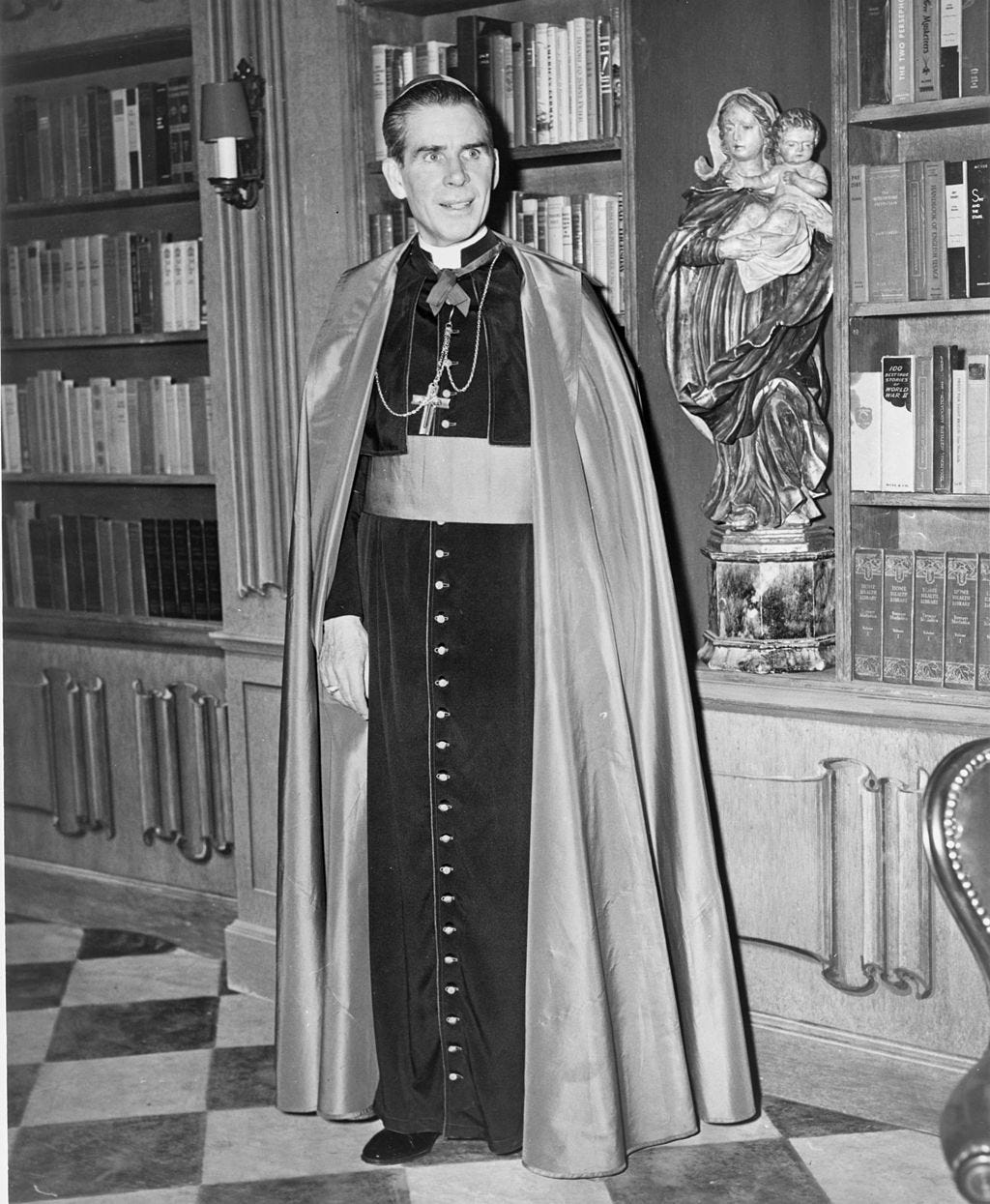
He continued, “Now, this creates a chaos because when everybody does his own will, what do you get? You get a crisscross of individual egotisms. Well, that produces confusion. Suppose sheep in the pasture are running in different directions, what does the shepherd do? Shepherd sends a dog after them. And when we produce a culture and civilization in which everyone does what he pleases there comes a reaction in which some dictator arises and says, ‘Now, you will not do whatever you please. Now, you will do whatever you must.’ So that totalitarian system is the forcible organization of a chaos that was produced by everybody doing his own thing without any concern for a neighbor. This kind of freedom is the communist freedom well described Friedrich Engels, who cooperated with Karl Marx in the development of communism. Engels said, ‘If I drop a stone from my hand that stone is free to fall because it obeys the law of gravitation. And so long as I obey the will of the dictator I am free. The moment I disobey the dictator I am no longer free. So freedom becomes a must.”
“I worry sometimes about how much the young people are under a must. The must of their own establishment,” he said. “‘And so when everybody’s taking dope, why shouldn’t I? I can’t be different.’ Or, ‘None of the other girls are virgins, why should I be one?’ The terrible must of an establishment.”
“We fail to realize that one-third of the people of the world are under this false definition of freedom,” he stated. From there, he quoted a passage from Dostoevsky's novel The Brothers Karamazov and the Grand Inquisitor character, “And we shall persuade them to renounce their freedom and give it over to us. In their leisure hours we shall make their life almost like that of a child. We’ll give them children’s games, innocent dances, and they will love us like children because we allow them to sin. We shall allow them to have mistresses and wives or not to have them. And they will come to use cheerfully. A day is coming when men will say there is no freedom, there’s only hunger. And he will come crying and fawning to our feet saying, ‘Give us bread.’ That’s the way freedom is defined in the totalitarian state. And the first way is the way we define it in our Western world.”

Archbishop Sheen then notes these false definitions of freedom are the way that freedom is lost. Instead of these false definitions he posits that “freedom is the power to do whatever we ought. That is freedom.”
He explains, “Now that implies something else. Freedom to do whatever we ought implies a goal, a purpose, a plan, a meaning in life. That’s the meaning of ought. For example, a man wants to be a doctor of medicine. He ought to study. He ought to practice. A man wishes to be athlete. He ought to exercise. Not me must. He ought to. Suppose my goal in teaching geometry is say to draw a triangle. Well, I ought to give it three sides. And not in a stroke of broad-mindedness giving it four. If I want to draw a giraffe, I ought to give it a long neck, not a short one. If I have a razor, I ought to use it to shave and not to sharpen pencils. You see everything has a goal or a purpose. And as long as we are working toward that goal we are free. For example, you’re free to drive an automobile, but you ought to obey the traffic laws. Sure you can do whatever you please then you’ll be subject to a must if you do that. So there’s always therefore an ought.”
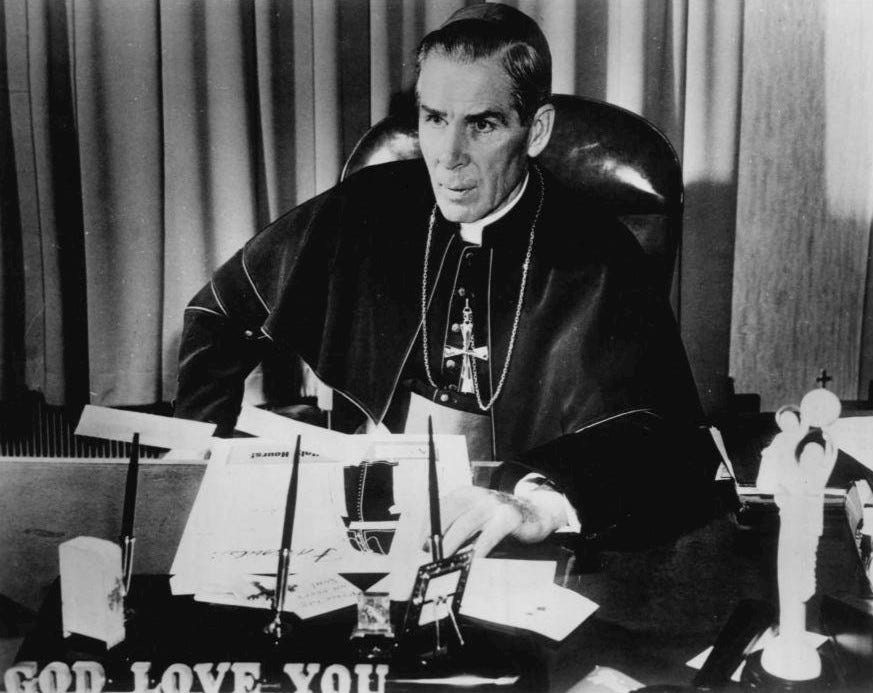
As he continued his lecture, Bishop Sheen noted that as humans we seek three things ultimate things in life that become our purpose: life without decay, truth, and love.
He says, “The more I live out my purpose of seeking life, and truth, and love, the more free I am. We have to understand that there is the difference between a freedom from and a freedom for something. Sure, we want to be free, for example, of being in chains. Why? What for? Well, in order that we may be men and women. That’s why we do it. There’s no purpose actually in having a freedom from something unless we have a freedom for something. A rich man went up to a taxi driver and said, ‘Are you free?’ Taxi driver said, ‘Yes, I am free.’ The rich men left shouting, ‘Hurrah for freedom!’ Crazy! If he is free, he ought to be free for something. So we have to be free from restraint for a purpose or goal and that implies indeed some limitations.”
“There was an island in the center of the sea,” he continued. “Inside of that island children lived, and they played, and they danced. And one day some men came in a rowboat to the island. And they climbed over the walls of that island and they said to the children, ‘Who put up those walls? They’re restraining your freedom. Break them down!’ So the children tore down the walls. Now, if you go back you will find all the children huddled together in the center of the island afraid to sing, afraid to dance, afraid of falling into the sea.”
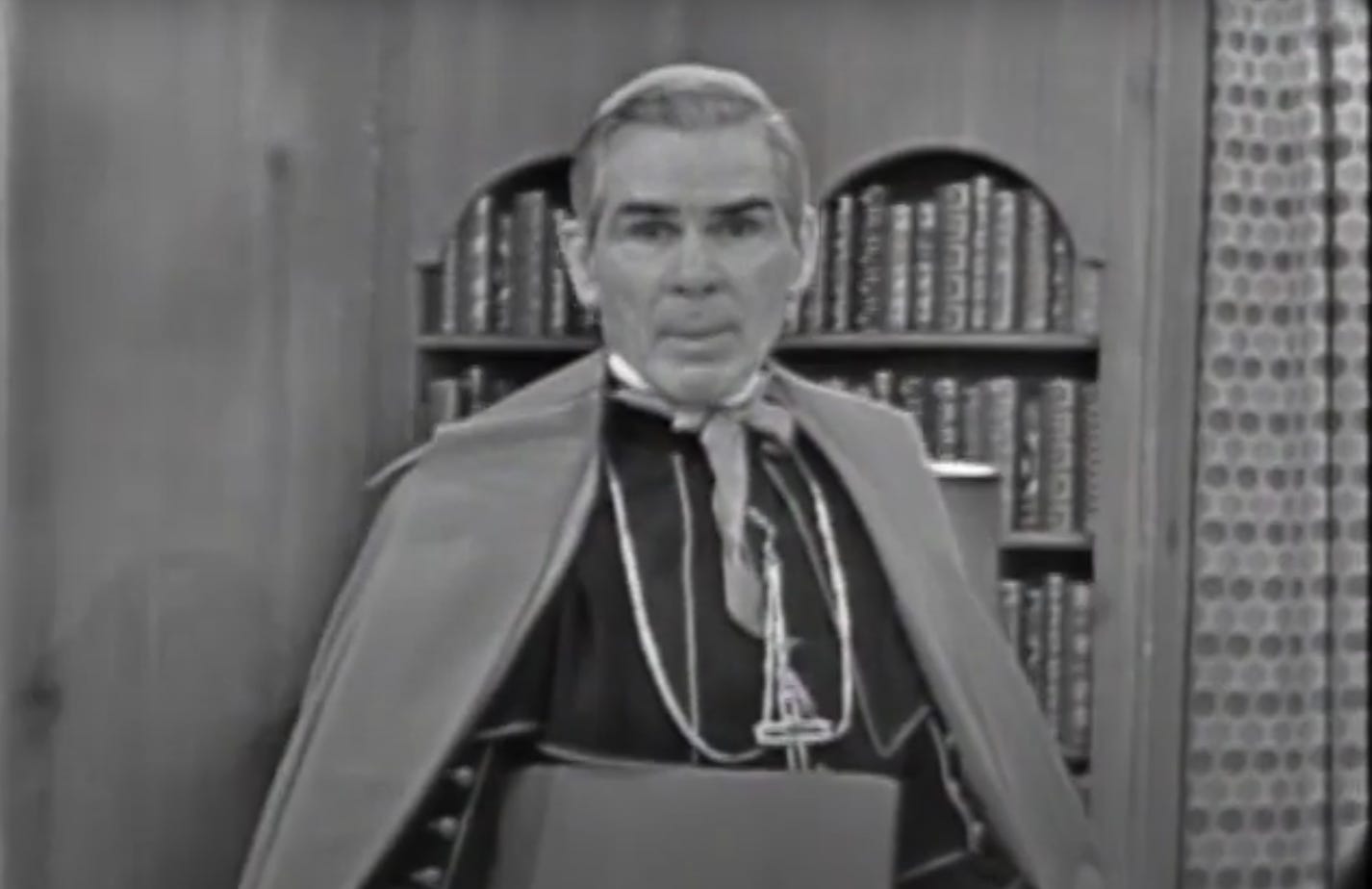
What do you make of Archbishop Sheen’s explanation of these false definitions of freedom?
NEXT: Father Chris Alar Explains Why He Believes Cultural Relativism Is "The Root Of All Evil"
Ahh, when I read the second paragraph, I had virtually zero doubt this would bring up Dostoevsky and The Brothers Karamazov. What a masterpiece. "Everything is permitted" - Ivan Karamazov is the archetypical representation of this folly. And of course, the Grand Inquisitor chapter... Such a powerful book!
1) Sheen is always gold, and we need to reference him more than we do.
2) You should un-suspend LumberJack, whose comment was hidden below. Let him continue to show us how terrible his godless libertarian nonsense is. Let him demonstrate what happens when your prophet is Ayn Rand and you worship at the alter of self. He's inspiring, just not in the way he thinks he is.