


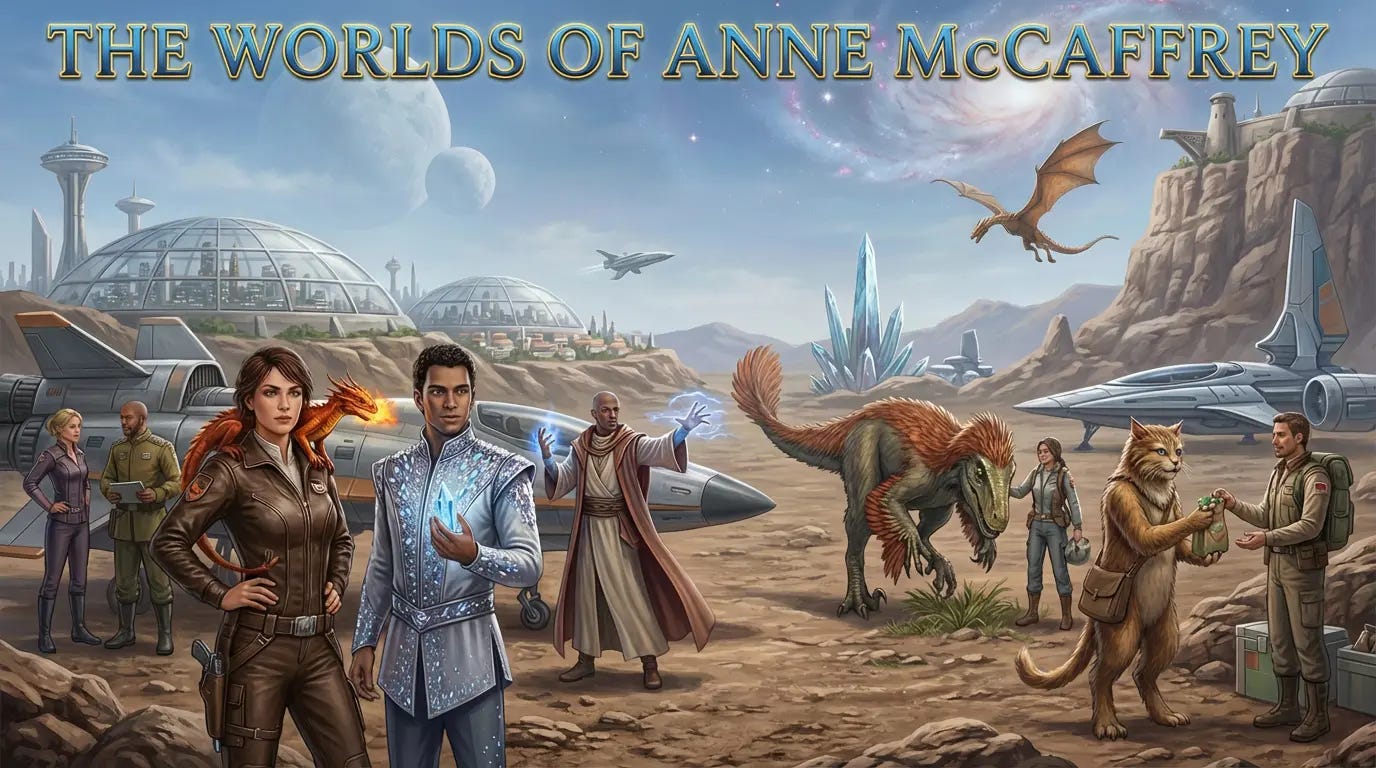
Most readers discover Anne McCaffrey through the Dragonriders of Pern. It’s one of science fiction and fantasy’s most beloved settings, and it’s where the majority of her readership begins and ends. What those readers often don’t realize is that Pern exists within a much larger framework, a shared universe called the Federated Sentient Planets that connects almost everything McCaffrey ever wrote.
At least with most of her novels. Her debut novel Restoree (1967) stands alone, set on the planet Lothar with no FSP connections whatsoever (though we can imagine it is). Everything else, from the Brainships, to the Crystal Singers, to the Planet Pirates, the to Talents, the Petaybee colonists, and finally Acorna’s people, exists within the same interstellar civilization. Beyond this, her Freedom series also has no connection, but the large body of her work can be traced and viewed as one big world.
For Pern fans looking to explore that larger universe, this guide is your roadmap.
What Is the Federated Sentient Planets?
The FSP is McCaffrey’s version of a United Nations for the galaxy—an interstellar governing body that regulates trade, colonization, and relations between sentient species. It’s not a utopia. Corporate interests frequently override humanitarian ones. Colonial oversight is imperfect. Individual planets maintain significant autonomy. And the bureaucracy, as any reader of the Petaybee novels will tell you, can be suffocating.
What unifies the FSP universe thematically is McCaffrey’s consistent interest in certain ideas: the rights of individuals against institutional power, the nature of consciousness and personhood, the ethics of exploitation, and the question of what makes someone truly alive and deserving of dignity. These themes run through every series in the universe, connecting them more deeply than mere shared geography.
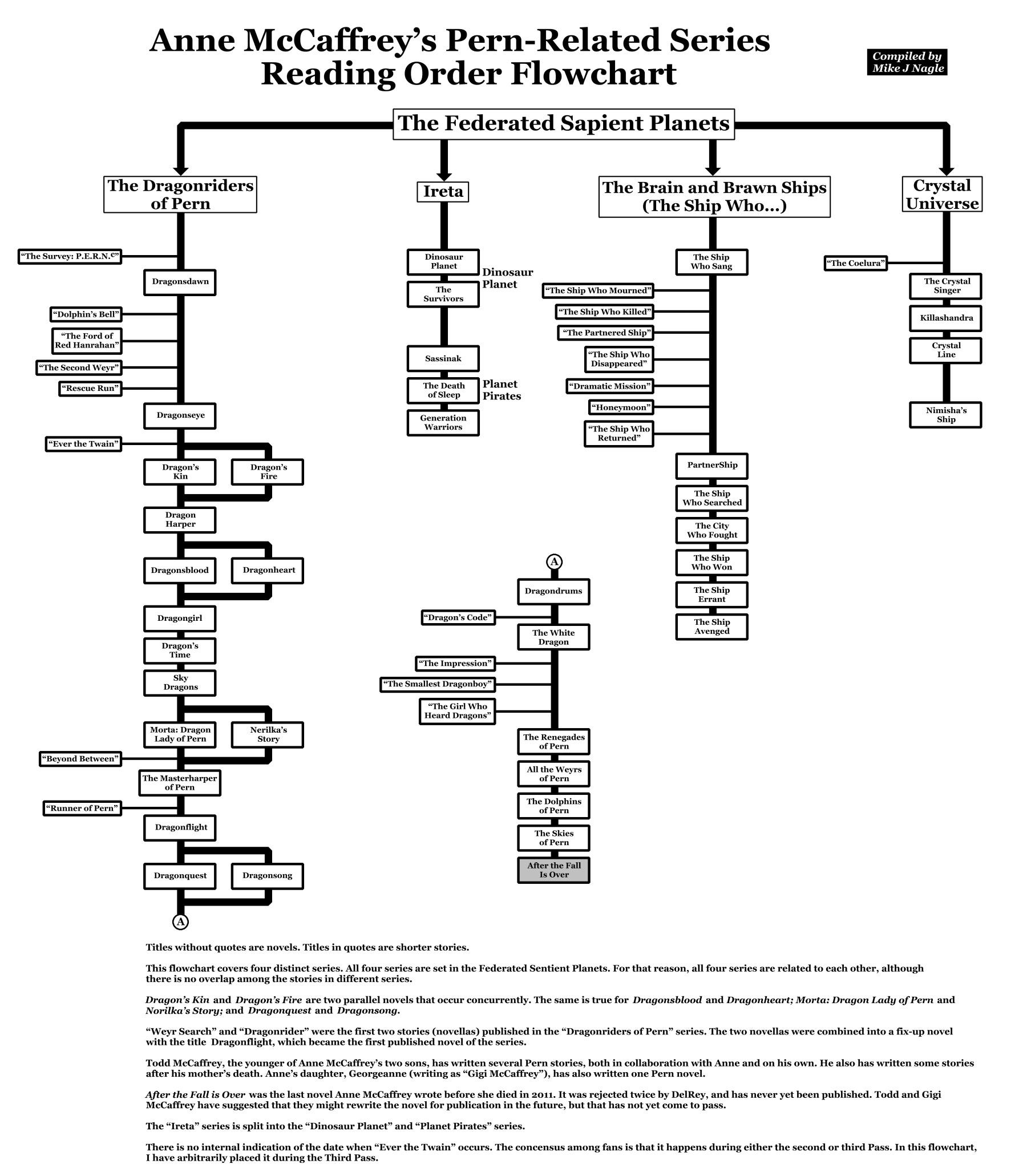
The flowchart created by Mike J. Nagle organizes the Pern-related series beautifully, grouping the Dragonriders, the Ireta/Planet Pirates storyline, the Brainships, and the Crystal Singer trilogy under the FSP umbrella. But as Nagle acknowledges, the chart doesn’t include everything. Acorna, the Petaybee novels, The Coelura, Doona, and the Talent/Tower and Hive series all belong in this universe and need to be placed.
The Series and Where They Fit
The Talent Universe (The Tower and the Hive)

This is arguably the earliest-feeling series in the FSP timeline, though pinning exact dates is difficult. The Talent universe begins with To Ride Pegasus (1973), which is set in the near future, close enough to our own era that it reads almost as contemporary science fiction. Humans with psychic abilities, or Talents, are identified, registered, and eventually become the backbone of interstellar communication and transport.
The series progresses through Pegasus in Flight and then jumps centuries forward to The Rowan (1990), where a powerful telepath/telekinetic named the Rowan serves as a Prime—a Talent strong enough to launch spacecraft across interstellar distances using mental power alone. The Tower and the Hive novels (The Rowan, Damia, Damia’s Children, Lyon’s Pride, The Tower and the Hive) follow the Rowan’s family across generations as they defend against an insectoid alien threat called the Hivers.
Timeline placement: The Talent universe almost certainly predates the other FSP series. The psychic network these novels establish—Primes launching ships between star systems—may explain how the FSP’s interstellar civilization maintains cohesion across such vast distances. Think of it as the communications and transport infrastructure upon which everything else is built.
The Barque Cats

A late offshoot of the Talent universe, the Barque Cats duology, Catalyst (2010) and Catacombs (2010), written with Elizabeth Ann Scarborough, follows ship‑born cats and their bonded “Cat Persons” whose telepathic links and uncanny instincts make them indispensable on FSP vessels. These cats keep ships vermin‑free, sense environmental hazards, and, in some cases, develop full two‑way mind‑speech with their humans, pushing the Talent setting’s interest in psychic bonds into delightfully pulpy territory.
Timeline placement and cross‑links: The Barque Cats are explicitly set in the same universe as the Talents and the Tower and Hive books, effectively a side‑series in the mature FSP era when telepaths are fully integrated into interstellar infrastructure. They are also name‑checked in the Acorna and Talents books, reinforcing that these stories share a common Federation where telepaths, unicorn‑like healers, and telepathic ship cats all coexist on the same trade lanes.
Connection to Pern: While the Barque Cats never appear on Pern itself, they showcase the same FSP habit of engineering and partnering with animals for highly specialized roles, much like the genetic work that created Pern’s dragons from fire‑lizards. Read alongside the Planet Pirates and Pern colonization novels, the Barque Cats underscore that dragonriders, crystal singers, telepaths, and ship cats all grow out of a single interstellar civilization whose technologies and bio‑engineering practices the Pern colonists deliberately chose to leave behind.
The Brain and Brawn Ships (The Ship Who Sang)

The Brainship series begins with The Ship Who Sang (1969), one of McCaffrey’s most celebrated works. Children born with severe physical disabilities but exceptional mental capabilities are given a choice: become a “shell person,” their body encased in a life-support titanium shell integrated into a ship, building, or station, and serve Central Worlds in exchange for paying off the cost of their construction.
Helva, the ship who sang, is the original and most beloved of these characters. Subsequent novels—written with various collaborators including Mercedes Lackey, Anne’s son Todd, and S.M. Stirling—follow other brainships: PartnerShip, The Ship Who Searched, The City Who Fought, The Ship Who Won, The Ship Errant, and The Ship Avenged.
Timeline placement: The Brainship technology suggests a civilization sophisticated enough to routinely integrate human consciousness with machinery but still dealing with significant social inequality. The shell persons carry enormous debt and must earn their freedom. This feels like a mid-period FSP civilization, after the Talent network is established but before the social advances seen in later series. The ethical questions raised by the Brainship program are never fully resolved, which is the point.
Connection to Pern: The Brainships are explicitly connected to the Planet Pirates storyline, which directly connects to the Ireta/Dinosaur Planet series, which is the origin point of Pern’s colonists. This is the clearest canonical link between the Pern universe and the broader FSP.
The Crystal Singer Trilogy

The Crystal Singer (1982), Killashandra (1985), and Crystal Line (1992) follow Killashandra Ree, a failed musician who discovers she has the rare ability to “sing” crystal on the planet Ballybran. The crystalline rock, when cut with voice-controlled machinery by singers with perfect pitch, is essential to advanced power and communications systems throughout the FSP.
The cost is brutal. Crystal immersion causes symbiont infection that extends singers’ lifespans dramatically but erodes their memories. The Guild that controls crystal harvesting is exploitative and ruthless. Killashandra is not a particularly sympathetic protagonist, which makes her one of McCaffrey’s most interesting.
Timeline placement: The crystal technology feels contemporaneous with the Brainship era or slightly later. The FSP is clearly well-established, with complex interstellar commerce and strong guild structures. Crystal communications technology may be what makes the Talent-based transport network even more effective.
The Coelura And Nimisha’s Ship

This short novel (1983) is set on Demeathorn, where Caissa’s father is explicitly the FSP Ambassador. The story involves a rare creature whose silk-like secretions are used to create extraordinarily beautiful fabric, and the political and ecological consequences of that discovery. It’s followed up with a book titled Nimisha’s Ship in the same general loose region of the universe though it has different characters.
Timeline placement: Brief but clearly FSP, probably mid-period given the Ambassador’s role and the political structures described. They’re largely considered part of the “Crystal Universe” as a subset, so they might be read around the Crystal Singer books as a time guide.
The Ireta Series and Planet Pirates

Dinosaur Planet (1978) and The Survivors (1984), later combined as The Mystery of Ireta, follow an Exploration and Evaluation Corps team that arrives on a planet expecting routine survey work and finds dinosaurs. Then their transport ship disappears, leaving them stranded.
The Planet Pirates trilogy (Sassinak, The Death of Sleep, Generation Warriors, written with Elizabeth Moon and Jody Lynn Nye) connects directly to the Ireta storyline. Pirates are attacking the space lanes of the FSP, raiding colony ships and selling colonists into slavery. The trilogy brings together characters from the Ireta storyline with Fleet officers, including the remarkable Sassinak, a survivor of a pirate raid who dedicated her life to fighting them.
Timeline placement: This series occupies a clearly defined middle period of FSP history. The civilization is expansionist, actively colonizing new worlds, and dealing with the criminal enterprises that exploit that expansion. The Ireta/Planet Pirates storyline connects directly to Pern through the colonization era, the people who would eventually colonize Pern are part of this same civilization and this same era of expansion.
The Pern Connection: Pern’s colonists left from this era of FSP history. They were leaving behind a civilization that included Brainships, crystal technology, and planet pirates. The original Dragonriders of Pern trilogy establishes that Pern was a deliberate choice by colonists who wanted to escape the complexities of FSP civilization and live more simply. The fact that Thread then cut them off from that civilization—forcing a technological regression that erased most knowledge of their origins—is the central tragedy of Pern’s history.
The Dragonriders of Pern

The flowchart handles the Pern reading order comprehensively, but its place in the FSP timeline deserves emphasis. Pern is not a fantasy world with a science fiction explanation bolted on, it’s a science fiction world that deliberately forgot its own history.
The colonists who settled Pern were FSP citizens. They brought genetic engineering technology sophisticated enough to create dragons from native fire-lizards. They had computers, medical technology, and interstellar communications. Thread stripped all of that away over generations.
When AIVAS is discovered in All the Weyrs of Pern, it represents the moment Pern reconnects with its FSP heritage. The plan to eliminate Thread permanently uses FSP-era technology that the Pernese had forgotten they possessed.
Timeline placement: Pern’s colonization happens during the same expansionist era as the Ireta storyline. The main body of Pern novels—the Harper Hall trilogy, the original trilogy, the later novels—takes place thousands of years after that colonization, effectively in the far future of the FSP timeline. Whether the FSP still exists in recognizable form by the Ninth Pass is unknown. Pern has been cut off long enough that no contact has been maintained.
The Doona Series

Decision at Doona (1969), Crisis on Doona (1992, with Jody Lynn Nye), and Treaty Planet (1994, with Nye) follow the human colonization of a planet that turns out to already be inhabited by the Hrrubans—a feline alien species. The diplomatic crisis that follows, and the eventual negotiation of coexistence, is a meditation on first contact, cultural understanding, and the FSP’s colonial policies.
Timeline placement: The Doona novels feel contemporaneous with the early-to-middle FSP expansion era. The FSP’s colonial bureaucracy is present and officious. The ethical questions about colonization rights suggest a civilization still working out the rules of interstellar settlement.
The Petaybee Novels

Powers That Be (1993), Power Lines (1994), and Power Play (1995), written with Elizabeth Ann Scarborough, follow Yanaba Maddock, a retired military officer assigned to investigate a corporate-controlled colony planet called Petaybee. What she discovers is that Petaybee itself is a sentient entity—a living planet that communicates with its human colonists through a unique symbiotic relationship.
The sequels, Changelings, Maelstrom, and Deluge, continue the story of Petaybee’s people as they defend their world against corporate and governmental exploitation.
Timeline placement: The Petaybee novels are explicitly FSP—the corporation controlling Petaybee operates under FSP oversight, and the conflict between colonial rights and corporate interests is framed in FSP political terms. The series feels like a later-period FSP story, when the civilization is large enough that individual planets can be effectively ignored or exploited by corporate interests operating within a vast bureaucratic structure.
Acorna and Her Universe

Here’s where the flowchart leaves a significant gap. The Acorna series, Acorna (1997) through multiple sequels, written with Elizabeth Ann Scarborough, follows a young alien with healing powers who is raised by human miners before discovering her own people, the Linyaari.
McCaffrey confirmed that Acorna is set in the FSP universe. The mining operations, the corporate structures, the interstellar civilization, all of it fits the FSP framework. But where exactly does it fit on the timeline?
Educated placement: The Acorna novels feel like a later-period FSP story. The civilization is mature, expansionist, and dealing with the moral complexities of interstellar commerce and alien relations that characterize the mid-to-late FSP era. The Linyaari, a unicorn-like species with healing abilities, suggest the FSP has been making first contact with new species for centuries. Acorna’s story of integration, identity, and the ethics of using her abilities feels thematically connected to the Brainship novels’ questions about personhood and exploitation.
Placement guess: Contemporaneous with or slightly later than the Planet Pirates era, given the similar corporate-dominated interstellar economy and the ongoing first contact dynamics.
A Speculative FSP Timeline
Pulling all of this together into a rough reading order that respects both internal chronology and narrative accessibility:
Foundation Era — Near Future
To Ride Pegasus → Pegasus in Flight (The Talent series begins; psychic abilities identified and developed on Earth)
Early FSP — Interstellar Expansion Begins
The Rowan → Damia → Damia’s Children → Lyon’s Pride → The Tower and the Hive (Talent Primes enable interstellar travel; Hiver threat emerges)
Mid FSP — Colonial Expansion
Decision at Doona (First contact protocols established)
The Ship Who Sang → Brainship sequels (Shell person technology developed and deployed)
The Crystal Singer → Killashandra → Crystal Line (Crystal technology essential to FSP infrastructure)
The Coelura (Corporate and diplomatic FSP structures in full operation) → Nimisha’s Ship
Catalyst → Catacombs
Expansionist Era — Pirates and Planets
Dinosaur Planet / The Survivors (Ireta discovery)
Sassinak → The Death of Sleep → Generation Warriors (Planet Pirates crisis)
Powers That Be → Power Lines → Power Play → sequels (Petaybee colonization and defense)
Acorna → Acorna sequels (Linyaari first contact and integration)
Colonial Era — Pern Founded
Pern colonization occurs during this period. The colonists are FSP citizens choosing to leave the complexity of FSP civilization behind. They bring FSP technology including the genetic engineering that will produce dragons.
The Long Silence — Pern Isolated
Thread cuts Pern off from FSP contact. Thousands of years pass. The FSP continues in some form—or doesn’t. Pern forgets its origins entirely.
Far Future — The Ninth Pass
The main body of Pern novels takes place here, thousands of years after FSP colonization. AIVAS represents the moment Pern recovers its FSP heritage and uses it to eliminate Thread permanently.
Why Pern Fans Should Care
For readers who love Pern and have never explored the rest of McCaffrey’s universe, this framework changes how the books feel. The colonists who created the dragons were citizens of a sophisticated interstellar civilization who chose to walk away from it. The genetic engineering that produced fire-lizards and eventually dragons was state-of-the-art FSP biotechnology. The AI AIVAS isn’t a mysterious ancient artifact—it’s FSP technology, the same civilization that produced Brainships and crystal communications networks.
Reading the Planet Pirates trilogy before the Pern colonization novels such as Dragonsdawn, and The Chronicles of Pern: First Fall, places those stories in a context that makes them richer. You understand what the colonists were leaving behind. You understand the resources they had access to. And you understand just how complete their isolation from that civilization eventually became.
Pern is the most famous corner of that civilization. But it’s far from the only one worth exploring.
What do you think? Are you going to be delving into Anne McCaffrey’s greater universe?
If you love a well-built universe, and if the golden age of Trek and Babylon 5 left a hole in your sci-fi diet, The Stars Entwined fills it — interstellar espionage between two civilizations on the brink of war. Read The Stars Entwined on Amazon!
I tried reading the White Dragon back in 70 or so. Just. Couldn't.
Didn't resonate as good fantasy for me.
The Black Company (Glen Cook) did.
Anne McCaffrey was like a dump truck with 1 working wheel.
Glen Cook's Black Company was a fully functional Porsche.
Just me? Dunno.