


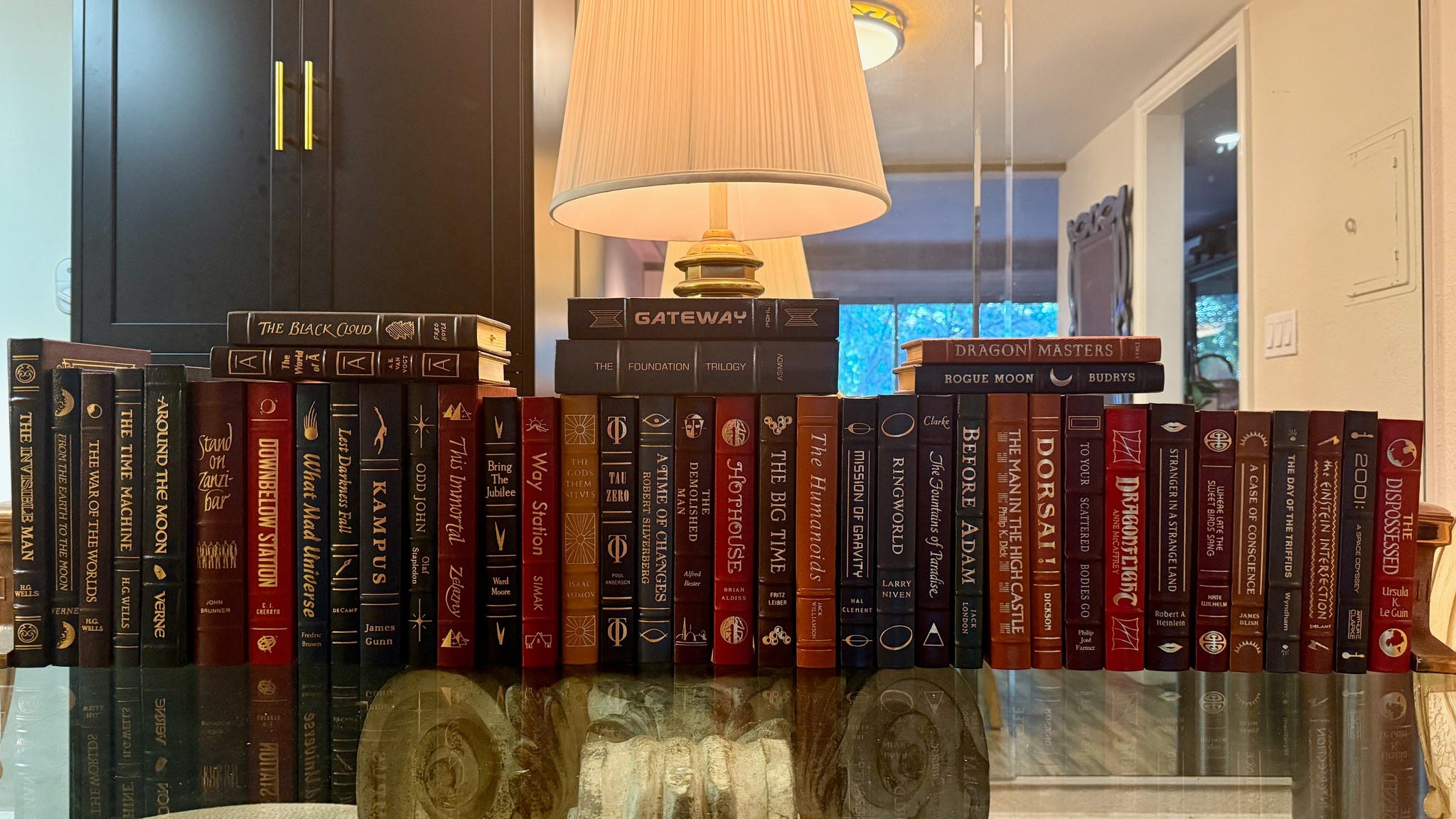
Easton Press launched the Masterpieces of Science Fiction series in 1986 and has not stopped. The series now runs past 140 volumes. Every book is bound in genuine embossed leather, printed on acid-neutral paper, gilded on three page edges, and accented with 22-karat gold titling on a hubbed spine. Many volumes came with commissioned introductions and original artwork. A significant portion were signed by the author on a special limitation page, with a numbered certificate of authenticity.
No comparable series exists in science fiction publishing. The Franklin Library ran a parallel effort, but it collapsed in the 1990s. Commercial publishers have never attempted anything at this production level for genre fiction at scale. What Easton built over those four decades is the closest thing science fiction has to the kind of fine press treatment normally reserved for Shakespeare or Dickens.
The series ran its heaviest output between 1986 and 1996. Sixteen volumes in 1986 alone, anchoring the list with H.G. Wells, Arthur C. Clarke, Philip José Farmer, Frank Herbert, and Ursula K. Le Guin. The 1988 class added Dune, Ringworld, The Man in the High Castle, Dragonflight, and The Foundation Trilogy in a single year. By the mid-1990s the series had covered most of science fiction’s genuine canon.
There are debatable choices in the catalog. Some slots went to ideologically fashionable titles that the market has not validated over time. The Female Man, Door Into Ocean, and a few others land in that category. Bug Jack Barron, Whatever that Thing is It Is Not Science Fiction, got a volume. So did On Wings of Song. These are real books that real editors believed in at the time, but they sit awkwardly next to Heinlein and Clarke. The series was not purely a meritocracy. It reflected the editorial consensus of the late 1980s and early 1990s science fiction establishment, which had its own priorities.
That said, the core of the list is extraordinary. If you collected only the Golden Age and Hard SF spine of the Masterpieces series, you would have a library worth displaying and worth reading.
Where to Start
Dune (Frank Herbert, 1987) is the obvious anchor. The Easton edition is one of the most reproduced images in collector SF circles. Deep red-brown leather, 22kt gold, full presentation. If you own one Easton SF, this is the one.
Dragonflight (Anne McCaffrey, 1988) is the signed Masterpieces volume and the right entry point for the Pern shelf. McCaffrey built one of SF's most complete secondary worlds across decades of work, and the Easton signed run through Dragon's Fire traces that whole arc. The bond between rider and dragon is the emotional engine of the entire sequence, and McCaffrey never let it go mechanical. The Easton editions do the books justice at a production level that matches what McCaffrey put into them.
Starship Troopers (Heinlein, 2008) is the one Heinlein volume in the Masterpieces run, and Heinlein should be in any serious SF collection. The book is the argument. Heinlein laid out the case for civic responsibility and earned citizenship more clearly than any other SF novel before or since. The Easton edition came late in the series but was done properly.
Ringworld (Niven, 1988) belongs on any Hard SF shelf. Niven built a structure that still holds up as an engineering thought experiment. The Easton volume collects the book at its best production quality.
The Mote in God’s Eye (Niven and Pournelle, 1991) is arguably the greatest First Contact novel in the genre. Two authors at the top of their game building a genuinely alien species with real sociological logic. This volume rarely gets mentioned first, but it should.
Tau Zero (Poul Anderson, 1987) is the hardest of Hard SF in the Masterpieces run. Anderson takes a single premise — a Bussard ramjet that cannot decelerate — and follows the physics to their logical end, past galaxies, past the heat death of the universe. Anderson was a traditionalist with deep Norse roots, a founding member of the Society for Creative Anachronism, and it shows in how he wrote about fate and endurance. His characters do not rage against the cosmos. They sail into it. If you want one book that captures what Hard SF was built to do, this is it.
Ender’s Game (Orson Scott Card, 1993) arrived as a signed edition and Card signed it personally. The novel is the single best argument in SF for why moral clarity in war fiction matters. It ran through the school curriculum for two decades before the culture turned on Card for his beliefs. The Easton edition predates all of that and exists as a record of when this book was treated as what it is: one of the best SF novels of the 20th century.
Hyperion (Dan Simmons, 1991) is the literary peak of the Masterpieces run. Canterbury Tales structure, genuine theological weight, prose that most SF writers cannot touch. The Easton edition did right by it.
Out of the Silent Planet (C.S. Lewis, 1994) is the one in the series that carries Catholic Christian weight. Lewis’s Space Trilogy has never gotten the mainstream credit it deserves. This is the rare case where an Easton volume could serve double duty: collector’s item and a book with something to say about the nature of creation and fallen worlds. The entire trilogy is worth tracking down, but the Easton edition covers the first book.
A Canticle for Leibowitz (Walter M. Miller Jr., 1994) is the other volume with genuine Catholic grounding. Miller wrote it after converting following his participation in the bombing of Monte Cassino in World War II. The guilt drove the book. The result is the best post-apocalyptic novel in the genre, and it has never been surpassed. This one you read, not just display.
Falling Free (Lois McMaster Bujold, 2001) is the Vorkosigan universe entry in the Masterpieces series and an ideal introduction to why Bujold won the Hugo for Best Novel four times, matching Heinlein's record. The novel follows an engineer who discovers the corporation he works for views his students as disposable assets and has to decide what he is willing to do about it. Bujold builds the moral case through engineering logic and human decency rather than ideology. Clean premise, clean execution. If Falling Free hooks you, the nine-volume Easton Signed First Edition run of the Vorkosigan Saga proper starts with Borders of Infinity and goes straight through Diplomatic Immunity. Collect them as a set.
Getting the Checklist
Fandom Pulse put together a complete spreadsheet covering all 139 Masterpieces of Science Fiction volumes. Each entry has Owned and Read checkboxes.
The market for these books is still active. eBay, AbeBooks, and VeryFineBooks carry steady inventory. First-year volumes from 1986 and signed editions from the early 1990s carry premiums. Later volumes from 2000 onward are generally available at lower prices since the collector market thins out as the series continued past its core canon.
The most prestigious science fiction bookshelf in existence has a checklist. The question is how many of them you already own.
What’s the one Easton Press volume on your want list? Drop it in the comments.

When genetic engineering nearly doomed the species, humanity made a desperate bargain: let the frontier do what nature intended. In a harsh universe, these cadets have to make impossible decisions. Read Space Fleet Academy today.
NEXT: Castalia’s Court of Carlos IV Is the Episodios Nacionales Getting Serious
I bought two of the 3 Book of the New Sun Easton editions released for the Science Fiction book club. Good ones. Shame that Book 3 was made in a different format and book 4 wasn't even adapted.
Great list. What surprises me is how many of them I've read over the years.