


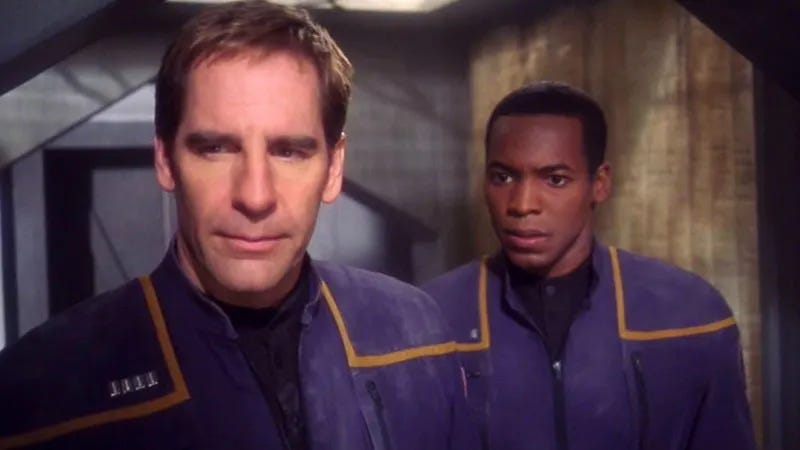
As Star Trek: Strange New Worlds and Star Trek: Starfleet Academy come to a close next year, some in the Star Trek fan community are wondering where it all “went wrong”. Some point to Alex Kurtzman, the steward of Star Trek over the last few years. Others point to JJ Abrams with the reboot Star Trek films, which Kurtzman helped write. Others point to Les Moonves, the former head of CBS and Paramount, as a culprit of doing damage to the Star Trek brand. Now the question of who is responsible could be a series of posts, but the question brought up in this particular article is: where did it go wrong?
Where did it go wrong? The most logical place to point to would be the cancellation of Star Trek Enterprise. Star Trek Enterprise ran from 2001 to 2005, set in the pre-Federation years of 2151-2155 in the 22nd century. We got to follow the voyages of Captain Jonathan Archer and the crew of the NX-01 Enterprise, Earth’s first Warp 5 ship. The choice to do a prequel series was controversial at the time, with the recent conclusions of both Star Trek Deep Space Nine in 1999 and Star Trek Voyager in 2001. Many were expecting the franchise to go forward, not backward.
Enterprise had other things going against it besides being a prequel. The title sequence had a song, “Where My Heart Will Take Me”, written by Diane Warren and performed by Russel Watson, which was considerably out of the ordinary from what had come to be expected from Star Trek. Fans had many issues with early seasons of Enterprise, especially the “Temporal Cold War” story that lasted all the way to the fourth season premiere episode “Storm Front”. This and some other stories bringing in future races that humanity was not supposed to meet yet would irritate some fans and writers. One such instance would be introducing the Ferengi in the first season episode “Acquisition”. This episode is one prequel problem fans often highlight. According to Captain Picard in the Star Trek: The Next Generation episode “The Last Outpost”, Starfleet knew “almost nothing about” the Ferengi. “The Last Outpost” takes place almost two hundred and thirteen years after “Acquisition”. How could Starfleet know almost nothing about the Ferengi when their first major exploration ship encountered them centuries earlier?
There are some highlights in the first two seasons, but there were still many detractor
s. Fans often point to either the third season “Xindi” arc as the turning point for them to enjoy the show. In this arc, Archer and the Enterprise are sent to confront the Xindi, an alien race who sent a weapon that launched a devastating attack on Earth. In the fourth season, a major plot arc involving the Romulans attempting to disrupt a potential alliance between the Territes, Humans, Vulcans, and Andorians helped portray the events leading to the founding of the Federation. This arc also highlighted some foreshadowing and reasons why the Romulans chose to go to war with Humans.
The Romulan arc and another arc in season four show how difficult forming the Federation was going to be. The other arc that showed the difficulty of forming the Federation is “Terra Prime”. Terra Prime was a xenophobic group who believed only Humans should be on Earth and should remain isolated from the rest of the galaxy. Some who sympathized with this cause chose violent methods to express their fear and anger. They even attacked some people in Starfleet, including their fellow Humans. Archer ended the arc with a message of hope that, despite various differences and fears, a better future could be made together.
Unfortunately, Enterprise was canceled, preventing the audience from seeing more events. Some events spoken of by writers of the show included showing the events of the Romulan War, the early days of the Federation, and more work with the characters from Star Trek Enterprise. Several, including Jamie from Tachyon Pulse, have said Enterprise has aged well. As Paramount goes through a transition period with no new Star Trek series announced at present, despite Star Trek celebrating sixty years of being in existence, is Star Trek Enterprise something that should be looked at as the final “good”, “proper”, or “canon” Star Trek series? What do you think of Star Trek Enterprise? Has it aged well? Has it been looked at with nostalgia since Star Trek’s quality has seemed to decline? Would you want to see more stories in this era?
Captain Alex Gabriel and the crew of the USS Arizona, fresh off their first mission run a test of the Quantum Slip Stream Drive. The test goes wrong due to sabotage. Will the crew find the saboteur before they strike again? Check it out in Aftermath: A Star Trek Fan production:
NEXT: William Shatner Returns To Star Trek As 60th Anniversary Documentary Lands Regal Theatrical Release

I like Enterprise for the most part, I also liked most of the characters. I felt the xenophobia storyline was to cater to a certain demographic, it felt forced and badly written. I am surprised you did not mention the abomination that was the final episode, but I guess that dead horse has long been beat into glue. And yes, I am one of those that felt the final speech should have been "These are the voyages of the Starship Enterprise. Enterprise definitely felt like Old Trek, that is why it appealed to me, but then again, I am old too.
I never understood the Enterprise hate. If they'd just had a "traditional" Star Trek opening credits, I'm convinced it would have taken far less flack, which is absurd, but that's how spoiled the fans were before the dark times.
We didn't know how good we had it back then that a dumb credits song and a few other choices (like era) could get the base so riled up and crapping on an otherwise excellent show.
And it was excellent, having aged like fine wine once some of the "not muh Star Trek' choices lost their outrage due to far, far FAR worse sins visited upon the body Trek.
That last episode though, my goodness, the only saving grace is that it can easily be reconned as "incomplete/incorrect/corrupt records" 200+ years into the future, or even just user error/poor subject knowledge on the holodeck sequence programmer.