


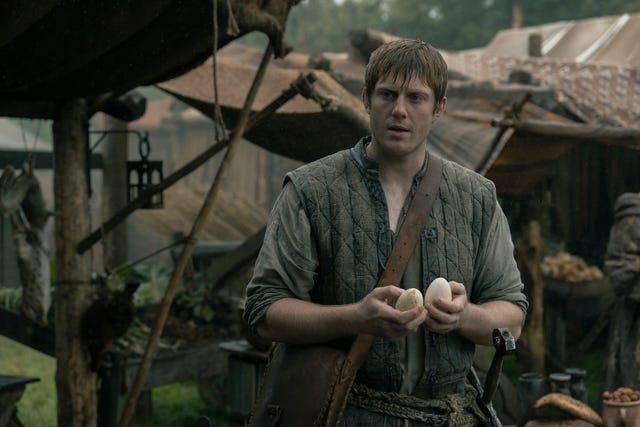
Reviews for HBO’s A Knight of the Seven Kingdoms promised a return to “medieval chivalry” and “an old-fashioned, chivalric moral compass.” However, three episodes in and the show has given us everything but that. Instead viewers have been exposed to intentionally shocking diarrhea scenes, full frontal male nudity, and most recently a song glorifying a woman shoving her arm up men’s buttocks in order to pleasure them.
If Hollywood really wanted to return to “medieval chivalry” and “an old-fashioned, chivalric moral compass,” they would be best to look to these five historical events that would make for great adaptations.
1. Battle of Covadonga
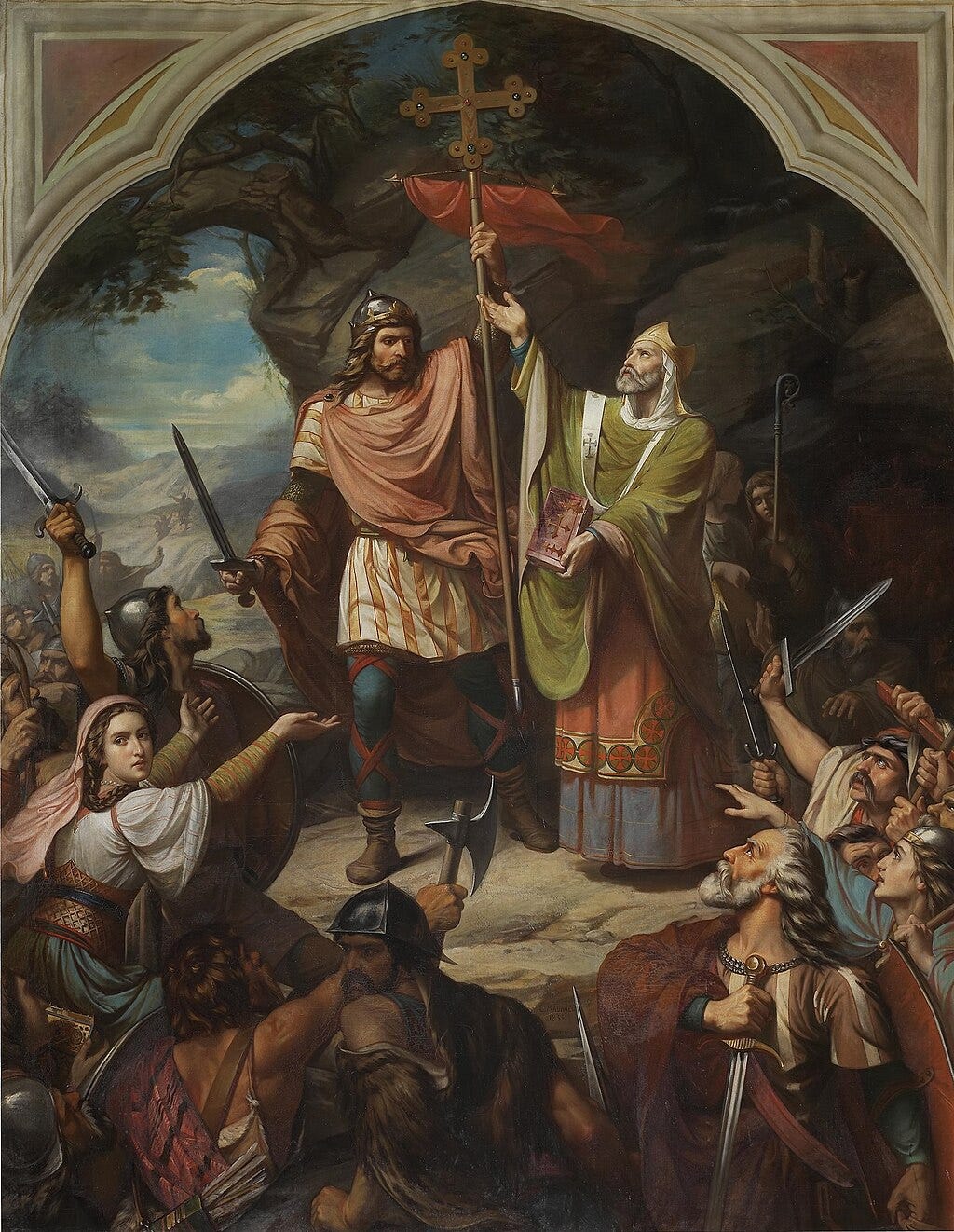
The Battle of Covadonga took place around 722 AD in the the Picos de Europa in northern Spain. The battle pitted Visigothic noble Don Pelayo and his Christian forces against the Umayyad Caliphate and its forces led by General Alkamar.
The outnumbered Christians used the advantageous terrain to their advantage and secured a decisive victory against the Muslim forces. On top of using the terrain, Don Pelayo relied on his faith. He went to the Cave of Covadonga and prayed through the intercession of Mary for special protection in the battle. She appeared to him and left behind a statue of herself and with the Christ Child.
When the Muslims launched their first attack with arrows, the arrows turned against the Muslims and fell those who had fired them.
Additionally, following the death of the Muslims’ second-in-command Suleiman a storm occurred resulting in mudslides and boulders and debris raining down on the retreating Muslim soldiers.
The battle secured the success of the Kingdom of Asturias and began the Reconquista, the Christian crusade to reclaim the Iberian peninsula from the Muslims.
To honor the intervention of the Blessed Mother, Don Pelayo had a monastery and chapel built that was replaced with a Basilica in 1901.
2. Battle of Tours
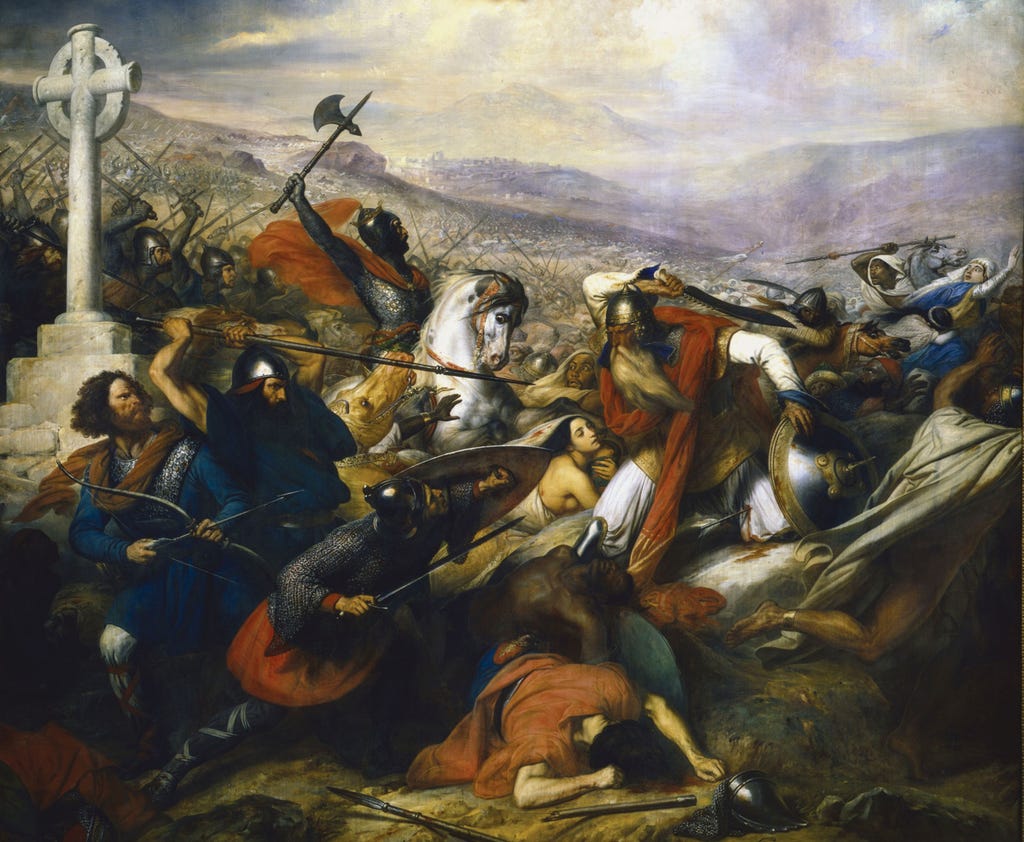
About a decade after the Battle of Covadonga, the Umayyad Caliphate under leadership of governor Abd al-Rahman al-Ghafiqi launched an attack into Frankish territory. He defeated Duke Eudes at Bordeaux, who sought the assistance of Frankish leader Charles Martel.
Martel responded by dispatching his cavalry to defend the city of Tours and the abbey of St. Martin of Tours. He then confronted Abd al-Rahman with his heavy infantry and was able to break the Muslim attack. Although some sources that Eudes led a cavalry attack to turn the tide.
Nevertheless, the Muslim army was slaughtered at the front. As word spread of the slaughter the lines started to break as they went to defend the army’s main camp which is where many of the men’s families were.
Abd al-Rahman would eventually be slain during the battle and the remaining Muslim forces would retreat to the south during the night.
3. Battle of Lepanto
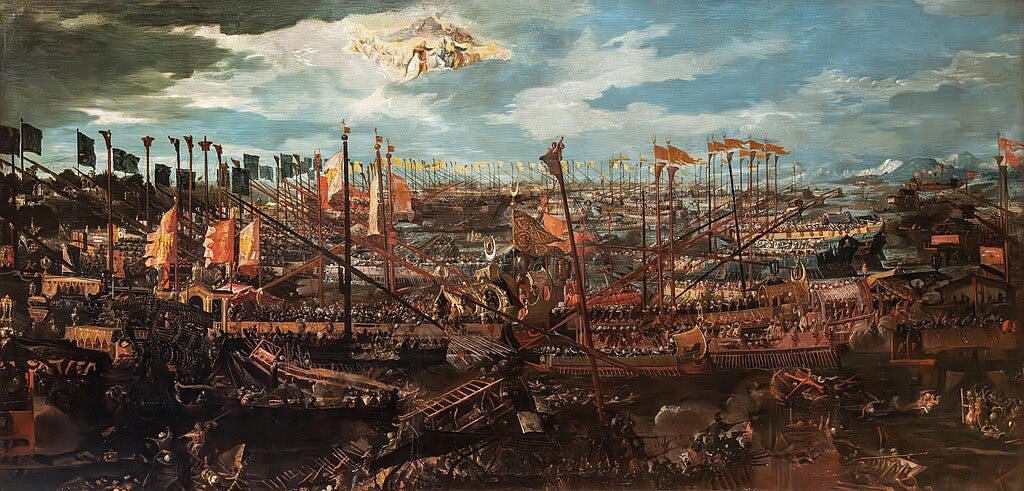
The Battle of Lepanto occurred on October 7, 1571, in the Gulf of Patras off the coast of western Greece. It pitted the naval forces of the Holy League, a coalition of Catholic states including the Spanish Empire, the Republic of Venice, the Papal States, Genoa, Savoy, and the Knights of Malta, against the formidable fleet of the Ottoman Empire.
The Ottomans, under Sultan Selim II, had recently captured Cyprus from Venice, including the brutal fall of Famagusta, and sought to dominate the Mediterranean and threaten Christian Europe further. Pope St. Pius V organized the Holy League to counter this expansion, appointing Don Juan de Austria as commander-in-chief, with papal support from Marcantonio Colonna and Venetian contributions prominent.
The Christian fleet, numbering around 206-210 galleys plus six powerful Venetian galleasses, assembled at Messina in Sicily and sailed to meet the larger Ottoman force under Ali Pasha. Though the Ottomans held numerical advantages in some areas, the Christians had superior firepower from the galleasses and disciplined formations.
As the battle loomed, Pope Pius V called on all of Christendom to pray the Rosary fervently for victory, opening churches in Rome for continuous prayer and invoking the intercession of the Blessed Virgin Mary. Reports hold that the Holy Father himself experienced a vision of the triumph while the battle raged.
On the day of engagement, the fleets clashed in what became the largest naval battle since antiquity and the last major galley warfare engagement. The fighting was brutal and close-quarters, resembling infantry combat on floating platforms. The Christian center, led by Don Juan aboard the Real, rammed and boarded the Ottoman flagship Sultana, leading to fierce hand-to-hand combat where Ali Pasha was slain. The Ottoman center collapsed, and despite a near-flanking maneuver by Uluch Ali on the Ottoman left, timely reserves under Álvaro de Bazán helped secure the field.
The Holy League achieved a decisive victory: they captured or destroyed around 117-137 Ottoman galleys, liberated some 12,000-15,000 Christian galley slaves, and inflicted heavy casualties. The Ottomans retreated, their naval power shattered for a generation.
4. Great Siege of Malta
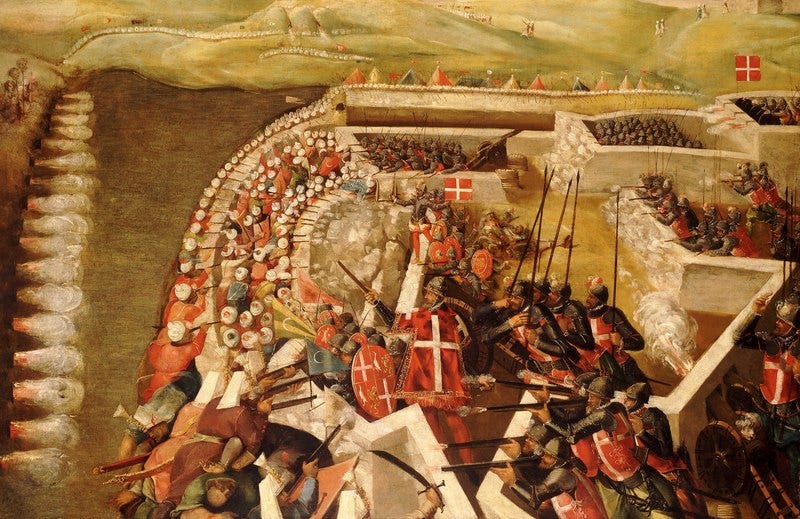
The Great Siege of Malta took place from May 18 to September 8, 1565, when a massive Ottoman armada under Sultan Suleiman the Magnificent attempted to conquer the island of Malta, then the headquarters of the Knights Hospitaller. The Ottomans sought to eliminate this Christian military order that had long harassed their shipping and posed a strategic threat in the central Mediterranean.
The invading force was enormous: around 180-200 ships carrying 30,000 to 50,000 soldiers, including elite Janissaries, supported by admirals like Piyale Pasha and the famed corsair Turgut Reis (Dragut), with Mustafa Pasha commanding the land operations. In contrast, the defenders numbered only about 6,000 to 9,000 in total. There were roughly 500-600 Knights of the Order, along with Spanish, Italian, and Maltese soldiers, local militia, and civilians who fought alongside them. Grand Master Jean Parisot de la Valette, a seasoned and devout leader, commanded the defense with unyielding resolve.
The siege began with the Ottomans targeting Fort St. Elmo at the entrance to the Grand Harbour, hoping for a quick victory. Despite relentless bombardment and assaults over weeks, the small garrison held out heroically until early June, inflicting heavy casualties (including the death of Dragut) before the fort finally fell. The Ottomans then turned to the main strongholds: Fort St. Angelo in Birgu and Fort St. Michael in Senglea. The fighting was brutal with close-quarters combat, mining and counter-mining, fire ships, and constant artillery duels in the scorching summer heat. The defenders endured starvation, disease, and overwhelming odds, yet they refused to surrender, often fighting to the last man in key positions.
Throughout the ordeal, faith played a central role. Grand Master de la Valette and the Knights placed their trust in divine protection, particularly through the intercession of the Blessed Virgin Mary. The miraculous icon of Our Lady of Philermos, the Order’s most sacred relic, was venerated fervently; accounts record a pure white dove resting upon it for hours during the siege, seen as a heavenly sign of impending victory. The Maltese people joined in ceaseless prayer, processions, and devotion to Mary. Reports from the time describe luminous apparitions and other signs that bolstered morale amid despair.
As September approached, the Ottomans launched desperate final assaults but were repelled with staggering losses. On September 8, the Feast of the Nativity of the Blessed Virgin Mary, a relief force of Spanish and Italian troops finally arrived from Sicily. Mistaking the reinforcements for a larger army, Mustafa Pasha ordered a retreat. The Ottoman fleet withdrew, leaving behind tens of thousands dead or wounded.
5. Siege of Belgrade
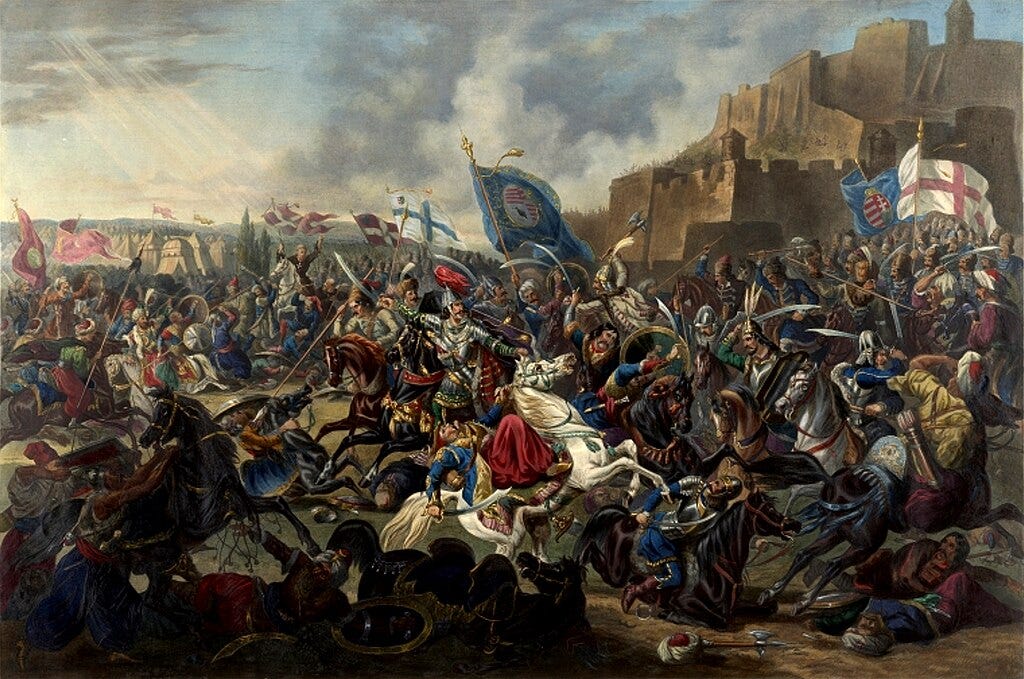
The Siege of Belgrade took place from July 4 to July 22, 1456, when the Ottoman Empire under Sultan Mehmed II laid siege to the strategic fortress city of Belgrade in the Kingdom of Hungary. Fresh from his conquest of Constantinople in 1453, Mehmed aimed to break through the Hungarian frontier and open the path for further advances into Central Europe, threatening the heart of Christendom.
The Ottoman army was immense: estimates place it at 60,000 to 100,000 troops, including elite Janissaries, supported by a fleet of 200–300 vessels on the Danube and a formidable artillery train of 200–300 cannons including 22 massive bombards.
In stark contrast, the defenders numbered far fewer. John Hunyadi, the legendary Hungarian general and voivode of Transylvania, had personally strengthened Belgrade’s fortifications and garrisoned it with about 7,000 men under his brother-in-law Michael Szilágyi. Hunyadi himself led a core professional force of 10,000–12,000 cavalry and infantry, supplemented by a remarkable volunteer “crusader” army of 30,000–60,000 mostly peasant fighters, poorly armed but fired with religious zeal, mobilized by the charismatic Franciscan friar St. John of Capistrano.
Pope Callixtus III had proclaimed a crusade, granting indulgences and calling on all Christendom to pray for victory. He ordered church bells rung daily at noon to summon the faithful to the Angelus prayer on behalf of the besieged, an observance that would later become a permanent tradition in Catholic churches. Capistrano preached tirelessly across Hungary, Germany, and Poland, inspiring ordinary people to take up arms in defense of the faith.
The siege began with Ottoman bombardment and a naval blockade of the Danube. On July 14, Hunyadi arrived with a flotilla of about 200 boats and, in a daring and bloody river battle lasting hours, broke the Ottoman blockade, sinking or capturing many vessels and resupplying the fortress, a feat widely regarded as providential.
Relentless assaults followed. Ottoman artillery breached sections of the walls, and on the night of July 21–22, Mehmed launched a massive general assault. Janissaries poured into the outer defenses and even parts of the city, spreading chaos as they began to plunder. In response, Hunyadi orchestrated a brilliant counterstroke: defenders hurled flammable materials (tar-soaked wood, sulfur, bacon, and pitch) into the breaches and moats, igniting massive fires that trapped and incinerated thousands of Ottoman troops. Amid the inferno, a spontaneous and ferocious Christian counterattack erupted, led in part by Capistrano’s crusaders shouting cries of faith, overrunning the enemy positions and driving them back in savage hand-to-hand combat.
The Ottoman lines collapsed. Mehmed, reportedly wounded, ordered a retreat. The besiegers fled in disarray, leaving behind enormous casualties while Christian losses, though heavy, were far fewer. The victory shattered Mehmed’s momentum and preserved Hungary and much of Central Europe from immediate Ottoman conquest for decades.
Across Europe, the triumph was hailed as miraculous. Contemporary chroniclers and papal correspondence attributed the deliverance to divine intervention through fervent prayer, the intercession of the Blessed Virgin Mary, and the heroic zeal of the faithful. Pope Callixtus III, upon receiving news of the victory, ordered the Feast of the Transfiguration observed universally in thanksgiving.
I had a feeling the siege of Belgrade would be there. I mean if something is commemorated to this day, almost 600 years later (even though most people probably don't know the reason), it is sure to be more than noteworthy.
I would personally also add the 17th century battle of Vienna and Sobieski's grand entrance, but since it's just five events, I guess that's for another time.
Those battles are all awesome! I read Siege of Malta every few years, again and again. But... there are 100s if not 1000s of amazing epic singular stories of Knights and the formation of Chivalry against the backdrop of default paganism, hedonism, slavery, torture, butchery, where the Church changed the World!!!
No other realm had such warriors, with such moral codes!
And today, the Templars are treated like they were Muslim enslaving slave raiders.
The World hates Jesus and anything that smells of it!
Expect nothing but hatred and contempt from them and their Grammy participant bards and court jesters.