


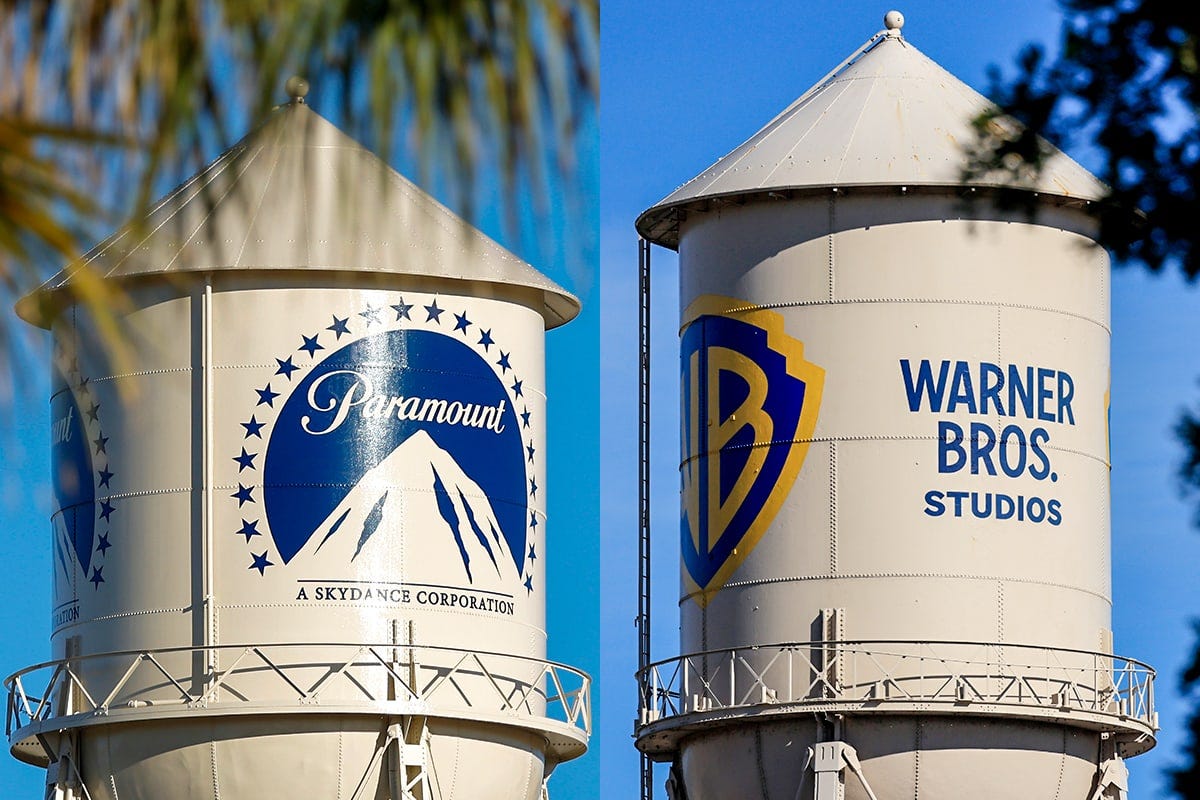
Paramount Skydance’s $110 billion acquisition of Warner Bros. Discovery hit its biggest legal obstacle yet on July 13, when a coalition of 12 state attorneys general filed suit to block the merger before it closes. California Attorney General Rob Bonta led the filing, joined by Arizona, Colorado, Connecticut, Massachusetts, Minnesota, Nevada, New Jersey, New Mexico, New York, Oregon and Washington.
Every one of those 12 states voted Democrat in the last presidential election.
The lawsuit, filed in the U.S. District Court for the Northern District of California, argues the merger would let a combined Paramount-Warner Bros. control nearly a third of wide-release theatrical film distribution and nearly a third of basic cable programming. Bonta’s office says the deal would leave three distributors controlling 75 percent of theatrical films nationwide. The states asked Paramount and Warner Bros. to pause the deal voluntarily while the case proceeds. If the companies refuse, the coalition says it will seek a temporary restraining order.
Here’s the part that undercuts the “we’re just enforcing the law” framing: the U.S. Department of Justice, under the Trump administration, already reviewed and cleared this merger. So did multiple foreign regulators. Bonta’s lawsuit isn’t stepping into a regulatory vacuum. It’s trying to override a decision the federal government already made.
Bonta made the political angle explicit himself at a press conference near the Hollywood sign. “Antitrust enforcement is a check on billionaires currying favor with the president so he’ll do their bidding,” he said. He also repeatedly cited the Ellison family’s ties to President Trump, noting that Paramount Skydance CEO David Ellison attended Trump’s State of the Union address and that his father, Larry Ellison, has donated tens of millions of dollars to pro-Trump groups.
Paramount’s response was blunt. A company spokesperson said the lawsuit “in the most generous light, reflects a fundamentally flawed application of the antitrust laws and is wrong on both the facts and the law.”
This fight has been running since last year. Warner Bros. Discovery originally had a competing, all-cash merger agreement with Netflix, amended in January to sweeten the terms after Paramount’s unsolicited bid put pressure on the board. Paramount ultimately won out. Now Netflix, having lost the bidding war, is reportedly exploring adding live TV channels to shore up its own declining viewership, a retreat toward the linear-cable model streaming was supposed to replace.
The financial stakes for Paramount are steep regardless of how the lawsuit plays out. The company has agreed to pay shareholders a 25-cent-per-share “ticking fee,” roughly $650 million per quarter, if the deal doesn’t close by its self-imposed September 30 deadline. A federal judge granting even a temporary restraining order could push the timeline past that date.
For a publication that covers what happens to DC Comics, HBO, and Warner IP, the outcome of this case determines who is actually setting creative direction at Warner Bros. for the next decade. Twelve Democrat attorneys general are asking a federal court to reverse a merger decision the Trump DOJ already made. If they win, on what legal theory do 12 state officials override a federal antitrust clearance, and what happens to Paramount’s deal with Warner Bros. shareholders if they do?
When genetic engineering nearly doomed the species, humanity made a desperate bargain: let the frontier do what nature intended. In a harsh universe, these cadets have to make impossible decisions. Read Space Fleet Academy today.

NEXT: Moana Got Cultural Consultants, Yet The Odyssey Got Mocked For Fans Wanting Greek Actors
Torn on this one.
Media conglomeration needs to stop. It's ultimately a very bad thing for consumers with centralized power easily controlled and exploited.
I am against this merger on principle.
However, we all know these buttwipes are actively trying to sabotage this merger so that Netflix can swoop in and buy Warner Brothers. Suddenly, all of their objections would just melt away.
That would be catastrophically bad.
While I don't like it, I like the alternative even less.
And by the way, where were these objections when Disney bought Fox? That was far worse in regards to monopoly building, but strangely that was OK because the "right" kind of people won. Disgusting hypocrisy.
Hollywood has chosen to destroy themselves over pettiness and spite than to be saved or salvaged by chuds. Hollywood is committing suicide because they rather die on their own activist swords (Martyars) than admit fault.
Let them burn.