


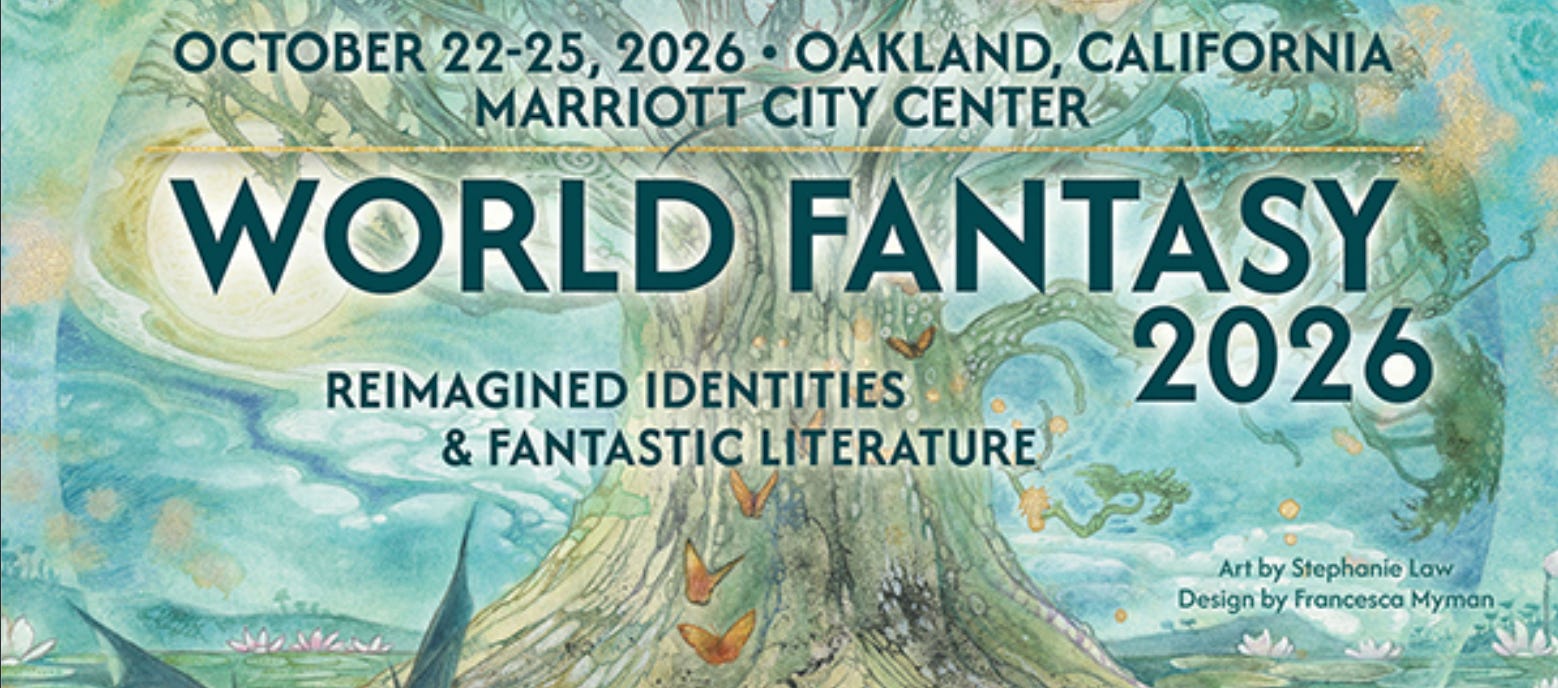
The World Fantasy Convention opens in Oakland on Oct. 22, and its program reads like a convention that remembers what it is for. Robin Hobb, Robert Silverberg and Joe Haldeman are on the schedule, and most of the roughly 50 panels, talks and interviews are about how books get written, edited, designed, sold and collected.
Contrast that to Worldcon (the World Science Fiction Convention) that tagged 101 of its panels “Inclusivity” and returned zero results for “Christian.” The two conventions drew up their schedules for the same genre, and they landed in very different places.
Hobb, Silverberg and Haldeman Fill Saturday
Robin Hobb has four slots on the schedule. On Friday at 1 p.m. she holds a kaffeeklatsch limited to ten seats. Saturday opens with a 10 a.m. panel, “Transformation: Wouldn’t You Rather Have a Talking Frog?”, built around a simple question about the trope: “People are magicked into becoming a bird, a rat becomes human; some even prefer their new state of being.” The 3 p.m. hour lists her twice, for a reading and for a sword-and-sorcery panel with Steven Boyett, Ellen Kushner and Madeleine Robins on Robert E. Howard’s Agnes the Sword Woman.
Saturday afternoon belongs to the veterans. Robert Silverberg is interviewed by Richard Wolinsky at 3 p.m., and Joe Haldeman sits down with Wolinsky at 5 p.m. Haldeman returns Sunday at 10 a.m. for a panel on speculative poetry alongside poet guest of honor Linda Addison. Silverberg and Haldeman each get an hour of conversation with no signing line attached, so the room is there to hear them talk.
The rest of the bill is stocked the same way. Peter S. Beagle holds a kaffeeklatsch on Friday and Kim Stanley Robinson reads Saturday. Tad Williams, Nancy Kress, Karen Joy Fowler and Cecelia Holland take the historical fantasy panel, and Paolo Bacigalupi, Ellen Datlow and Sharon Shinn are all programmed. A convention that books working novelists and editors at this density has earned credit for it.
A Program Built Around the Book as an Object
The panel list reads like a working writer’s syllabus. “Mapping Fantastic Worlds, Or Why Are Those Mountains There?” asks:
“What’s with the chasm of knife-sharp rocks? Is that a lake or just a stagnant mere? Why is there an impenetrable forest?”
“Fantastic Food – Can your Army March on its Stomach?” covers provisioning an elvish army and keeping magical librarians fed through the winter. “Red Ink is Our Medium: Editing as an Art Form” puts Ellen Datlow and Nick Mamatas in a room to discuss a relationship that “can be a match made in heaven, or a deal with the devil.” Saturday adds a panel on John Crowley’s Little, Big that asks what makes a classic, a swordplay demonstration for fiction writers and a session on cover design called “The Cat on the Cover Made Me Buy It!”
The book trade gets its own hours. “Brick & Mortar in the 21st Century” brings in DreamHaven Books and Dark Carnival to explain what keeps specialty stores open. A librarians’ panel asks why people collect books, a magazine panel with the editors of Weird Tales and F&SF covers the role of magazines, and the American Bookbinders Museum runs two hands-on workshops where attendees bind a book. Friday night ends with a mass autographing session open to every published author.
The convention has a theme of its own, “Reimagined Identities & Fantastic Literature,” and some panels follow it. “Fantasy and Horror Writing: An Act of Resistance” takes on fascism and nationalism, and “Anti-Imperialist Themes in 21st Century Fantasy and Horror” opens with this:
“Though fantasy and horror historically often skewed towards a conservative longing for a ‘time that never was,’ many of the 21st century’s most exciting and engaging works have had strong anti-imperialist themes.”
By the descriptions, about six of the roughly 50 programmed items take identity or politics as their subject. The rest are about craft, books and the people who make them.
Worldcon’s Schedule Went the Other Way
Fandom Pulse reported that Worldcon 2026 tagged 101 panels “Inclusivity,” while a search of the full program schedule for “Christian” returned zero results. The panels behind the tag include “Let’s Get Physical: Positive Body Representation in SFF,” “Time-Traveling Lesbians Save the Universe,” “Decolonizing D&D” and “Reading Is Political: SFF as Political Conversation.” The last of those states its premise in the title.
Neither convention schedules a Christian fantasy panel. The difference is what fills the schedule around that absence. Worldcon’s program carries an identity tag and fills 101 slots under it. World Fantasy’s fills its hours with the work: maps, food, editing, cover design, bookstores and collecting.
The same names show up on both. Annalee Newitz appears on Worldcon’s program and also joins Ted Chiang at WFC on “What Are We Going to Do about AI?”, a panel with this stated goal: “to explain/dispel common myths about LLMs and to have experts discuss rewarding human creativity in an age of generative slop.” Newitz is the same author in both places, and the two programs ask her to talk about different things.
If a convention can fill most of its schedule with editing, cover art, map-making and bookselling, why did Worldcon need 101 panels tagged Inclusivity?