


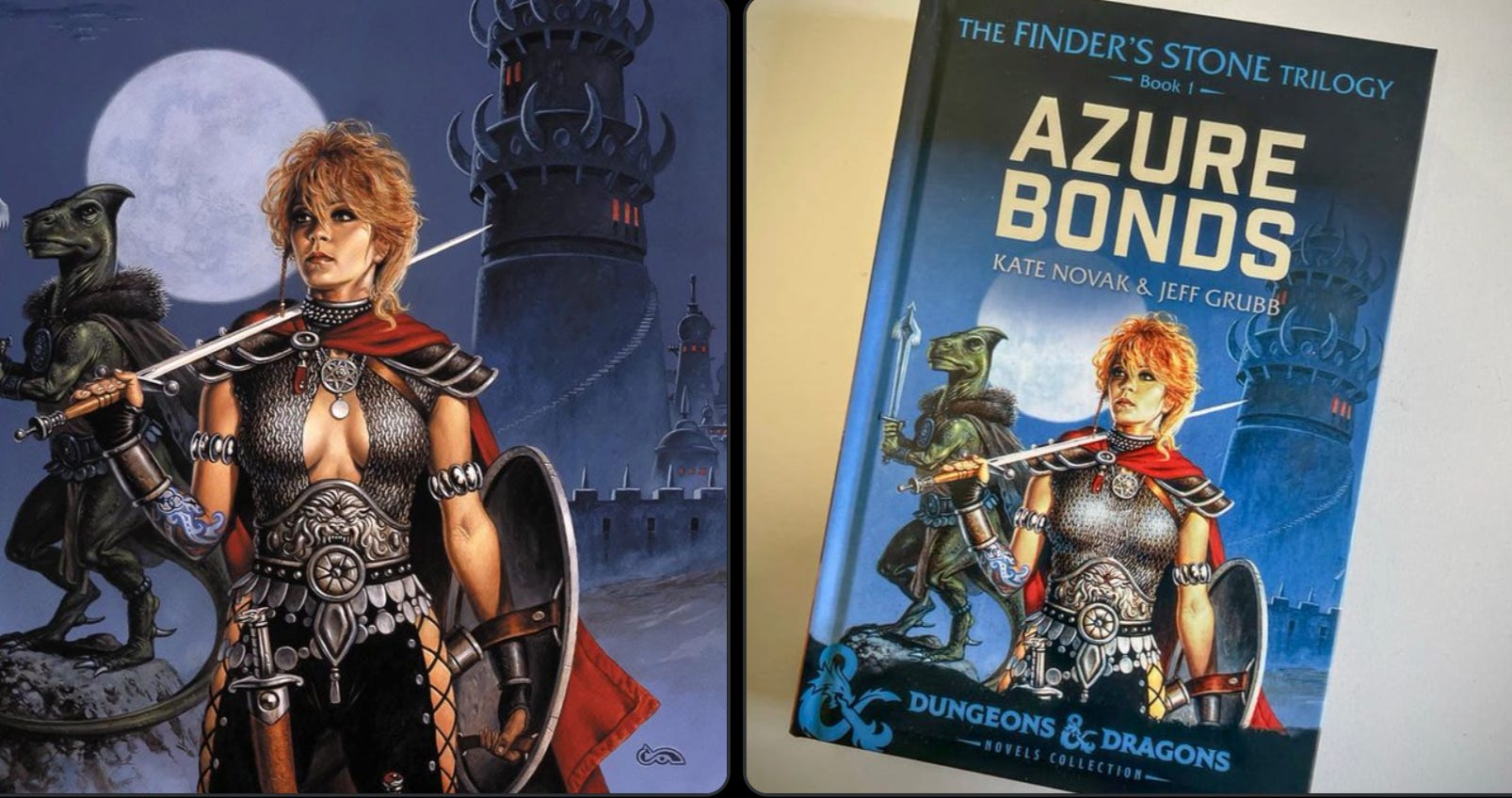
Somebody closed up Alias’s chainmail, and nobody will say who. Hachette Partworks’ new 2026 reissue of the Dungeons & Dragons novel Azure Bonds alters the 1988 cover painting, and neither the publisher nor Wizards of the Coast, which owns D&D, has explained who made the call or why. The one person with a right to an opinion had stayed quiet until this week. Clyde Caldwell painted that cover, and what he told a fan journalist changed the tone of the whole story.
The Side-by-Side Nobody Asked For
The reissue is part of Hachette Partworks’ D&D Novels Collection, a hardcover series that ships two books a month. On September 24, the D&D blogger NewbieDM posted a comparison of the original Azure Bonds cover and the new one. The Adventurous Dad and Daughters blog documented the same change that day.
The 2026 cover keeps the composition, with a little cropping and a shift in levels. It loses the open neckline on Alias’s armor. The blog’s author said his daughters preferred the revised image and called it interesting that publishers thought tastes had changed enough to revise it. Nobody involved in the decision has described it in those terms or any others.
The painting had been touched once before. Jeff Grubb, who wrote the book with Kate Novak, asked Caldwell to make Alias’s tattoo all blue and her hair a little redder before the cover went to print. That revision went through the artist. Whether anyone asked Caldwell this time is the question the public record cannot answer.
What Caldwell Said
Then the DaveCon account got him on the phone. Before releasing the message on the Nerdcognito podcast, DaveCon said, “I talked to Clyde Caldwell today about the altering of his art and he is decidedly not happy.”
Caldwell’s message to DaveCon reads in full:
I was actually surprised that they reused my old art for that one. One reason that I retired when I did was that the publishing industry, especially the book publishers, were all getting too politically correct for me. When I visited the Frazetta museum quite a few years back, I was surprised to learn that publishers back in the 70s were complaining that Frazetta’s females were too sexy. Frazetta has always been my favorite fantasy artist, and his work was a huge inspiration to me. I guess fantasy art just isn’t what it used to be.
All the best,
Clyde
Caldwell left TSR in 1992 to freelance and is now retired in Wisconsin. His TSR work includes the 1990 Ravenloft boxed set cover and the cover of Dragon Magazine issue 172. A Kickstarter for his art book, The Art of Clyde Caldwell Legacy Anthology, closed in April. His letter says he retired partly because book publishing had become too politically correct for him. Then the same politics reached back and altered the painting he left behind.
A Record Six Years in the Making
Fans did not need the Caldwell statement to see where this fits. In July 2020, Wizards added a legacy content disclaimer to older TSR titles sold through the DMs Guild. The notice said some older material reflected ethnic, racial and gender prejudice that was commonplace at the time, and that “These depictions were wrong then and are wrong today.” The addition followed a Twitter post from Asians Represent podcast co-host Daniel Kwan criticizing the treatment of Asian cultures in Oriental Adventures. Wizards kept selling the books and attached the moral verdict to every one of them.
Kyle Brink became the face of the attitude behind it. In February 2023 he was quoted saying, “People like me can’t leave the hobby fast enough.” That same January, Wizards had dropped its planned OGL 1.2 license after community resistance. According to Axios, 88 percent of the 15,000 people who had submitted feedback said they would not publish under the new terms, and Brink said the volume and direction of the feedback forced the company to act. Fandom Pulse reported in July 2024 that Brink was out at Wizards.
The Gygax controversy came next. The Making of Original Dungeons & Dragons 1970-1977 is a Wizards-published history. Senior designer Jason Tondro wrote in the preface, “Some language in the first iteration of D&D presents a moral quandary.” Jon Peterson’s foreword described the original game as created for and sold to a wargaming community that was almost exclusively white, middle-class men. Fandom Pulse reported that Tondro’s writing called Gary Gygax misogynistic. Early D&D author Rob Kuntz responded that the book’s treatment of him and his colleagues was “slanderous.” A company built on the work of Gygax, Dave Arneson and Kuntz had published a book cataloguing their moral failings.
The 2024 core rulebooks followed. Fandom Pulse reported that the Dungeon Master’s Guide imported the safe-space practices of the BDSM fetish community, including a signal where a player crosses their arms in an X and the DM must stop the game. The Player’s Handbook filled its art with BIPOC and female characters at a ratio above five to one against white male characters. One playable race lost its slavery-tied history entirely, and official art showed a family of orcs as Mexican immigrants. Elon Musk publicly asked how much Hasbro would cost, a question Fandom Pulse covered.
Dark Sun Arrived First
Only weeks before the Azure Bonds edit surfaced, Wizards confirmed at Gen Con 2026 that Dark Sun is returning for D&D 5.5E, with a 2027 release and a Season of Survival launching in February 2027. Dark Sun was a 1991 TSR setting designed by Timothy Brown and Troy Denning, and its look owes much to the artist Brom. Wizards had said previously that it would not revive the setting because the content was problematic.
Executive producer Greg Bilsland told TTRPG Insider the team invested more deeply in sensitivity readers for Dark Sun than for other settings. He said a setting does not need slavery to be oppressive, and pointed to the city of Urik, where the leadership presses people into military service and pushes the poor to give up their freedom to survive. The original lore includes slavery, genocide and torture, and the new version is being built around a different kind of oppression.
The Fan Response
Nerdcognito, the podcast that read Caldwell’s statement, answered with a call to action for fans: “ICYMI: Wizards of the Coast is still TALKING a good game, but their ACTIONS... Censorship, sensitivity readers, and destruction of lore... tell a different tale. The latest example: One of these things is not like the other.
Not a single GP more, until crap like this STOPS.”
Caldwell’s letter ties the Azure Bonds edit to a history older than Wizards. He says publishers in the 1970s were already complaining that Frank Frazetta’s women were too sexy. The paperback covers that built the TSR look came from that era of fantasy painting, and Hachette is now reworking one of them 38 years after it first shipped.
Every item above has a defender who says it is a small adjustment. A disclaimer is a paragraph. A closed neckline is a crop. A conscription system is a plot device. Fans keep a longer ledger, and it now has a living artist’s name on the latest entry.
Hachette plans to ship two novels a month from a catalog full of covers painted in the same era as Azure Bonds. If Wizards will not say who approved the edit to Caldwell’s painting, what happens to the next cover?