


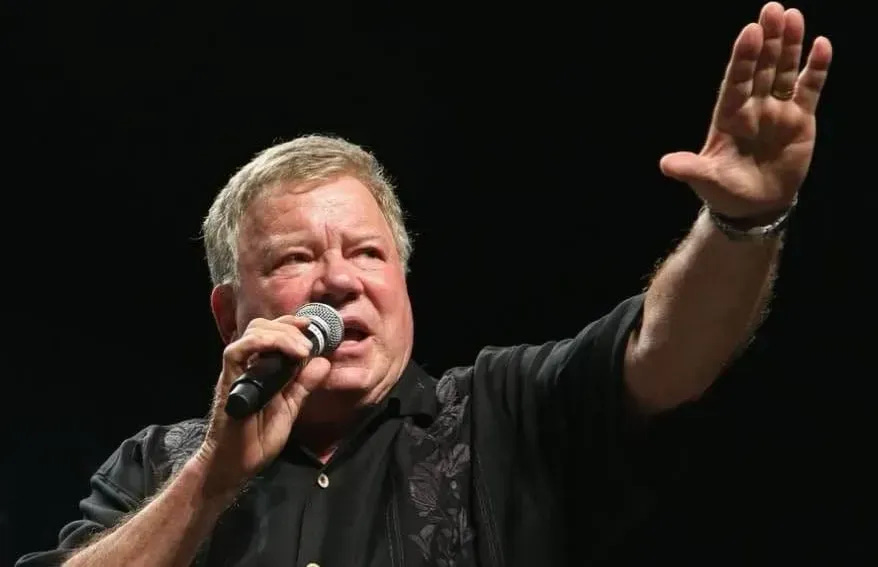
William Shatner is 94 years old. He’s been to actual space. And now he’s releasing a heavy metal album featuring covers of Black Sabbath and Judas Priest.
The new album will feature collaborations with metal musicians personally selected by Shatner. He’s calling it “a gathering of forces.” The album will include covers of Black Sabbath, Judas Priest, and Iron Maiden, alongside new original material.
“Metal has always been a place where imagination gets loud,” Shatner said. “Each artist brings their fire, their precision, their chaos. I chose them because they have something to say, and because metal demands honesty.”
For those who don’t know, Shatner doesn’t sing. He never has. His vocal style is art spoken word, part performance art, delivered with the intensity of a Shakespearean actor interpreting rock lyrics as soliloquies.
He’s made self-deprecation about his “singing” a core part of his public persona. He’s in on the joke, but he’s also serious about the work. That balance is what makes his music compelling rather than embarrassing.
Has Been and the Ben Folds Collaboration
Has Been (2004) was the album that proved Shatner’s musical projects could be more than novelties. Produced by Ben Folds, the album featured collaborations with Joe Jackson, Aimee Mann, and Henry Rollins. The songs dealt with aging, loss, and the passage of time.
Folds understood what Shatner brought to the table. He built arrangements around Shatner’s spoken delivery, creating musical landscapes that supported the theatrical performance rather than fighting against it.
The title track, “Has Been,” is a meditation on fame and relevance. Shatner delivers the lyrics with self-awareness and vulnerability. “It Hasn’t Happened Yet” features Henry Rollins and deals with mortality. “I Can’t Get Behind That” is a rant about modern annoyances, delivered with Rollins providing counterpoint.
Critics noticed. Has Been received positive reviews, establishing that Shatner’s music was worth taking seriously.
Space Odyssey
Shatner followed with Seeking Major Tom (2011), a concept album about space exploration featuring collaborations with Peter Frampton, Bootsy Collins, and Patrick Moraz. The album’s centerpiece is a cover of David Bowie’s “Space Oddity,” reimagined as a conversation between Ground Control and Major Tom.
Then came the real thing: his actual trip to space aboard Blue Origin’s New Shepard rocket in October 2021. At 90 years old, Shatner became the oldest person to travel to space. His emotional reaction upon returning—captured on video as he tried to articulate what he’d experienced to Jeff Bezos—was raw and genuine.
“What you have given me is the most profound experience,” Shatner said, visibly shaken. “I hope I never recover from this.”
He later described the experience as overwhelming and terrifying. The beauty of Earth contrasted with the “ugliness” of space affected him deeply.
At 94, Shatner is still creating and willing to try things that might fail spectacularly. He’s not coasting on Star Trek residuals and convention appearances. He’s actively pursuing new projects, collaborating with younger artists, and exploring genres that most people his age wouldn’t touch.
The self-deprecating humor helps. Shatner knows his vocal style is unconventional. He knows people make fun of it. He’s made peace with that and uses it as part of his appeal.
“I’ve spent a lifetime exploring in both reality and fiction,” Shatner said. “Now I am stepping out into the unknown once again with my new project in heavy metal… The whole project is destined for this year. I hope you will join me in the exploration.”
For a 94-year-old who’s already been to space, recording a metal album probably feels like a relatively safe adventure.
What do you think? Is Shatner’s theatrical spoken-word style a legitimate artistic choice, or is it a novelty that happens to work occasionally?
For a great alternative to mainstream publishing, with sci-fi spy thriller action, read The Stars Entwined on Amazon!

As a metal fan, I really appreciate this. There are surprises like this here and there, which pop up unexpectedly. The great Christopher Lee used to collaborate with metal bands as a narrator and singer (and apparently got a heavy metal award for his own album). It was really something to hear his deep voice in songs.
One of my favorite Shatner moments of all time was when he kept mispronouncing "sabotage" and got increasingly annoyed when they corrected him.