


Will Murray, one of the pulp fiction community’s most prolific writers and its foremost living historian, died earlier this week at age 73. Matt Moring of Steeger Books announced Murray’s death on Facebook Friday morning.
Murray had been active in pulp fandom since the early 1970s. He edited and largely wrote the fanzine Duende from 1975 to 1977, and The Duende History of The Shadow Magazine, which he co-authored, remains a foundational text in Shadow scholarship. His breakthrough came in 1978, when a visit to the La Plata, Missouri home of Doc Savage creator Lester Dent turned up the outline for a Dent story that had never been written. Murray built a novel from it, Python Isle, published in 1991 under the Kenneth Robeson house name. It launched more than 20 new Doc Savage adventures written by Murray. He had served as literary agent for the Dent estate since 1979, and went on to write authorized continuations of The Spider, Tarzan, and King Kong under their respective house names or estates. He had recently completed a story featuring Robert E. Howard’s El Borak for an upcoming Howard-inspired anthology.
Beyond Doc Savage, Murray built a bibliography of more than 75 novels, contributing extensively to The Destroyer and The Executioner series, and writing short fiction featuring Superman, Batman, Spider-Man, Sherlock Holmes, the Phantom, the Green Hornet, Zorro, Honey West, and the Cthulhu Mythos. He was widely regarded as one of the top authorities on 20th century pulp fiction. Pulpcon awarded him its Lamont Award in 1979, when he was 26.
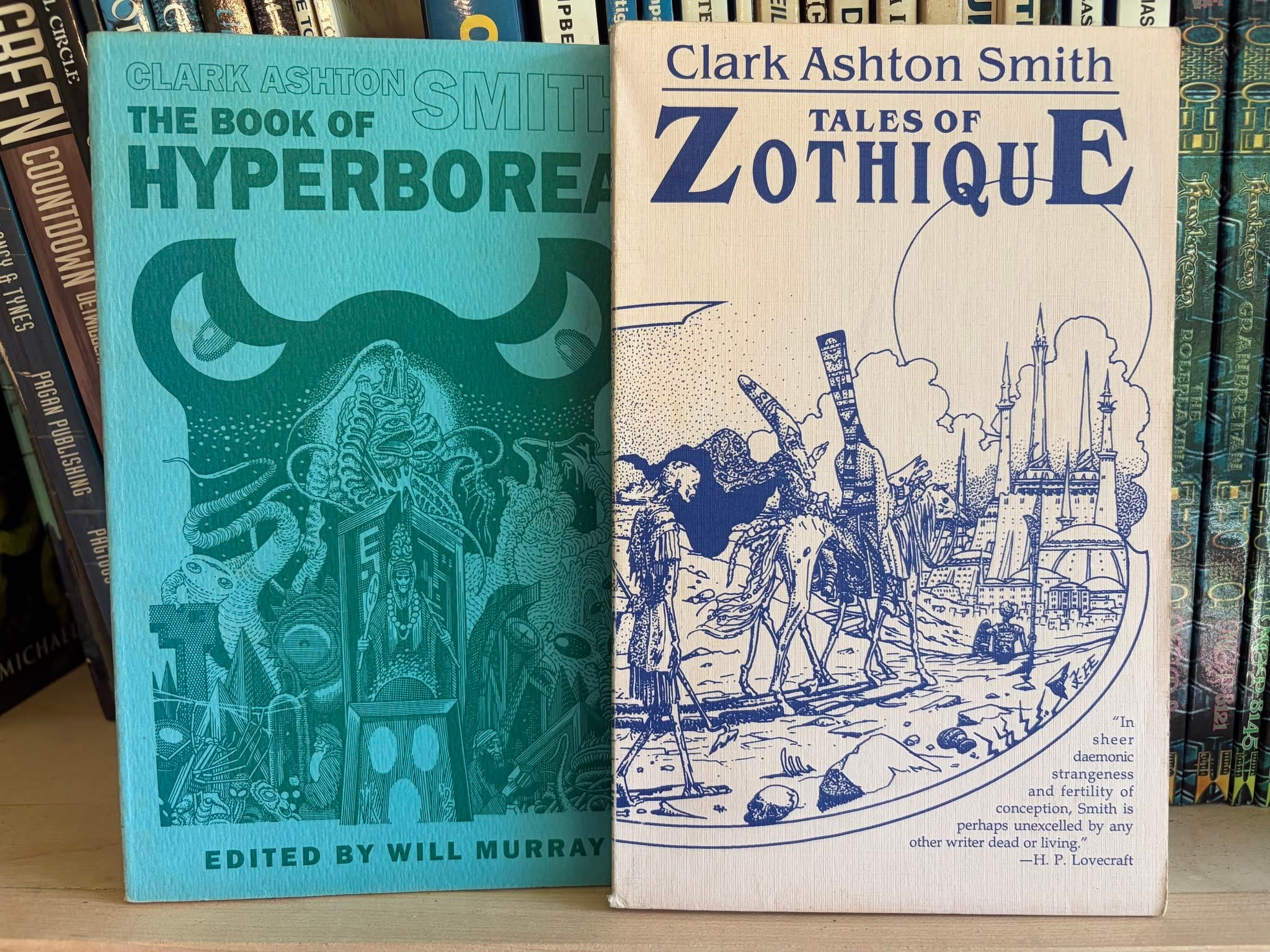
Genre readers with an interest in Clark Ashton Smith know Murray’s editorial work directly. In 1995, he co-edited Clark Ashton Smith’s Tales of Zothique with Steve Behrends for Necronomicon Press, organizing Smith’s Zothique cycle stories in chronological order of original publication. Necronomicon Press followed in 1996 with The Book of Hyperborea, gathering Smith’s Hyperborean cycle. Both books served for years as the standard editions of Smith’s two best-known story cycles before newer collections arrived.
In comics, Murray co-created Squirrel Girl with artist Steve Ditko for Marvel Super-Heroes vol. 2 #8 in 1991. Murray wrote the character’s origin story without an artist attached, originally intending to work with Tom Morgan before requesting Ditko. Ditko added the character’s signature knuckle spikes, a detail not in Murray’s script. Murray later described the character’s genesis in his own words:
“Actually I created Squirrel Girl in script form without any artist input. Tom Morgan was originally going to draw it, but when he dropped out, I requested Ditko and got him. Ditko did a great job in bringing my baby to life. He invented that knuckle spike. It wasn’t in the script. I based Squirrel Girl ironically enough on a long–ago girlfriend who read comics and was into “critters”—wild animals of all types. Coincidentally, she was a big Ditko fan. I think I got the idea because I had a bunch of squirrels running around my roof and sometimes coming in through my open bedroom window and inspiration struck.”
Squirrel Girl went on to become a recurring Marvel character with her own ongoing series decades after that 1991 debut, and Murray returned to write a story for her in 2016.
Murray grew up in Boston, graduated from North Quincy High School in 1971, and went on to graduate summa cum laude from the University of Massachusetts at Boston. He remained a fixture at PulpFest and its predecessor Pulpcon for decades, appearing as a dealer, panelist, and in 2013 as guest of honor. His most recent PulpFest appearance came on August 1st, 2026, on a panel titled “Working With Licensed Characters.” He had contributed to every issue of The Pulpster, the convention’s program publication, from its first issue at Pulpcon 20 in 1991 through issue 35 released at PulpFest 2026 just weeks before his death.
Murray’s decades of work kept Doc Savage, The Shadow, and Clark Ashton Smith’s lost continents in print for generations of readers who came to them long after the pulp era ended.
RIP! Unbelieveble how many familiar/famous people die at the moment! Let alone people like you and me.
Sad! The man had an incredible output. I loved his Doc Savage, Shadow, G8 and his Battle Aces, and The Spider. I was unaware he wrote King Kong. I recall he also did a Zorro comic book which I enjoyed. He also wrote a Nick Fury novelization. I'm a big fan of the Don Pendleton EXECUTIONER but his novel, RED HORSE, is also very readable. He also wrote some great articles for RETRO FAN magazine, a magazine that the readers of FANDOM PULSE would likely enjoy (particularly The Boomers and Generation Jones). RIP.