


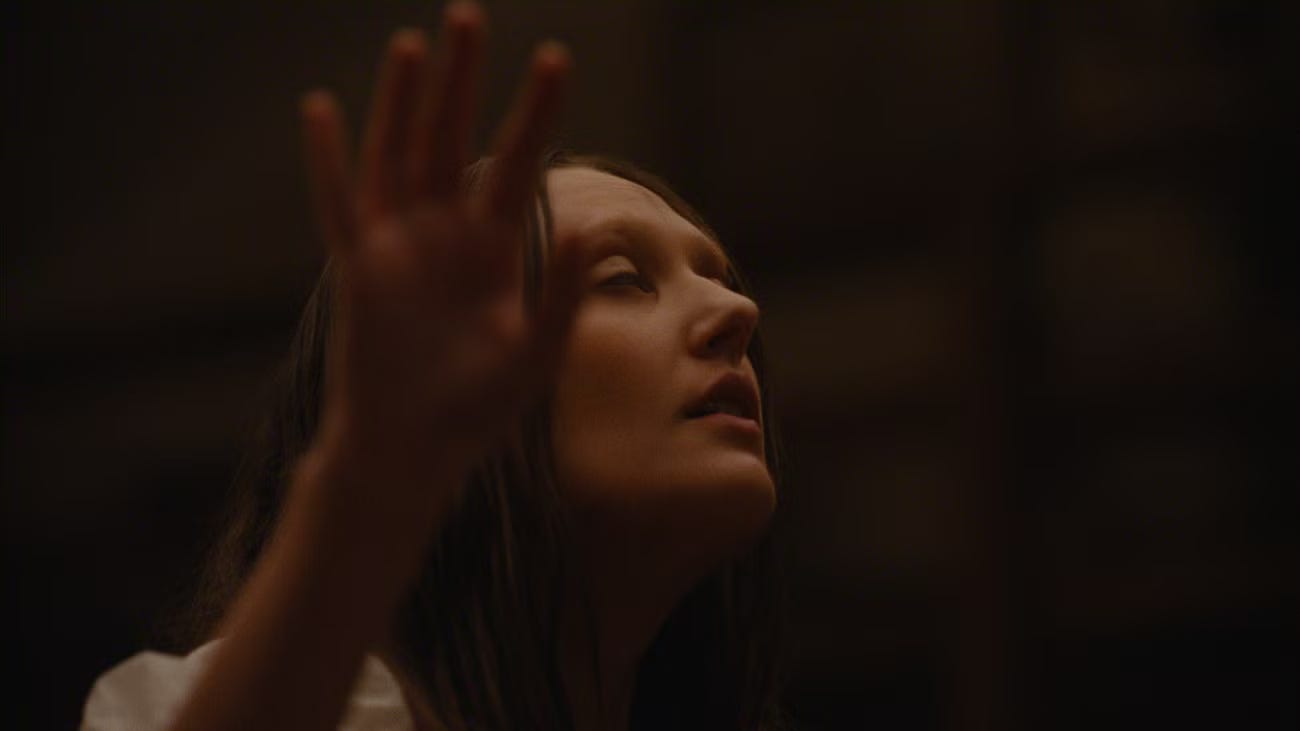
Every girl on the St. Mark’s dance team agrees about what happened in the abandoned convent on Halloween night, 2004. They agree it was a joke. They agree nobody was supposed to get hurt. Then the new girl stops waking up.
Netflix released The Body on November 11, all eight episodes at once. Within a week, more than 117,000 people had signed a petition calling it anti-Catholic, and X was arguing about who the show was for. The petition went up before anyone could watch the series, which gave Netflix’s defenders an easy answer. The people who did watch it, including the ones who liked it, describe the same material. Their reviews make a better case than the petition does, and the case starts with what the girls were joking about.
Per the reviews and recaps, the “joke” was a ritual. The dance team had been taking ecstasy at a party in the convent, which the students call Devil’s House, and they offered the new recruit, Grace, to Satan as a sacrifice. One review calls it a prank staged so the team could make Regionals. Empire’s review describes the whole scene as a satanic ritual performed jokingly on drugs. TV Insider calls the show a mix of Mean Girls and The Crucible that delivers “sex, drugs, and blasphemy inside a Catholic school.” TV Insider is a listings and promotion outlet, so the word “blasphemy” is not a petitioner’s choice. It is a friendly trade’s own summary.
The convent matters. A convent is where women gave their lives to God, and the series uses an abandoned one as a party house named for the Devil. The cross and the Mass are the show’s visual vocabulary. Episode titles include “Jesus, Literally” and “Unholy Thoughts.” The show takes sacred places and objects and sets them next to ecstasy and desire, then asks the viewer to find the result thrilling. Empire says one early scene, the troupe convulsing to a choir version of a pop song, “borders on euphoric, practically divine.” The review makes clear the divinity belongs to the dancers.
The institution gets a different treatment. According to one review, the priest and school principal, Father Franklin, whom the girls call Daddy Franklin, is a stoic nearing his breaking point as he tries to manage the girls and the church’s growing zeal. He is played by Nnamdi Asomugha. Another review describes a town in religious panic, awash in teen hormones and relentless guilt.
Put those together and the structure is clear. The Church in this show supplies the panic. Its priest is overwhelmed, its nuns watch girls lie, and its guilt feeds the hysteria. A faithful reader will recognize the zeal as a real failing, and a serious drama could treat it as one. This one treats it as the engine of the plot.
The show also tells you what to think of religious experience. By the recaps, a girl named Elise pretends to see the comatose Grace on the cross, then fakes a seizure during Mass. Father Franklin and a nun know she is lying, and her story convinces the dance team that Grace has returned to haunt them. Another character, Lisbeth, whom the show nicknames Slutty God, claims the ritual worked when it did not. The recap for episode 5 is titled “Faking It.”
So the visions are lies and the ritual is a performance. A show that wanted to honor faith could still include fraud, since believers know the difference between a miracle and a performance. This one puts the fraud at the center, in the church and at Mass, and surrounds it with sexual awakening. One critic praised the series for “the kind of ecstatic faith that cults are built on.” That critic liked the show, and the sentence is a compliment. It also tells you what the writing says religious faith is.
Quinn Shephard, who created the show, has said she wanted to revisit The Crucible and the Salem witch trials “with the shading of our current political climate.” The comparison deserves a close look. Arthur Miller wrote The Crucible to condemn a panic in which the religious authorities were the persecutors. The accusers acted in God’s name and the damage came from their zeal. A show built on that model takes on Miller’s cast. The Church plays the court, the hysteria is the fruit of belief, and the girls are both victims and manipulators.
The framework also tells you which political climate she means. Her phrase puts a school of Catholic girls in Salem’s place and asks the audience to see something happening now. If the answer is the Church, the series is a polemic. If it is something else, the show never says what.
Shephard has described the show three ways in public. In Netflix’s own Tudum, she called it “a raunchy teen psychodrama with a dash of Catholic horror.” The word “dash” matters. Catholicism supplies the seasoning, and the main dish is the raunch.
She has also said she has always been interested in girlhood as a religious experience. That sentence treats religion as a metaphor for something else, a way for a show to talk about girls, and makes no claim about God.
The third description is the one Netflix could not have written for her. In a Variety interview, she called the show “very faith-positive, but system-critical.” I’m giving the rest of that exchange as paraphrase because I have it secondhand. As reported to me, she called the series the perfect metaphor for a queer girl’s coming of age, with worshipful experiences that give life meaning followed by deep repression.
Put the three descriptions side by side and a pattern appears. The Church is a source of ecstasy and then of repression, a dramatic structure the show borrows. The “system” she criticizes is the institution that taught these girls to pray. Calling that “faith-positive” asks a believer to accept that the series respects faith because it admits faith feels good. The positive side, as she describes it, is the experience of worship. The negative side is the Church, which is what a Catholic means by the word.
The test of a “faith-positive” show is whether it contains a believer whose faith the series treats as true. The coverage points to none. The priest is exhausted and the nun knows a girl is lying. The girls fake visions or perform rituals as pranks. The town is hysterical. I found no character the reviews describe as sincerely devout whose prayer goes unmocked.
If viewers know of one, that character would change the argument. Without one, the show is a place where Catholic symbols are available and Catholic belief is not.
Netflix marketed the show with a joke about the faith. On November 11 its official X account posted “Pray hard. Sin harder. The Body is now on Netflix.” The post drew about 1.09 million views and 17,300 likes. The line took the show’s thesis and made it a sales pitch. Netflix’s social team did not stumble into those four words. It chose the pairing of prayer and sin because it expected the pairing to work, and it did, because the show delivers on it.
CitizenGO launched its petition on November 5, six days before release, addressed to Netflix content chief Peter Rice, with co-CEOs Ted Sarandos and Greg Peters copied. It accuses the series of defiling the faith of millions of Christian families. It cites rituals invoking the Devil, a mockery of the Mass and prayer, and All Saints’ Day promotional art with the characters dressed as mock saints. It passed 90,000 signatures by November 14, topped 110,000 by Wednesday morning, and stands above 117,000 against a 200,000 goal.
The petition has a weakness, and it is the same one critics have named. It was live before anyone could watch the show, and Forbes’ Paul Tassi has written that its backers miss major themes of the series. One outlet noted that the petition never mentions LGBT people anywhere in its text. Those are fair points about how the campaign was built.
They say little about whether the content matches what it describes. The reviews above answer that. The petition’s sharpest line, as it appears in coverage, says Netflix wants to teach a teenage viewer that “prayer leads to the Devil.” That is a compression, and a hostile one. It is also close to the structure of the premise, in which a team’s choir-backed ecstasy ends in an offering to Satan. A fair reader can reject the wording and still see where it came from.
The petition’s strongest move is its comparison. The Daily Mail quoted it asking whether Netflix would ever turn Muslim prayer, Hindu worship or Wiccan ritual into a “sex-and-Satan horror story for teenagers.” The question assumes Netflix would not. Netflix has not said whether that assumption is right, and the question is the one that carries the argument. A defender has to answer it with a reason a Catholic school is a different case, and the reasons on offer, that Catholicism is dominant or that the Church has history to answer for, are arguments for treating the faith with less respect than others.
Netflix has not issued a statement on the petitions, and I found no statement from the Church or from any bishop. The show is doing well. The series sits at 86 percent from critics on Rotten Tomatoes, reached the top ten in dozens of countries, and by your figures drew 5.1 million views in five days and reached third place on Netflix’s English-language TV list. A supporters’ petition asking for a second season has passed 19,000 signatures, according to one outlet.
The record shows how Netflix has handled this kind of fight before. For Cuties in 2020, it apologized within days, though only for the poster, and kept the film. For The First Temptation of Christ, a Brazilian Christmas special, a petition passed 2.3 million signatures and Netflix did not pull it. The pattern is quick regret when a broad audience is offended and firmness when the objectors are religious and the numbers are large but concentrated. Silence on 117,000 signatures tells you which category the company put this in.
Shephard calls the series faith-positive and system-critical. In a show where the visions are faked, the ritual is a prank, the priest is overwhelmed and the guilt drives the panic, what is the positive thing about the faith that she says the series respects, and where does it appear on screen?