


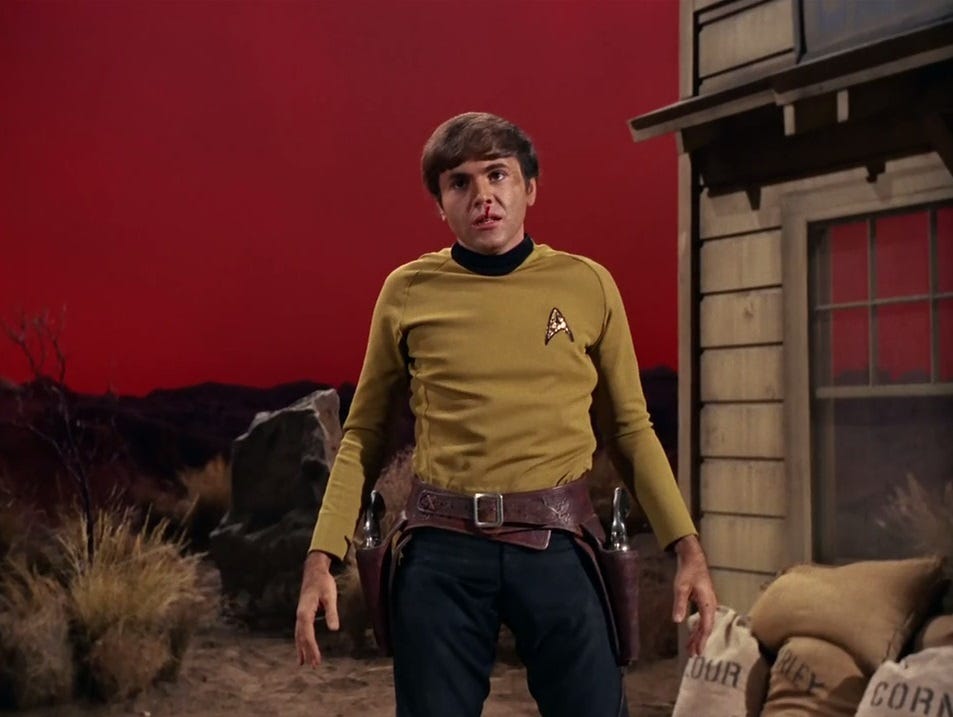
Walter Koenig called “Spectre of the Gun” the Star Trek episode he enjoyed doing most. With the man who played Chekov gone at 90, it seemed like the right time to sit down with it and see whether his favorite holds up. It holds up reasonably well, and it is nice to see Koenig get some love for it.
The Setup
“Spectre of the Gun” is season three, episode six, first aired October 25, 1968. Gene Coon wrote it under the name Lee Cronin, and Vincent McEveety directed. It was the first episode produced for the third season, the year the money got tighter and the sets showed it.
The Enterprise heads for Melkotian space to open contact. A warning buoy tells the ship to turn around, and Kirk ignores it. He beams down with Spock, McCoy, Scotty and Chekov, and a Melkotian voice condemns the landing party to death. The method will be drawn from Kirk’s own mind.
They arrive in Tombstone, Arizona, 1881, under a red sky. Their phasers have become revolvers. A newspaper is dated October 26, 1881, the day of the gunfight at the O.K. Corral, and the town takes them for the Clanton gang. Kirk is Ike Clanton. Scotty is Billy Clanton. Chekov is Billy Claiborne. The shootout starts at five o’clock, and nobody in town will let them walk away from it.
The Idea
The Star Trek pitch is that a Federation crew walks into a death trap designed to make them kill, and the test is whether they can refuse. McCoy and Spock try to build a gas grenade to put the Earps to sleep. It fails, and Spock concludes the whole town is an illusion with no reality behind it. He mind-melds the landing party and convinces them the bullets are only shadows. The Earps open fire at the corral and the shots pass through them. Kirk disarms Wyatt Earp, then throws his own gun away instead of killing him. Back on the bridge, a Melkotian acknowledges that Kirk did not kill and invites the Federation to send a delegation.
I call the concept okay. Humans overcoming their basic instincts to impress an alien intelligence is a very Star Trek move, and the series did sharper versions of it. Here it works because of the Western dressing, more than because of the argument.
The Budget Shows
Koenig described the episode as “an interesting concept mandated by economics,” and said the stylized approach gave it “some class and some style” that “worked very well.” The economics were real. The third-season budget fell from $185,000 to $175,000 an episode, and the script’s outdoor Western location was out of reach. Matt Jefferies built the town as an abstract stage: false building fronts with no sides, doorways and window frames standing free, and the red sky over all of it.
That is the generous reading, and I only half share it. The lack of budget shows. It shows here the way it shows across season three, in sets that look a little unreal. You can argue the theater-stage look suits a town assembled from Kirk’s memory. You can also argue they ran out of money. Both can be true, and I land closer to the second.
The Tombstone Problem
My other hang-up is how much these people know. A starship crew from the 23rd century recognizes the Earps and the Clantons on sight, knows the date of the gunfight, and knows it starts at five o’clock. That much specific knowledge of one afternoon in one Arizona town is pretty absurd.
The episode has an answer. The Melkotians pulled the setting out of Kirk’s head, which explains why the town is incomplete and why the details come from one man’s memory. I accept the explanation. I just do not love how much the episode leans on it.
Chekov Gets the Spotlight
This is the reason Koenig loved it. NBC had sent memos asking for more Chekov in season three, and this episode delivers. Chekov falls for a woman named Sylvia, played by Bonnie Beecher, who takes him for Billy Claiborne.
The romance matters for another reason. By this point the show had handed Kirk a new love interest every other week, and it had gotten absurd. Giving the love story to Chekov, a crewman who usually stood at the helm in the background, reads as a deliberate attempt to spread the stories around.
The romance sets up the episode’s emotional hit. Morgan Earp, played by Rex Holman, confronts Chekov, Chekov draws, and he is shot. Sylvia’s scream is what alerts the others. Chekov is killed inside the illusion, which gave Koenig a death scene, a rare dramatic moment for the character. When Kirk later faces Wyatt Earp, he throws his gun away instead of avenging Chekov. That choice is the thematic payoff, and it only lands because Chekov mattered in the story.
Is this the most Koenig got to do in the series? It is hard to prove, but it is one of the biggest showcases the character received. He had a sizeable part, a love story and a death scene in a season where he was often just on the bridge. After 36 episodes as Chekov, he got a real piece of the story, and I think that explains why it stayed his favorite.
The Verdict
The concept is okay. The Federation overcoming its basic instincts to impress an alien life form is familiar territory. The lack of budget shows, and the season three sets look unreal in a way I cannot unsee. The Tombstone specifics are a stretch.
But it is nice to see Koenig get some love. He got an episode built partly around his character, and he remembered it fondly. Watching it again now that he is gone, that counts for something.
Is “Spectre of the Gun” a stylized classic or a cheap episode that got lucky? And which Chekov episode is your favorite?