


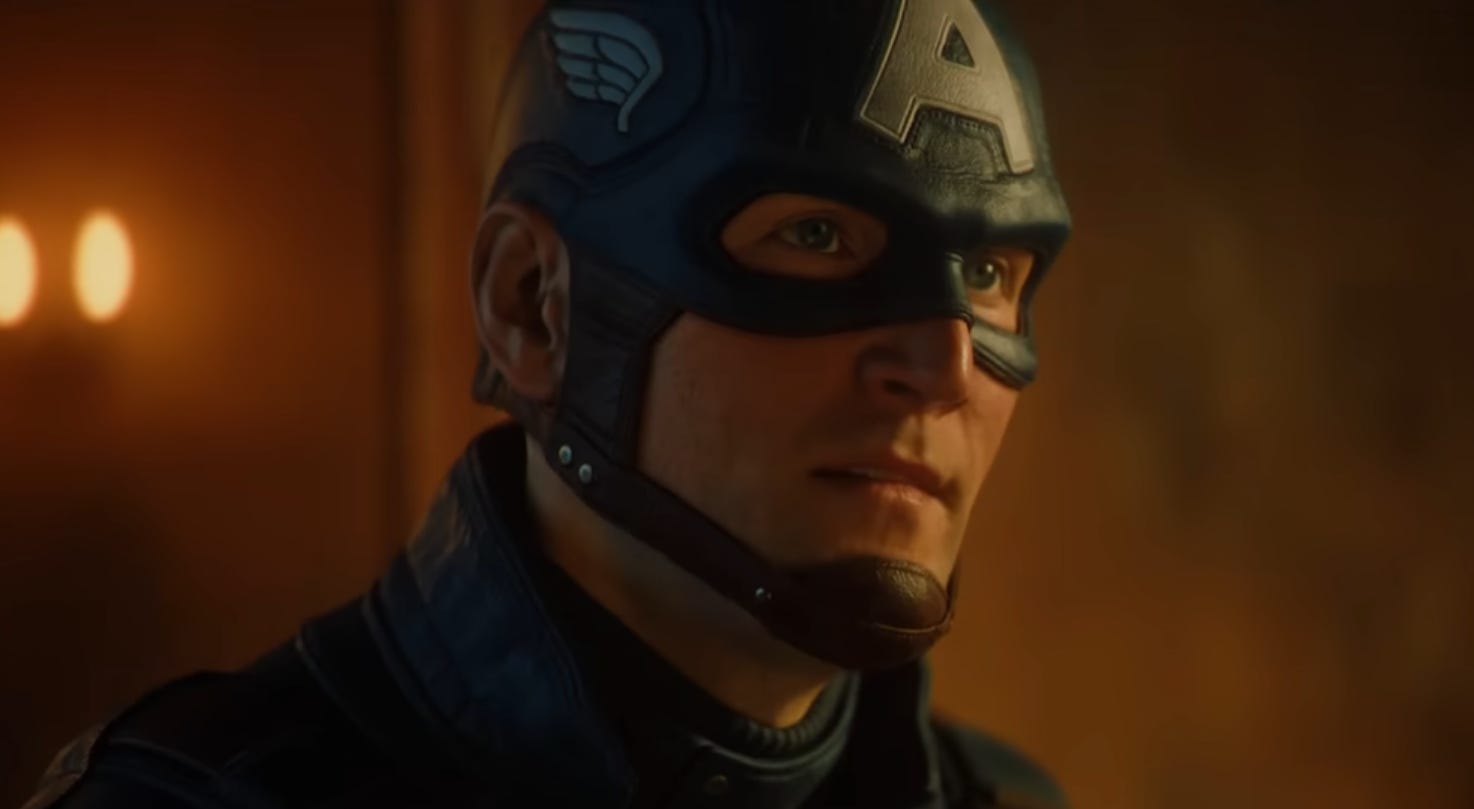
Skydance Games, the studio behind Marvel 1943, recently announced that their ambitious WWII superhero title will not be arriving in early 2026 as planned. No, they’ve decided to push it back indefinitely because, presumably, Captain America needs more polish before he can punch Hydra in the jaw.
Rockstar Games, the studio behind Grand Theft Auto, also delayed its next installment. GTA VI won’t arrive until November 2026. Again, the timing is suspicious. Layoffs, union busting, and internal chaos abound. Also, note the irony that a video game whose series glorifies the myth of the American outlaw is now stuck in production purgatory during a government shutdown.
Now I’m not opposed to excellence. I’m a Calvinist, after all. We believe in doing things decently and in order. But when a number of Western AAA studios start delaying their mythic tentpoles at the same time the government can’t pass a budget, you don’t need a prophet to see the pattern. You just need eyes that work and a spine that’s still connected to your brain.
Is It Just a Coincidence?
No, it’s not.
Looking at this practically, we could note that some AAA studios, especially those with defense or simulation ties (e.g., Unreal Engine used in military training) might rely on federal grants or tech contracts. A shutdown could stall these, delaying shared tech pipelines or funding.
UE is both a commercial game engine and a tool used in military simulations and federal training programs. Therefore, if a studio’s pipeline depends on Unreal Engine modules codeveloped or co-funded through federal partnerships (e.g., DARPA, DoD training simulations, or public-sector visualization tools), then a shutdown could delay those modules or stall collaborative R&D.
However, there’s another angle to all this that will remain elusive to most commentaries: Video games have long been viable propaganda tools utilized by the government. Naturally, a government shutdown would mean a loss of funding.
Does anyone remember Dustborn? Often described as “ultra woke,” or a “DEI parody,” critics often cite its overt political themes and its progressive character design. The game was pure Leftist propaganda.
Dustborn received funding from the Norwegian Film Institute, the European Union’s Creative Europe program and even the United States government? That’s right. Uncle Sam chipped in to help build a narrative game whose protagonist whose abilities were all based in activist discourse.
From Myth To Culture To Politics
For those waiting for that press release tying AAA games studios to the federal government, I’ll save you some time because it will never be written (much less published.) Instead, I will speculate as why the government would be invested in using video games in the first place.
The proof is in the pudding.
Throughout the past century, we have allowed the governing principles of individual sovereignty to give way to more and more control of a centralized government body. Therefore, we should not be surprised that those whom we have elected to rule over us would do so by means of programming and reprogramming us to be the kinds of moral people they believe human beings ought to be. The most effective tool for the job has shown itself to be the digital screen.
These tools of mythology are not neutral vectors. If you want an example of the kind of sponge-minded individuals whose entire worlds are built upon worlds of fiction and are not in any way tempered by reality, just look to the modern Left and especially to their progressive cohorts.
Video games are one of our primary myth-making tools for the generation and stoking of narratives. Because of the potential of video games to move our minds and shake our hearts (as is true of any narrative), what logically follows is that our government would want to be involved in video games.
Beyond using technology to sermonize to us, we must also ask what the sermon itself is. What is the governing ideology that has been pushed down our throats, into our stomach, and is forcefully digested ensuring we partake in the pagan communion of our time?
Civil Rights.
Why Diversity Is Forced Into Media
Yes, the reason so many video games (among other media) are so focused on egalitarian facets such as diversity is because our government subsist on a power wholly derived from Civil Rights.
If you read Christopher Caldwell’s The Age of Entitlement, you will soon learn that we live within what has been referred to as the Fifth Republic. The governing regime under this republic is the Civil Rights Act which made it the job of the government to root out inequality. What this meant was that it became the government’s job to remove all bias.
According to Caldwell, “...political correctness is the natural outcome of civil rights, which makes fighting bias a condition for the legitimacy of the state.” Furthermore, “Once bias is held to be part of the ‘unconscious,’ of human nature, there are no areas of human life in which the state’s vigilance is not called for.”
What this essentially means is that in order for the government to retain its relevance, bias must always exist in some form or another and the government must always come to the rescue to save us from it. This formulates the bedrock of our modern myths which almost always involve heroes fighting against some form of bigotry. This is why everyone who is evil is some variation of a Nazi because Hitler’s preference toward an Aryan race.
In another article, I mentioned how J.K. Rowling’s Harry Potter series is the ruling mythology for Millennials and how the story basically gave us a narrative to live by. The diversity squad (Harry, Ron, Hermione, Hagrid, Dumbledore, etc.) fight racist wizards (Malfoys, Death Eaters, Voldemort, etc.) This presents the world with a myth to live by: a binary struggle that is comfortable and resistant to dismantling.
Anyway, the long and short of my saying all this is that this is why I believe these delays are wholly due the government shutdown. These AAA studios are and have long been in bed with the feds.
NEXT: Take-Two CEO Confirms ‘Borderlands 4’ Sales “Softer” Than Expected

Compelling arguments tying government and huge studio game delays together. Another great article!
I just think Skydance has little to no fate in the Marvel brand, especially with the way Marvel is run, right now. And this game, having to follow Kevin Feige’s guidelines.