


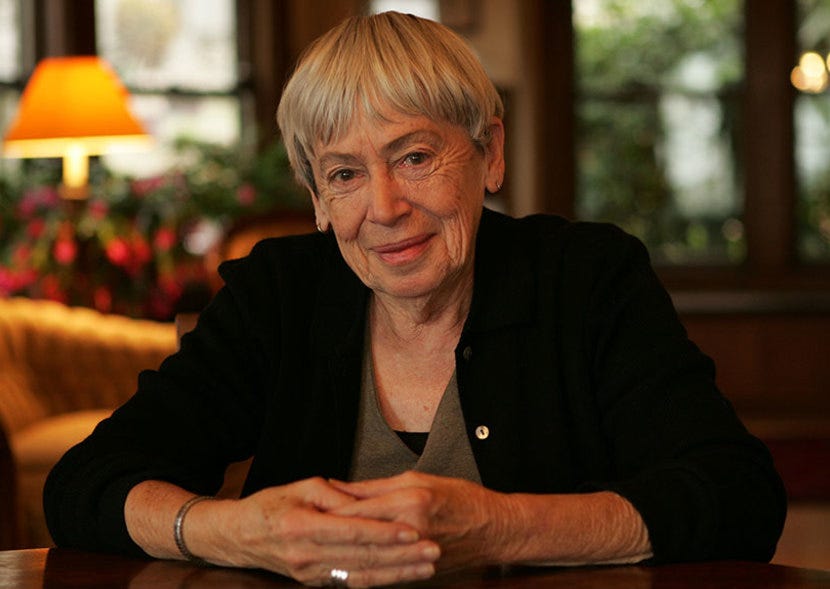
Ursula K. Le Guin, celebrated author of The Left Hand of Darkness and the Earthsea series, stood before a Planned Parenthood symposium in Portland in March 1978 and told the audience that an unwanted child was morally comparable to a birth defect. The remarks were not obscure. She reprinted them herself in her 1989 essay collection Dancing at the Edge of the World, under the title “Moral and Ethical Implications of Family Planning.”
She opened with a definition of moral choice: “A moral choice in its basic terms appears to be choice that favors survival: a choice made in favor of life.” She then expanded “survival” beyond any individual life to encompass the species. From there, the architecture of what she was actually arguing snapped into place.
“The survival of our species and of all higher forms of life on the planet now depends primarily and, as I understand it, very urgently on the limitation of the human population,” Le Guin told the audience. She offered three options: “strict family planning to reach zero population growth and then a decline until we get back into ecological balance; or plague and/or famine; or World War III.”
Abortion and population limitation were not concessions to a difficult reality in her framing. They were the pro-life choice, by her own redefinition of the word “life.”
The conclusion she drew from this framework was the passage that should follow her legacy:
“[I]f we can trust in ourselves and so let women think and feel that an unwanted child or an oversized family is wrong — not ethically wrong, not against the rules, but morally wrong, all wrong, wrong like a thalidomide birth, wrong like taking a wrong step that will break your neck — if we can get feminine and human morality out from under the yoke of a dead ethic, then maybe we’ll begin to get somewhere on the road that leads to survival.”
The comparison is to thalidomide, the drug that caused severe birth defects in thousands of children in the late 1950s and early 1960s. Le Guin was not reaching for a random metaphor. She was saying an unwanted child and a deformed child belong in the same moral category: both are wrong, all wrong, something to be prevented.
She also approvingly quoted author Irene Clarement de Castillejo on the same theme: “Woman, who is so intimately and profoundly concerned with life, takes death in her stride. For her, to rid herself of an unwanted foetus is as much in accord with nature as for a cat to refuse milk to a weakling kitten.”
The essay’s intellectual scaffolding rested entirely on the “population bomb” panic that was mainstream in elite circles during the 1970s. Paul Ehrlich’s 1968 book The Population Bomb had opened with the line, “The battle to feed all of humanity is over,” and predicted hundreds of millions of starvation deaths in the 1970s and 1980s. He told an audience in 1971 that England would not exist by the year 2000. He predicted the United States would be rationing water by 1974 and food by 1980. Every major prediction failed. The global population more than doubled after the book’s publication, and by most measures humanity grew considerably richer and better fed. Ehrlich died recently having been wrong about nearly everything he had ever publicly forecast.
Le Guin built her moral case for abortion on that foundation. The “dead ethic” she wanted women freed from was the belief that individual human lives carry inherent worth. The “survival” she was arguing for required subordinating that worth to population targets.
The population control movement Le Guin drew on was not ideologically neutral. Ehrlich himself repeatedly endorsed coercive measures to reduce birth rates. The movement had direct institutional roots in early 20th century eugenics, the same intellectual tradition that produced forced sterilization programs in the United States and provided academic scaffolding for Nazi racial hygiene policy. The through-line is not incidental. It is the logical destination of any framework that locates the value of life at the collective level rather than in the individual person.
That is the move Le Guin made at the podium. Once “survival” means the species rather than the person in front of you, the question is no longer whether some lives can be eliminated for the greater good. The question becomes only which lives qualify as unwanted. History has answered that question repeatedly, and the answer is always the same: the poor, the disabled, the politically inconvenient, the ethnically disfavored. The thalidomide comparison Le Guin reached for was not a rhetorical accident. It placed the unwanted child in the same category as the damaged child, and the damaged child in the category of preventable tragedy.
This is the logic of ethnic cleansing. It is the logic of genocide. The costume changes. The structure does not.
The contradiction at the center of her career has not been lost on close readers of her fiction. Her most famous short story, “The Ones Who Walk Away from Omelas,” describes a prosperous city whose happiness depends on the suffering of one confined child. The story is widely read as a rebuke to utilitarian ethics, a refusal to accept that the many can be served at the cost of one. Her Planned Parenthood speech operates on the opposite logic entirely. The unwanted child is the one in the basement. The survival of the species requires leaving it there.
Le Guin had three children of her own, all born well before the 1978 speech. In later essays she acknowledged a personal abortion she had in college in 1950, which she described as necessary to the life she went on to build. That context does not change the argument she made at the podium. She was not describing a private grief or a hard personal choice. She was making a public moral claim: that an unwanted child belongs in the same category as a preventable tragedy, and that women who accept that framing will be on the right side of survival.
What does it tell us about the relationship between an artist’s moral philosophy and the fiction that made them famous when the two contradict each other this directly?
When genetic engineering nearly doomed the species, humanity made a desperate bargain: let the frontier do what nature intended. In a harsh universe, these cadets have to make impossible decisions. Read Space Fleet Academy today.

NEXT: BookCon Returned After Six Years, And Immediately Generated A Boycott Over An ICE Contract
I have never bought the "There's not enough food to feed the world" shit. As a former farmer, I can attest to the fact that we can feed the world, but only the government gets out of the way. We routinely plowed under whole fields of grain and soybeans because DC didn't want to export it.
We can even send people overseas to show people how to plant, how to harvest, and how to fix food.
That should never be a reason for "Family planning"
Nor should having too many children. Right now, we are beneath replenishment levels, that why they are allowing criminals to cross the border and become citizens.
Another eugenicist.