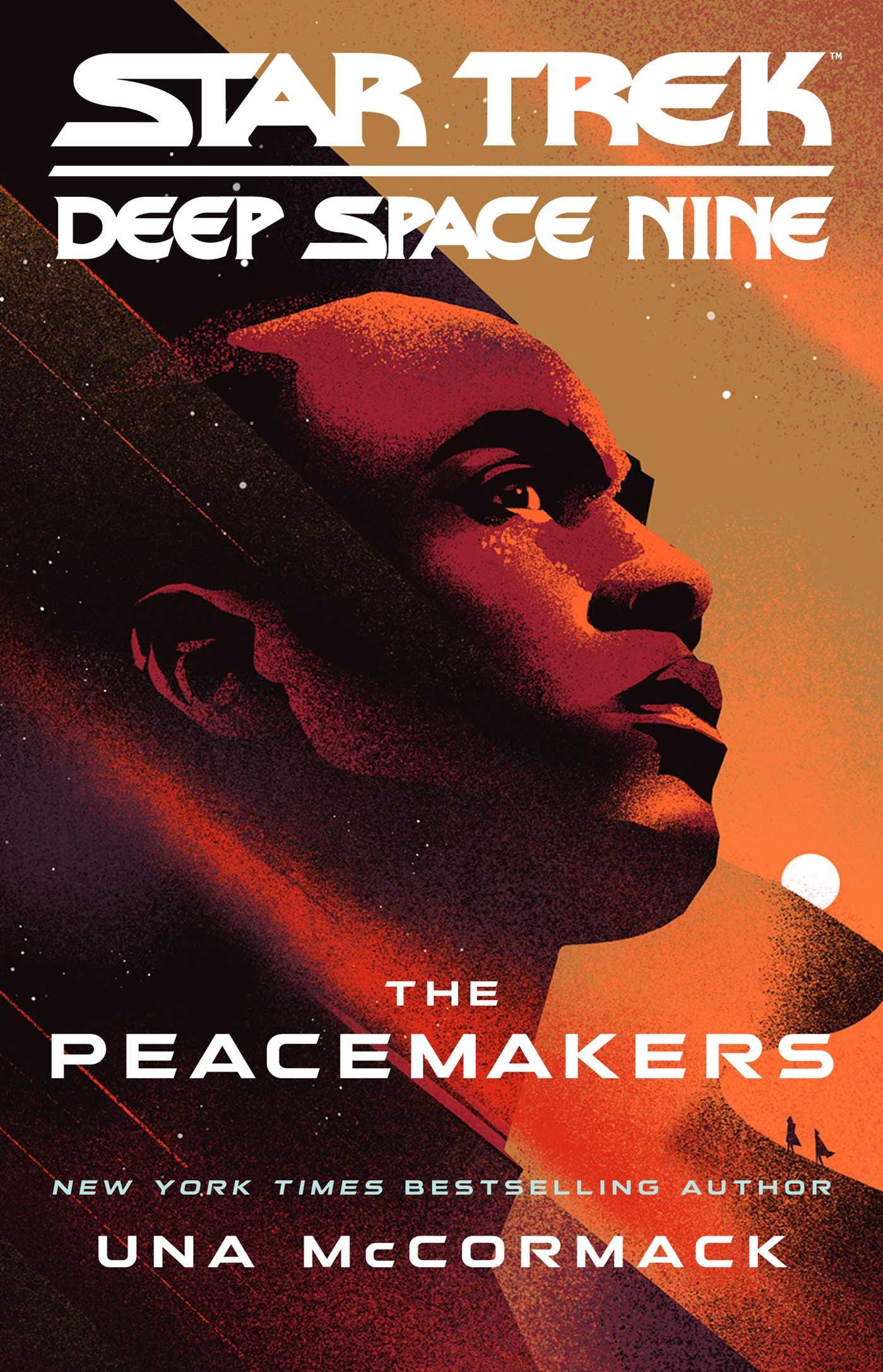
Una McCormack’s The Peacemakers is one of the worst Star Trek novels I’ve ever read, if not the worst. The new Deep Space Nine book from Pocket Books holds off on a plot until the halfway mark. It then gives Jake Sisko a sidekick who calls him “doofus” the entire way through, and it can’t keep its own Starfleet universe straight.
Jake Sisko Can’t Carry a Whole Book
Taking an entire novel about Jake Sisko and making it interesting is a hard proposition. Deep Space Nine made him interesting once, in “The Visitor.” That season 4 episode was written by Michael Taylor, and Sisko gets lost in time while his son Jake grows old before his eyes, with Tony Todd playing the older Jake. It was one of the most interesting episodes of the entire series. It had a cool science fiction premise, and it tied straight back to Benjamin Sisko, which gave it weight.
Jake on his own is not that interesting a character, and we’ve seen the problem before. S.D. Perry’s Rising Son, published by Pocket Books in 2003, is a post-series Jake novel. It was one of the hardest to read of the whole relaunch, and that one at least was full of callbacks, with a Tosk returning from the first-season episode, and plenty of action. The Peacemakers meanders.
Half a Book of Sightseeing
The book is set five years after the Dominion War, with Jake back on Earth after a trip around the Gamma Quadrant, finishing a book about life out there. He is also lost, with no idea what he wants to do with his life. He’s a writer moping around after a failed relationship, and there isn’t much to latch onto.
The first third is Jake getting told he’ll be appearing at a festival on Cardassia, then people warning him not to go. Okay. He goes, and the festival gets almost no page time. Jake spends most of the first half sightseeing, and it is extremely boring.
Then a Plot Gets Bolted On
Around the halfway point, McCormack seems to realize she has to put a plot in the book. Jake joins a tour of ancient archaeological sites in the Cardassian desert, the party is cut off from the rest of the world, and the murders begin. So we get a murder mystery in desert catacombs with a pile of new characters. One is a Cardassian trying to be Bajoran. One is a Bajoran who hates Cardassians and wants to dig up Bajoran artifacts, which calls back to the solar sailer trip Jake and his father took in “Explorers.” Some people die, and you don’t care about any of them.
Jake’s company also includes Dorian, a woman who follows him around, nags him the whole time and calls him “doofus.” She is always smarter than he is, and he never pays attention to anything. Jake just tolerates it, which undercuts him as a character. Spending the entire book with Dorian is painful.
Spock Shows Up, Because Of Course
Once they dig into things, we learn that Spock’s mission to get Romulans to convert to Vulcanism has failed. A couple of the people involved are hiding on Cardassia, one has died, and the Tal Shiar is after the rest. One of the people trapped with Jake, a Ferengi, was hired to deal with the situation. This comes out of nowhere. Why are they on Cardassia of all places? It makes no sense, and it reads like she forgot she needed a plot and tied something in.
Then comes the trick that gets pulled in a lot of Star Trek novels. Jake runs into a mysterious person who turns out to be a famous character from the original series or Next Generation. Yay, what a reveal: it’s Spock. Spock and Jake have a moment, they get rescued, and then Jake starts worrying that his father committed war crimes. So he goes to Dr. Bashir with questions, and Bashir assures him they didn’t. That’s the entire novel.
It’s an absurd setup. Why doesn’t Jake trust his father at this point, and why would he think war crimes? It doesn’t match the character at all, given the relationship the two had on the series.
A Murder Mystery With No Science Fiction in It
The novel has zero science fiction concepts. It is Jake acting as a writer, getting dragged into a murder mystery, with episode callbacks stapled on so you’ll care a little. It’s shocking how little this has to do with science fiction or Star Trek. You could set it in 20th-century America, with characters going to Germany after the war to look at what happened under the Nazis, and there would be no difference. Nobody would like it, because it wouldn’t tie into Deep Space Nine episodes, and without them there is nothing to the book.
It’s slow at a lot of points, and the characters and background characters are ones you don’t care about whatsoever. It reads like a first draft written without an outline, with a heavy political agenda and no point.
The Title Doesn’t Even Fit
McCormack uses “Blessed are the peacemakers” and a few other biblical building blocks a couple of times to set up her point. But no peace occurs in this book. There’s a murder plot, and Jake isn’t involved in any negotiations between worlds. He isn’t a peacemaker. The title doesn’t match the story at any stage.
Twentieth-Century Talk in the 24th Century
The anachronisms and modernisms are easy to spot, and they make for poor writing. Dorian swears on writers’ names, Virginia Woolf among them, and McCormack leans on feminist names in particular. These are people talking like they’re from the 20th century. The doofus line repeated over and over is ridiculous on its own.
When Jake steps in front of Spock and takes a disruptor blast, Dorian tells him, “you took a bullet for him.” No, he didn’t. Would she even know what bullets are at this point? Which brings me to the blast itself. We’ve seen disruptors on the show, and they are very lethal and dangerous. They aren’t phasers. You get vaporized or blown to bits, and you don’t just get shot and recover. The book forgot its own internal consistency to make it feel like a gunshot.
Jake’s publishing setup is ridiculous too. It reads like McCormack writing about her own life in publishing. Jake talks to an agent who’s booking him things, and he talks about taking gigs where you can get them. We’re in the Federation, so don’t they not have money? Why would they have agents? None of it gets explained. Jake also reads paperbacks throughout, and people sign his book, when the series always showed PADDs. These are 20th-century details that don’t make sense in Star Trek.
The Politics Run All the Way Through
McCormack is insufferable with this stuff. There are little rants about refugees in the middle of the story. Jake talks to Bashir, and Bashir says, “One of the biggest challenges has been persuading people to get vaccinated.” That’s a COVID-era anachronism. Why are we talking about vaccinations in this story? It has nothing to do with anything.
There’s also a Vulcan character, T’Nal, written with they/them pronouns. Why would a Vulcan have they/them pronouns? The “T’” prefix for Vulcans and Romulans usually denotes female. The naming conventions are binary, because Vulcans are literally biological males and females. It throws you out of the novel because it makes no sense in this universe.
Then Jake talks about “Blessed are the peacemakers” and explicitly says he doesn’t believe in God but he believes in change. What the heck? It comes from someone who doesn’t understand the biblical principle and is using it for her own little political agenda rather than what the Bible says on the topic. The point doesn’t make sense either, same as many of the points in this book.
They also go to an art museum, where Dorian tells Jake, “we don’t like fascists’ art, and we don’t like fascists.” What are you talking about? These people talk like they’re on Bluesky. They don’t talk like people in the Deep Space Nine world in the Federation at this stage.
Of course there’s the standard play on infinite diversity in infinite combinations, as Spock somehow knows who Nog is and knows he’s the first Ferengi cadet, though Spock has been on Romulus the whole time. Too many contrivances. The book loves to trot out IDIC, but obviously not for “fascist art” or fascists. That’s diversity too, isn’t it? None of it makes sense. IDIC in the original series is not a statement of judgment or value. It says things exist in the universe, and modern woke authors have manipulated it.
A Kiss Out of Nowhere
The most egregious part is the ending. The entire book is told from Jake’s perspective, and then it cuts to Julian Bashir’s point of view at the end, literally so he can share a kiss with Garak and make them explicitly homosexual. There’s no purpose to the scene other than to add that slash fic element. That wasn’t part of the show, and it’s something they’ve been crusading for in modern times.
McCormack started out writing Deep Space Nine fan fiction, which led to Pocket Books inviting her to pitch. As I understand it, she wrote an earlier version of this scene in a novel that Simon & Schuster did not publish, and she later put it out as fan fiction, with Garak kissing a man.
Longtime Star Trek book editor Margaret Clark passed away on March 15, 2025, and she had edited the line at Simon & Schuster for many years. It now looks like nobody is at the wheel. These look like people putting out brand slop with zero oversight, and this book is exactly that.
Any editor would have cut it tremendously. Any editor would have refined the plot so the first half doesn’t meander out of boredom, and any editor would have stopped the anachronisms and modernisms from happening. This is extremely sloppy writing, super unprofessional, and possibly the worst Star Trek novel ever written.
What’s the worst Star Trek novel you’ve read, and did it fail the same way, with a plot nailed on halfway through?
First contact with the Oridians was supposed to be humanity’s proudest moment. Instead, their chief engineer is dead, their ship is sabotaged, and an ancient alien technology is stealing souls. Book one of the Valiant Frontiers series delivers exploration, mystery, and the kind of crew you’ll want to follow across the galaxy. Read The Soul Catcher on Amazon and start the adventure.