


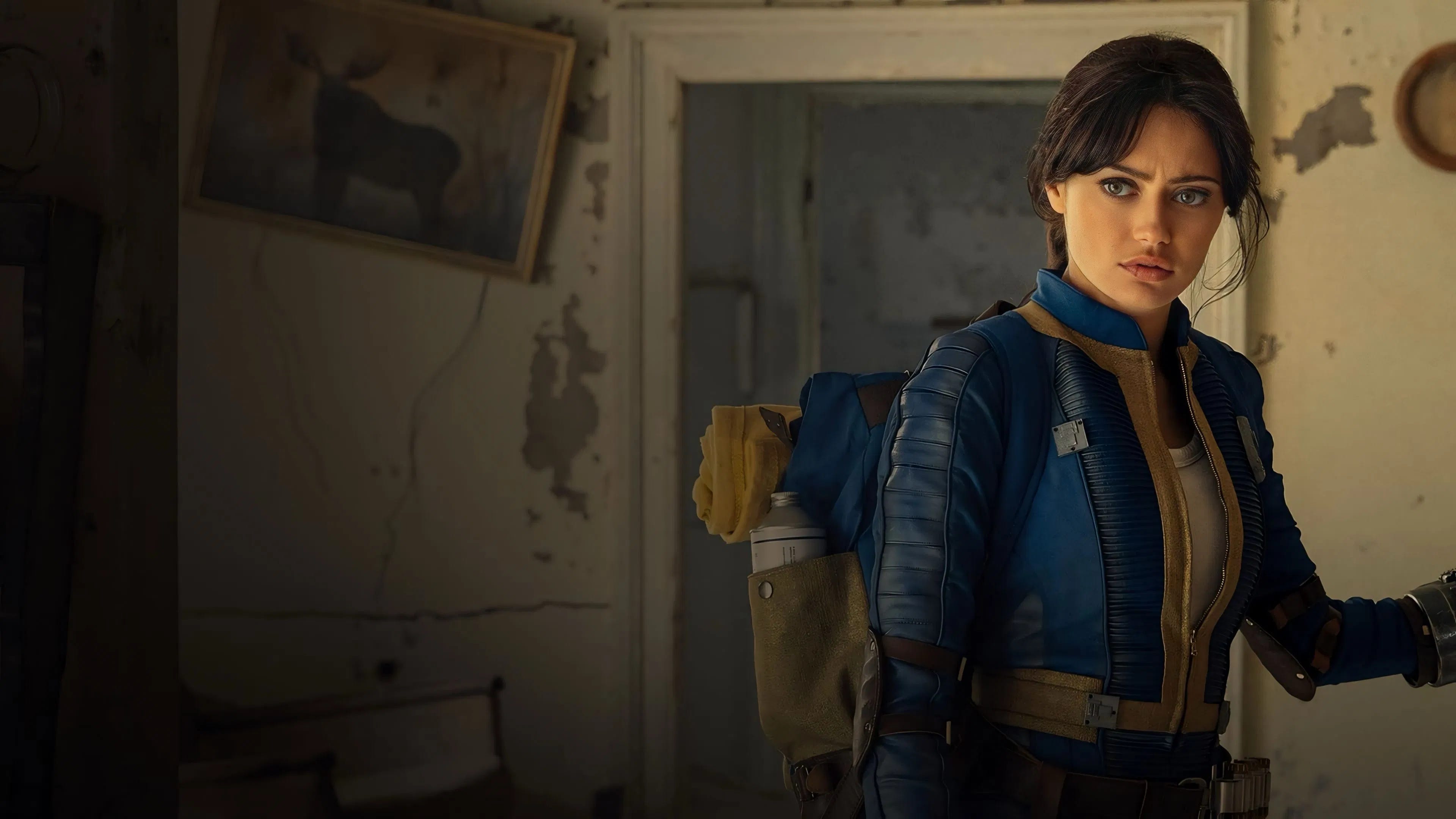
At the core of Fallout Season 2 is the erasure of Fallout: New Vegas. What some had dismissed as fan paranoia during Fallout Season 1 now appears as genuine: the show’s world is arranged so that New Vegas must fall no matter what choices the player made in the game. Whatever future the Courier once carved out of the Mojave doesn't matter because Bethesda doesn't want it to exist.
And, by Bethesda, I am referring to Todd Howard and Emil Pagliarulo, but mostly Todd Howard. Todd has repeatedly reaffirmed that the show is canon and that Bethesda will integrate its events into future games. He chose the showrunners and director, he oversaw canon, lore, and tone, and he approved all major creative decisions.
The Fallout TV series seems determined to catechize its viewers into a single truth: the past is disposable and the stories that shaped us can be overwritten without consequence. In keeping with themes I've talked in the past, I issue that this too is a form of soft power. This is an attempt to define what counts as canon in the minds of Fallout fans. Moreover, this entire topic falls within a broader scheme of corporate media to determine which stories are allowed to shape our imaginations.
Soft power, as I've talked about, is called "soft" because it does not intentionally coerce people. People allow themselves to be persuaded by it. Soft power forms us and trains us to desire certain futures while dismissing the past and even the present. In this case, Bethesda wants to teach us what worlds are “official” and what are disposable.
The Assassination of a Place
Since it was produced, Fallout: New Vegas has only grown in stature since its release. The game has been kept alive, expanded, and reimagined by vast modding communities that treat the Mojave like it was their own sandbox. The show’s consolidation of canon stands in stark contrast to the flourishing, communal creativity that has made New Vegas more beloved now than it ever was when it was first released.
In Fallout Season 2, New Vegas has been ritually humiliated. The Strip is misrepresented, its geography distorted, and its factions reduced to rubble off‑screen. As recent as Episode 4, The King (now a Ghoul) has been dispatched by the show's female lead without ceremony.
One wonders if viewers with no prior investment in the games can sense the ongoing hostility and contempt that Todd has for Fallout: New Vegas. He is less interested in telling a story than in clearing the ground. The Courier’s triumphs have been rendered meaningless and the world has been rearranged so that only one timeline remains: the one that leads inevitably to the dominance of a Bethesda canon where New Vegas has been ritually destroyed.
Note, the Bethesda canon could have easily been one where New Vegas never even existed. But, no, Todd specifically set out to destroy it. He wants old fans to know how much he hates them and Fallout: New Vegas.
The State‑Like Logic of Canon
It's time to stop acting and talking like media designers, directors, and producers are all exercising creative preference when they make their products. The truth is, corporate media is participating in a broader ecosystem of state authority and international financial influence that shapes how cultural products are made, remembered, and legitimized.
This is not conspiracy. This is the ordinary functioning of power in a global market economy. Contemporary game development is increasingly entangled with actual state institutions, public funding bodies, and transnational financial networks. France's CNC backing Sandfall Interactive in the production of Expedition 33 is a clear example of a government agency directly underwriting a studio’s creative output as part of some transnational strategy.
None of this is unusual either (although, perhaps, it should be). This it has become the norm in a global media economy where state authority is invested in cultural productions in order to cultivate soft power, international prestige, and economic influence. This means that once a franchise reaches a certain scale, it inevitably becomes part of this ecosystem. Its canon, its world‑building, and even its internal memory become matters of institutional interest.
Large franchises, therefore, start to standardize all narratives in an effort to cultivate a singular cultural identity that can be further marketed, expanded, and defended. This is also why smaller, less successful franchise try to "opt in", so to speak, by adopting the same values in their writing.
Meanwhile, new fans of these franchises are less fans of the old stuff and more fans of a brand they see is popular They defend their corporate products not because they recognize anything inherently valuable about the franchises but because they enjoy the association with a popular brand; a solidarity that solely amounts signaling status regardless of personal investment. New fans are the ideal foot-soldiers for the New Canon. They represent a rival polity to Old Canon and often show their true colors in their efforts to gatekeep the modern franchise from the old fans.
Fallout: New Vegas - The Sty in Bethesda's Eye
Ever since Fallout 4 (if not earlier) Bethesda has been trying to turn Fallout into something that is culturally recognized as being of Bethesda. Doing that necessarily means they need to destroy Fallout: New Vegas in the minds of the modern audience.
Fallout: New Vegas is particularly threatening because it embodies ideals that resist the kind of centralization craved by globo homo. The NCR, Legion and House all represent forms of state authority, each with their own ethos and their claims to legitimacy and sovereignty. Meanwhile, the Player Character enjoys a freedom that has become unfashionable in the current cultural climate; a freedom where you are permitted to weigh pro from con, unabated by any overarching narrative that ever tells you what the "correct" choice even is. Moreover, your agency is not constrained by anything except the game's mechanics.
Moreover, power is depicted as fragile and contested, begging the question what true hierarchy even looks like. Modern institutions depend on widely-held assumptions that their authority is absolute and should not be questioned. But the Mojave of Fallout: New Vegas paints a picture of a world where power is facile and constantly being negotiated. Moreover, the game testifies that even an individual can meaningfully disrupt the ambitions of empires.
Fallout: New Vegas shows power as something provisional and contingent. In this manner, the game's story holds true to Ephesians 6:12:
For our struggle is not against flesh and blood, but against the rulers, against the authorities, against the powers of this dark world, and against the spiritual forces of evil in the heavenly realms.
This is precisely why the game's vision is unwelcome in the current cultural climate, much less a franchise that now operates within corporate, state‑like authority. Therefore, the Fallout TV show represents a competing vision of what the franchise is and means. And, like any consolidating power, Bethesda must domesticate or neutralize the ideas that were promoted by Fallout: New Vegas.
The Constant Displacement of the Present by the Future
In Fallout Season 2, Todd Howard has narratively destroyed New Vegas. This is now the "official" timeline set down by the man who was also the director of Starfield. And what's tragic is that many Bethesda fans will accept Todd's vision as canon all because their love of the franchise only extends as far as the popularity of its brand. Even their adherence to the game's lore only extends as far as whomever gets to edit the Wikipedia pages.
Older fans should recognize Todd's gesture as a projection of soft power and an obligatory insult and rejection of a mythology that has, since its inception, maintained a deep resonance within many fan communities. Newer fans won't understand this because soft power always presents its authority as common sense. The esteemed "modern audience" are a shallow people, conditioned into thinking that media never rises above its escapism. They rarely notice any formation taking place in their own hearts and minds and might even prefer a Fallout where the rugged and morally ambiguous Mojave is replaced by Bethesda's cleaner, more manageable brother.
To quote Red Letter Media in their highly sardonic "Mr. Plinkett's Titanic Review":
Most people are dumb and don't like to be challenged intellectually or emotionally. They like the familiar and gravitate toward things that feel safe and non-confrontational...The success of movies often comes in their simplicity, just like how most newspapers are written on the fourth grade reading level...If you want your film to make money, you've got to aim for average. The brilliant, complex, and challenging falls to the wayside while the safe and the familiar is the norm...
Lucy and Cooper might as well be on a roller coaster ride operating on the logic of a fast‑travel menu. As a consequence, the Fallout show feels very small as it accommodates the plot. While establishing shots gesture toward a vast wasteland, the characters move through it as if geography were an inconvenience rather than a reality.
The show's writing also mimics a style we've seen implemented as far back as the science fiction series Lost by J.J. Abrams called "the mystery box" wherein the entire plot is ordered toward the not‑yet. Your focus is always oriented in the direction of what comes next rather than attending to the here and now. So many scenes flicker by in small increments, each one a placeholder for some future revelation. All the while the present is never allowed to live and breathe. This narrative form is perfectly suited for an audience shaped by the rhythms of TikTok, Instagram Reels, and endless scrolling. And this is how you know the show isn't for fans, it's for low-attention span morons whose entire existences have been shaped by market forces. These are people who have been formed to see both not only the past but even the present as insufficient and to be discarded unless they are instantly replaced by something newer, faster, and more stimulating.
This is also what tricks people into thinking the show is "good" or even well-written. Everything happens quickly and before your brain has caught up with it, the moment is gone and replaced with something else. Much like doom-scrolling, viewers are suspended in a constant state of anticipation rather than contemplation of fulfillment. perpetually crave the next twist to a setup rather than dwell on the meaning of any given scene. The modern audience are consumers who believe that good storytelling is whatever most effectively trains their attention spans.
Nothing in the show feels weighty nor will it be well-remembered. But that's not the point anyway. You're just meant to laugh and clap as you witness the antics of a highly diverse Brotherhood of Steel playing around with a plasma grenade. You're meant to nod with approval as Cooper Howard's Native American friend hands him a cigarette lighter in a flashback that serves absolutely no purpose to the plot. Meanwhile, in real life, there's an ongoing immigration crisis throughout many Western countries. Oh, but take care in pointing that out. People might think you're racist!
Consigned to Oblivion
The logic of late-stage consumer capitalism is run by a perpetual displacement of the present by the promise of a future product. This basically turns every story into an advertisement for itself, simultaneously promoting its own continuation as it generates an endless appetite for the next installment; a craving that can never be fulfilled because each ‘future’ exists only to advertise another future.
Moreover, much of the modern audience does not engage with the Fallout series out of any genuine affection for its setting, story, or characters. Instead, their loyalty is to the brand itself and to the identity it allows them to perform. To call oneself a ‘fan’ becomes a kind of self‑promotion, a way of feeling elevated without having invested in the franchise’s history beyond the narrow canon established by Todd Howard's vision as was all but officially set down by Fallout 4 and its successors. The devotion of these fans is less love of the world of Fallout than love of their own reflection in it. These are the kinds of fans who reshape the franchise to mirror their personal vanities, and who police the boundaries of fandom with zeal, They are the ones who go online dismissing any criticism, however measured, as a threat to the identity they have built upon the brand.
The good news is that shallow stories erase themselves. In a culture trained to swipe past anything that fails to captivate instantly, forgettable media is not to be defeated in some grand culture war; it is simply forgotten. Moreover, the media cycle only serves the interests of globo homo anyway, not the communities that gave meaning to these franchises in the first place. The real fans will continue to mod, expand, and reinterpret Fallout: New Vegas, while this newer, thinner iteration by Bethesda will drift into the same oblivion as the last thing dismissed with a flick of the thumb on a doomscroll.
NEXT: Viggo Mortensen Shares What His Favorite Scene From 'The Lord Of The Rings' Trilogy Is

Fallout was brand new to me but the themes in the TV show are quite striking and you are correct that it feels rushed. They went through all the trouble of introducing the Roman guys and then the writers just toss a grenade. On to the next thing! It's more about feeding a scrolling addiction than exploring an interesting world.
This isn't the only choice. There's a Church choice. Make a bad ass post apoc game or mod where you play as CHRISTIANS. Explicitly. Not allegorical or through being nice. Explicit. Evangelism, converting, planting churches.
Fallout is in a Post America, there are ruined churches and lots of comics to find.... but NO BIBLES??? Weird.
CHANGE THAT. Put OUR CHRIST front and center in these games! Create mods and servers where Christians are bandying about converting locals, fighting baddies and building church based communities. You know... like how the West and all those whiteys were a land of Churches once! Where we got magna cartas and constitutions and colonizing missionaries that spread across the globe with the greatest civilizational concepts! Stopping paganism, brutality, mass slavery, human and baby sacrifices.... ONCE... but it appears... not anymore.
Make Christian mods of evangelism and church building.