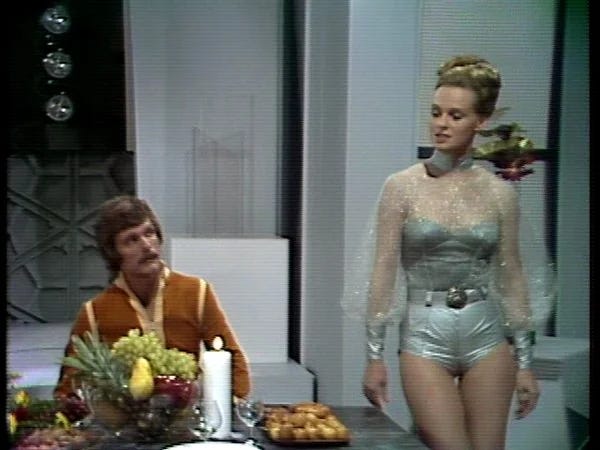
Harlan Ellison won a Writers Guild Award on March 31, 1974, for the pilot script of The Starlost, a Canadian-made science fiction series that had finished its run nearly three months earlier. The script that won was not the script that aired. The broadcast version carried the credit Cordwainer Bird, the pen name Ellison attached to work he considered wrecked by producers.
Ben Bova, hired as the show’s science adviser, watched the same wreck from inside the production and answered it with a novel. The Starcrossed, a comic roman à clef, appeared in 1975. Between the series and the book, the affair became one of the most documented production disasters in science fiction television. Here is what The Starlost is, what happens in it, and what Bova packed into the novel that mocks it.
The Starlost aired on CTV in Canada in 1973 and was syndicated to local stations in the United States. Sixteen episodes ran from September 22, 1973, to January 5, 1974. Fox did not pick up the options for more.
The origin was a pitch, not a passion project. Robert Kline, a 20th Century Fox television producer, asked Ellison in February 1973 for an eight-episode science fiction concept to take to the BBC. The BBC passed. Kline could not place the show in prime time, so he went cheap and aimed at syndication. By May he had sold it to 48 NBC stations and to CTV. A writers’ strike ran from March 6 to June 24 that year, but Kline obtained a Guild exception because the production was entirely Canadian, and that let Ellison write the series bible.
The premise sits in a long line of generation ship stories. Heinlein’s “Universe” ran in 1941 and was later collected in Orphans of the Sky. Brian Aldiss followed with Non-Stop in 1958. Ellison’s version is the Earthship Ark, 50 miles wide and 200 miles long, divided into dozens of sealed biospheres after an unexplained accident in 2385.
The names behind the camera looked solid on paper. Douglas Trumbull, who handled effects on 2001: A Space Odyssey and directed Silent Running, served as executive producer. Jerome Zeitman shared the title. Keir Dullea, who played Dave Bowman in 2001, took the lead.
The story opens in the year 2790 in Cypress Corners, an agrarian community that resembles the Amish. Devon (Dullea) questions the village’s ways and refuses to accept the arranged marriage of Rachel (Gay Rowan) to his friend Garth (Robin Ward). Devon then learns that the village elders have been manipulating the computer terminal they present as the Voice of The Creator. The elders answer by sentencing him to death by stoning for heresy.
Garth helps him escape, and Rachel and Garth both follow him out of the village. They reach the ship’s bridge and find a skeleton crew. The Ark is on a collision course with a Class G star much like our Sun, and the only fix lies at the backup bridge at the far end of a ship 200 miles long.
That sets up the weekly structure. Each episode drops the group into a new society with its own customs and laws. Mu Lambda 165, the Ark’s partly functioning computer, helps them or gets in their way, and William Osler plays the computer and narrates every episode. Sterling Hayden and Ed Ames appeared as guests, along with Walter Koenig, the Chekov of Star Trek, which tied the show back to Ellison’s most famous teleplay. Ursula K. Le Guin supplied the story for “The Goddess Calabra,” which Martin Lager scripted.
The village’s faith turns out to be a computer terminal worked by the elders, a twist science fiction has used for decades. The Starlost plays it in the first act.
Trumbull’s Magicam was supposed to be the selling point. The system used two servo-controlled cameras, one filming actors against a blue screen while the other filmed a model background, so the two images could be combined with matching camera movement. It did not work reliably. The production fell back on simple blue screen with static shots. The rented Canadian studio was too small for the sets the scripts required, so crews built partial sets.
Ellison watched the budget shrink and the story get simplified. He complained of a “dumbing down” of the concept. That phrase describes a process, not a single bad decision: each cost cut removes a piece of the idea that made the show worth pitching, and the next cut removes another. His pilot, titled Phoenix Without Ashes, went to air as “Voyage of Discovery.” He used a contract clause to put the name Cordwainer Bird on the credit. The pseudonym is a tribute to Cordwainer Smith, the pen name of Paul Linebarger, with “Bird” doing the work of a raised middle finger.
Bova’s name stayed in the credits even after he soured on the show. Ellison has said that Bova and Trumbull both quit after contributing to the first episode. Bova put his anger in print in a June 1974 editorial in Analog, the magazine he edited.
The reviews were blunt. Critic Michael Walsh wrote in September 1973 that the show was “written, directed, acted, lit, photographed, recorded and edited like a church basement production.” The list runs from the script to the final cut, with no department left out.
The standard science fiction reference works call the series dire, and television guides have ranked it among the worst science fiction shows of all time. It kept an afterlife anyway. Episodes were rebroadcast in 1978 and 1982, and five feature-length compilations were sold to cable in the late 1980s. VCI released the full series on DVD in 2008.
Ellison’s original City on the Edge of Forever script took the Writers Guild Award while the filmed Star Trek episode took the 1968 Hugo. The same split repeated here. The Guild honored the original Starlost script, and the version viewers saw carried a pseudonym.
Edward Bryant novelized the pilot script as Phoenix Without Ashes in 1975, with a lengthy Ellison foreword describing the production. IDW adapted the original script into comics in 2010.
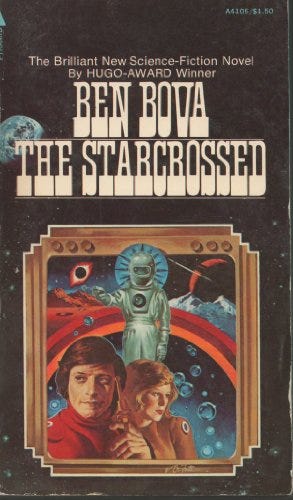
Bova’s novel moves the disaster a few decades into the future and changes the names. Titanic Productions, run by chief executive Bernard Finger, is near bankruptcy after a string of flops. Its reality shows are not performing, and its mafia-connected bankers want a hit that pays dividends. Finger’s assistant Brenda suggests Ron Gabriel, a volatile writer with a history of violence against a producer. Finger has a rule against letting Gabriel back into the studio unless the studio needs him, and the studio needs him.
Gabriel agrees for the money and for promised artistic control. He also insists on hiring Bill Oxnard, an engineer raising funds for his laboratory on the strength of a flicker-free 3D television system, as technical consultant to keep the science accurate. Titanic picks up Gabriel’s idea as a test vehicle for Oxnard’s 3D. In an early scene, Gabriel pounces on Oxnard’s offhand phrase “starcrossed lovers,” leaps up in a towel, and has his show: Romeo and Juliet in space.
From there the studio does what studios do in this story. Deceit and cost-cutting meet ignorance of both science and science fiction, and the comedy follows. The future setting adds jokes of its own. Los Angeles smog is colored and perfumed instead of cleaned up, and the skyscrapers are earthquake-proof.
The book contains several in-jokes:
Ron Gabriel is Ellison. The character is a volatile, blacklisted writer who sells a space series on his own terms and loses control of it. The novel’s Hollywood treats him as dangerous and indispensable at the same moment.
Bill Oxnard is Bova. The author put himself in as the technical consultant nobody listens to, the same role he held on The Starlost.
Oxnard’s 3D system plays the part Magicam played. In the real production, Trumbull’s unproven camera system was the technical hook. In the novel, a flicker-free 3D system is what gets Titanic to take Gabriel’s pitch.
Titanic Productions. A studio named after the most famous ship that sank needs no decoder.
The Romeo and Juliet pitch. The book’s title comes from the Shakespeare phrase, and the idea Gabriel pitches echoes the Starlost pilot, which turns on Devon refusing the arranged marriage of Rachel to Garth. The show Ellison built had a love triangle at its center, and the novel has him pitching star-crossed lovers.
The dedication. Bova dedicated the book to Cordwainer Bird with the line “may he fly high and strike terror in the hearts of the unjust.” The line casts Ellison’s pseudonym as an avenging figure, and it tells the reader which side of the production Bova stood on.
Ellison’s reputation. Finger’s rule about keeping Gabriel out of the studio is a joke only readers who know Ellison’s history with producers will catch. The novel travels with the series for that reason: the jokes need the Starlost story to land.
Ellison got a Guild award for a script that never reached the screen as written. Bova got a novel. Trumbull’s Magicam did not work reliably, and the production fell back on static blue-screen shots.
Ellison’s answer was a pseudonym that told the audience the creator had been overruled. A studio bought his idea and lost the man who understood it. Crowdfunding now lets a writer keep control of a story from the pitch to the printed page, with no network to cut the budget in the middle. Does the Starlost story show why independent production has a stronger case today than it did in 1973?
If the golden age of Trek and Babylon 5 left a hole in your sci-fi diet, The Stars Entwined fills it — interstellar espionage between two civilizations on the brink of war. Read The Stars Entwined on Amazon!