The first two episodes of The Pendragon Cycle functioned as historical prologue, necessary context delivered through fragmented timelines and ancestral backstory. Episode three, “A Fatherless Child,” abandons that structure entirely and delivers what feels like the actual beginning of the series: a tightly paced, character-driven narrative that finally allows the show to breathe.
From Madness to Purpose
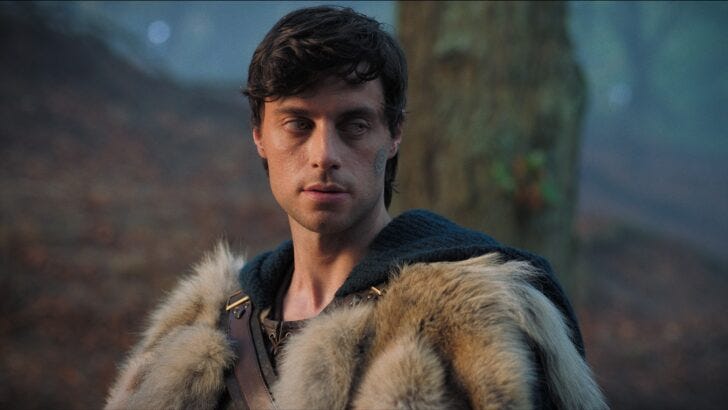
The episode opens with Merlin (Tom Sharp) emerging from the forest in a state of neurosis, a direct continuation of episode two’s time jump. The show skips roughly half of Stephen R. Lawhead’s Merlin novel, bypassing the wizard’s early life and his relationship with his wife (a touching sequence in the source material that’s regrettably absent here) to land on the moment Merlin enters the larger political conflict consuming Britain.
This is where the adaptation makes a smart choice. While Lawhead’s novel reads like a historical chronicle—alternating between broad narrative summary and intimate scenes, the show commits fully to dramatization. We’re dropped into the middle of a crisis: Vortigern (who has declared himself High King) is a paranoid tyrant attempting to build fortifications against an approaching army. His walls keep collapsing. His advisors blame evil spirits. Merlin arrives in chains and immediately diagnoses the real problem: an underground river is destabilizing the foundation.
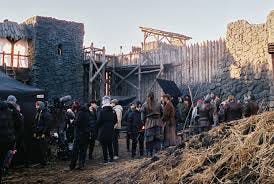
In the novel, Vortigern’s advisors are transparently corrupt, grasping for money and influence. Here, they’re simply wrong, and their opposition to Merlin feels less calculated. When Vortigern executes one of them and demands Merlin’s counsel, the wizard refuses. He has no interest in propping up a tyrant.
Then Vortigern’s son is captured. The army of Aurelius Ambrosius arrives. Vortigern dies in a fire, but not before placing his crown on a young boy who had been serving him. The boy accidentally stabs Vortigern, then takes an arrow himself. As both lay dying, Vortigern crowns the child. It’s a brief moment, but for anyone familiar with Arthurian legend, the symbolism is clear: a foreshadowing of the child-king Arthur, and a thematic statement about legitimacy, fate, and the transfer of power.
Aurelius and the Sword
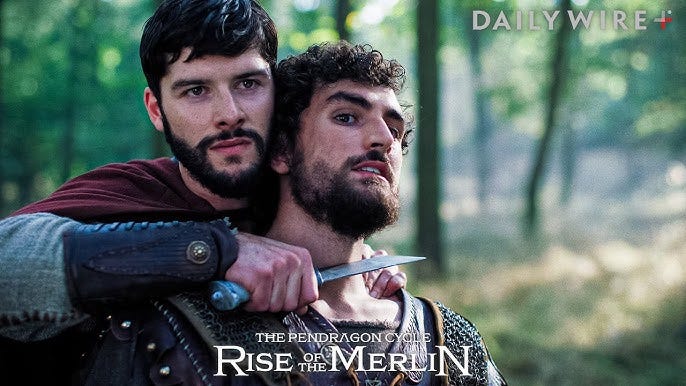
Merlin returns after the battle to meet Aurelius and Uther. Aurelius carries the sword of a former Roman emperor, a relic that Arthurian fans will recognize as deeply loaded with meaning. Merlin recognizes Aurelius as the rightful king and pledges to help solidify his claim. This requires traveling back to his homeland, a place where he’s unwelcome and hasn’t visited in years.
The episode ends with Merlin’s return home and a reunion with his mother—a moment of warmth after an hour of political maneuvering and violence. We also see Dafyd, the priest from episodes one and two, now much older. In a nice bit of symmetry, Merlin frees Dafyd from chains in this episode, just as Dafyd once freed Merlin.
Faith, Prophecy, and Linear Storytelling
“A Fatherless Child” is the first episode that feels like traditional episodic television. The first two episodes could have been released as a standalone prequel film, disconnected from the main narrative that begins here. This episode establishes Merlin as the protagonist, gives him clear objectives, and surrounds him with a cast of political players whose motivations are immediately comprehensible.
Tom Sharp’s performance as Merlin is charismatic and grounded. He plays the character with quiet certainty, a man who has glimpsed both past and future and understands his role in the unfolding story. The show leans into the Christian elements of Lawhead’s novels with Dafyd’s presence, moments of prayer, the theme of faith triumphing over chaos.
Vortigern, by contrast, feels less ruthless than the novel version. He’s nervous, paranoid, but not quite the tyrant the text presents. Uther, meanwhile, is being positioned as a future antagonist. He questions Merlin repeatedly, while Aurelius demonstrates faith in the wizard. Anyone familiar with Arthurian legend knows where this is headed, and the show is planting those seeds early.
Production and Pacing
The battle sequences are well-executed and clearly consumed a chunk of the budget. The show relies on practical effects and real-world stunt work rather than a lot of CGI, giving the action a tactile, grounded quality that recalls television from the ‘90s and early 2000s, before digital effects became the default solution for every visual problem. There are a few CGI moments, but they’re minimal.
The violence is also more pronounced than in the first two episodes. Those were relatively family-friendly; this one earns a harder content warning. There’s blood, brutal combat, and executions. If you’re comparing it to a Marvel film, this is more violent. Parents with children under ten should take note.
The pacing is tight. The episode moves quickly without feeling rushed, balancing character moments with political intrigue and action. The narrative is linear, focused, and propulsive in a way the first two episodes weren’t. You care about the characters because the show finally gives them room to exist as people rather than historical figures being moved across a timeline.
The Series Finds Its Voice
“A Fatherless Child” is the episode where The Pendragon Cycle stops being a prologue and becomes a show. The first two episodes were necessary—they established Merlin’s lineage and the historical context—but this is where the story actually begins. Merlin has a mission. Aurelius has a claim to defend. Uther is waiting in the wings. The pieces are moving into place for the arrival of Arthur, and the show has found its narrative footing.
The acting is strong across the board. The side characters are well-cast and given enough dimension to matter. The production values are impressive, particularly for a Daily Wire Plus series operating outside the traditional Hollywood system. The commitment to practical effects and location shooting gives the show a visual authenticity that CGI-heavy productions often lack.
If the first two episodes were a test of patience, “A Fatherless Child” is the payoff. The show has transitioned from historical chronicle to character-driven drama, and the result is the strongest episode yet.
9/10 - some of the best fantasy TV in awhile.
What do you think? Does the shift to linear storytelling improve the series, or did you prefer the historical structure of the first two episodes?
NEXT: Brandon Sanderson’s Apple TV Deal Reveals Why Stormlight Archive Went Woke in Wind and Truth
If you enjoy great fantasy fiction with great worldbuilding and a classic D&D feel, read The Adventures of Baron von Monocle six-book series and support Fandom Pulse!