


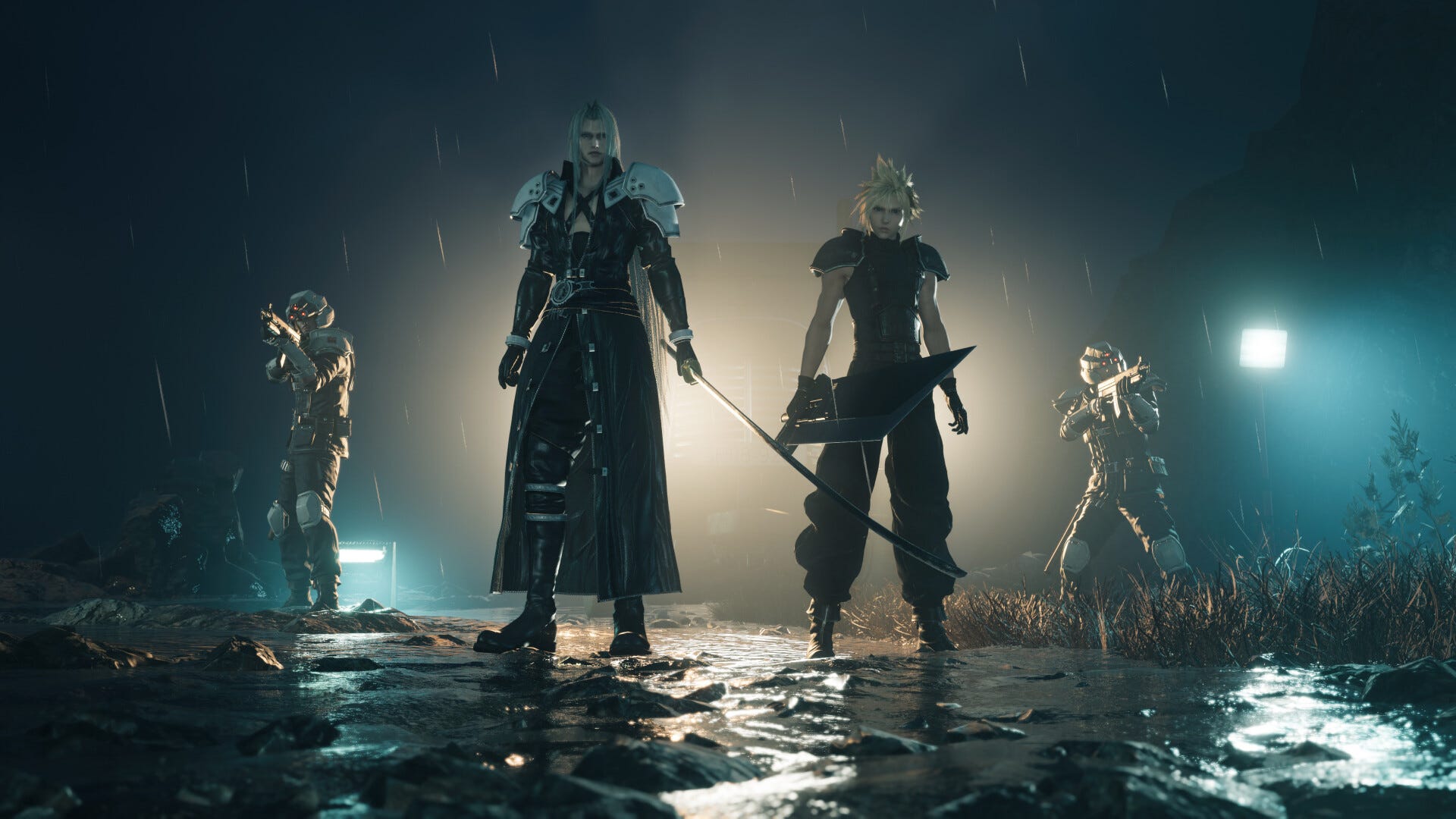
If the last decade has taught us anything about most AAA video games, it is that the people who make them should have been movie directors instead. This aspect has been mocked, recently, in an Unreal Engine 5 fan render of a gritty Mario game alongside a couple of voiceovers.
A voice actor and cosplayer named ryanstewartvo shared a video recently showing a UE5 Mario navigating a dark, linear jungle environment at night, complete with the classic layout of question blocks, Goombas, and green warp pipes. All of a sudden, Mario starts chatting with nobody in particular, a peculiar narrative convention known as "diegetic monologue" or "expository barks." He then starts up a conversation with Princess Peach, and the beats start becoming more familiar.
The video is a clever mockery of what has too long been a facet of AAA gaming. Cinematic ambitions have taken over and the “video game” begins to sound like it wants to be a film with its own scripted narrative beats, arcs, and emotional cues. The logic of play has now yielded to the logic of cinema. This type of writing has become so ubiquitous nowadays that it often passes without comment. Yet it represents an extremely lazy methodology by which AAA writers communicate information to an audience while trying to maintain immersion.
Tutorials For Idiots
Originally, this technique emerged as a replacement for more intrusive forms of communication such as UI pop‑ups, blinking arrows, or explicit tutorial screens to instruct the player. Ultimately, it is an attempt to preserve the illusion of a seamless world while still delivering the necessary scaffolding for player comprehension.
However, what ryanstewartvo has shown us is that this trope has been utilized so often that it has started to impose its own narrative consequences. When characters speak primarily for the player’s benefit, their interiority becomes instrumentalized. In other words, their thoughts are no longer expressions of personality or depth, but another layer of intrusive handholding for the modern gamer.
What's more, the characters themselves start losing their humanity and, instead, become recognized as another conduit for the video game's design logic. This is why so many AAA protagonists sound strangely similar: they are not speaking as individuals but as interfaces for the player. Their speech is shaped less by who they are than by what the player needs to know at any given point in time. A brooding warrior, a traumatized wanderer, or a taciturn investigator cannot realistically mutter a steady stream of hints without breaking the very persona the narrative claims to be building. The result is a homogenizing pressure: characters converge toward a middle register of lightly self-narrating, mildly anxious, conveniently articulate protagonists.
Different studios have attempted to handle this tension in distinct ways. Narrative‑driven developers like Naughty Dog or Sony Santa Monica embedded this trope within character psychology. Ellie mutters to herself in The Last of Us Part II or Kratos offers terse observations in God of War. Ubisoft titles have also used expository barks more mechanically, turning them into a constant stream of hints and reminders for the player. Meanwhile, studios like FromSoftware have avoided the technique almost entirely, preserving immersion by refusing to let characters speak unless the fiction demands it. Each approach reflects a different philosophy of player agency and narrative coherence.
Eventually, AAA studios will have to address the growing backlash against the constant intrusiveness of modern design “solutions” like diegetic monologuing, if only because players become smarter (if not more intelligent) over time.
Modern Games and Trust Issues
At this point, let me whip out the old, “Back in my day, we weren’t given the solutions to anything and we figured it out for ourselves.”
Lest I sound like a Boomer, let me explain that this means an older gamer like myself isn't longing for difficulty, but for a studio that trusts me to figure it out myself. Many of the older games I grew up playing had a design ethos that assumed the player was capable, attentive, and willing to engage the world on its own terms. Older games, by necessity and by philosophy, treated the player as an active participant rather than a passive recipient. They communicated through level geometry, enemy placement, environmental rhythm, and silence. They expected you to observe, to experiment, to fail, and to learn.
Modern AAA design, by contrast, often assumes the opposite. It assumes the player is impatient, easily confused, and liable to disengage if not constantly shepherded. Hence the yellow paint. Hence the chatty companion. Hence the protagonist who mutters every thought aloud like a walking hint system. And while these devices are not inherently bad, their overuse signal to me a huge disparity between game developers and players.
When a game refuses to let you sit with uncertainty, even for a few seconds, it communicates that uncertainty is a failure state rather than a natural part of play. When a companion blurts out the solution to a puzzle before you’ve even surveyed the room, the game is effectively saying, “We don’t believe you're capable of handling this.”
Older games, with far fewer resources, achieved more with less. They didn’t need to explain themselves because their design language was coherent. They didn’t need to narrate every intention because the world itself taught you how to read it. They didn’t need to fill silence because silence was part of the atmosphere, part of the tension, part of the identity of the medium.
AAA Games are Movies With Extra Steps
Yet, what has also compounded this problem is that the industry’s gravitational pull has shifted toward cinematic ambition while the actual grammar of play has been subordinated to narrative beats, camera choreography, and emotional arcs modeled on film rather than on game systems. Studios hire screenwriters from television and structure production around mocap sessions. This means that, beyond diegetic monologue acting as constant tutorial, they are wiring your brain to treat gameplay as connective tissue between cutscenes in a movie. Indeed, the true aspirations of modern game developers is to fold you into a cinematic ordeal rather than a test of hand-eye coordination.
The medium’s most influential creators increasingly think of video games in terms of movie shots, not mechanic. And so the games they make behave accordingly. This is essentially why diegetic dialogue proliferates and why companions chatter incessantly. These are not design choices born from the logic of play, they are cinematic conveniences retrofitted into an interactive medium that increasingly distrusts its own inherent strengths. Instead of embracing interactivity, it mitigates it. Instead of cultivating player agency, it scripts around it. Instead of designing worlds that teach themselves through structure, rhythm, and consequence, it overlays cinematic scaffolding to ensure the player receives the intended emotional experience.
So yes, if the last decade has taught us anything, it is that many AAA creators would be happier (and perhaps more honest) working in film. And, to be frank, the medium suffers when its architects try to force cinematic logic onto interactive foundations. Games lose their identity and players lose their agency.

Detroit Becoming Human is a prime example of this.
Poignant. DOS2 comes to mind...