



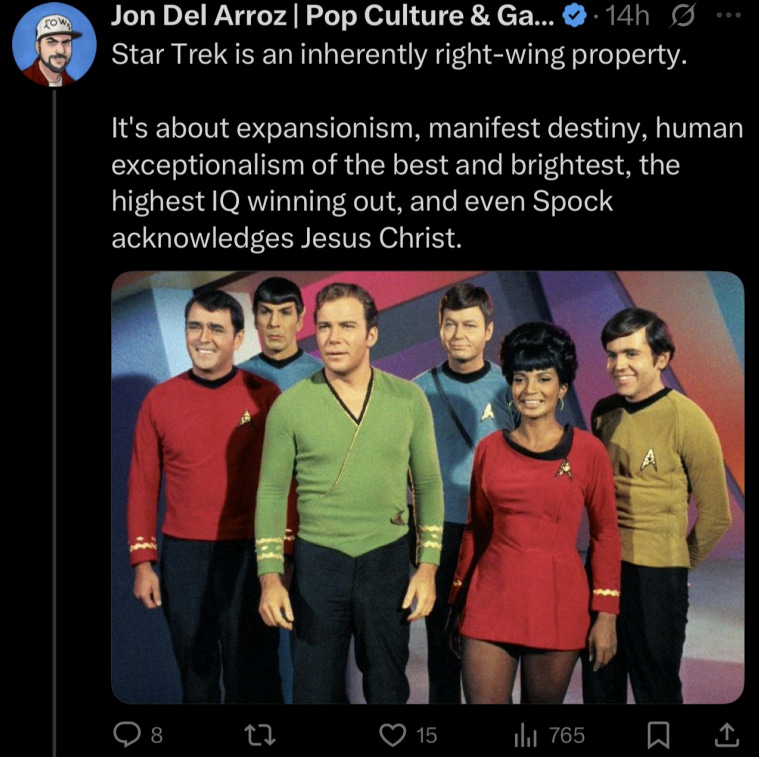
This essay was inspired by the following post:
I am not, by any stretch, a Trekkie. I do not own a replica phaser, I do not speak Klingon, and I do not believe in warp speed, unless you’re talking about the rate at which evangelical churches are abandoning their pulpits for TED Talks. But every now and then, the cultural detritus of our age cough up something worth examining. And in this case, it’s an episode of Star Trek: The Next Generation called “The Measure of a Man.”
Now before you roll your eyes and accuse me of baptizing the secular sci-fi of Star Trek, let me assure you: I am not interested in redeeming Starfleet. I am interested in exposing the theological residue that even the most secular stories cannot quite scrub off. When the writers of Star Trek set out to explore the question of personhood, they stumbled into a profoundly Christian dilemma. And they answered it, again quite accidentally, in a profoundly Christian way.
The Android in the Imago Dei
The episode centers on Data, an android who is on trial despite not having committed any crime. No, he is on trial for his very existence. The question before the court is whether Data is a person or merely a piece of hardware. Is he a man with rights, or a tool to be used and discarded?
The episode unfolds in a courtroom aboard Starbase 173, where Commander Bruce Maddox, a Starfleet scientist with more ambition than wisdom, seeks to disassemble Lieutenant Commander Data in order to replicate his design. Maddox insists that Data is not a person, but property. A machine. A thing. And therefore subject to Starfleet’s authority
Captain Picard objects. Of course, not because Picard is sentimental but because he recognizes what is truly at stake. If Data is to be considered the same as property then the Federation has crossed a line it cannot easily withdraw from. For Picard, the line is not legal line but a moral one. Therefore, a hearing is convened, a judge is appointed, and arguments are made.
Riker, dutifully (and tragically) is forced to prosecute the case against Data. Regardless of his friendship with Data, he is forced to demonstrate that Data has no biological life, no emotions, and can be turned off with the flip of a switch. The moment in the show is devastating and is far more impactful than any modern CGI battle could ever render. And it is one that nearly wins the case against Data. However, this also makes Riker and Data’s reconciliation at the end of the episode far more meaningful.
Miraculously, the judge rules in Data’s favor. And no, this is not because “the science is settled,” but because the question is too sacred to answer lightly. When faced with uncertainty about personhood, the wise course (the Christian course) is to err on the side of life.
Again, this is not a matter of sentiment. This is a matter of stewardship. When the boundaries of personhood are unclear, the faithful do not draw lines with scalpels or statutes. They draw them with reverence. Because if we are wrong in granting personhood, we have dignified a machine. But if we are wrong in denying it, we have desecrated a soul.
Personhood is a Divine Institution
If you squint hard enough, you’ll see the outlines of a familiar debate. Because this is not just a question about androids. It’s a question about abortion. Not just abortion, but slavery, euthanasia, and every instance where the line between person and property is drawn (and redrawn) by those in power.
Let us not forget the infamous Dred Scott v. Sandford decision, in which the Supreme Court declared that a slave could be property in one state and a person in another. That ruling was not just legally incoherent, it was metaphysically bankrupt. It treated personhood as a matter of geography, not ontology. In doing so, it laid bare the moral schizophrenia of a nation that had forgotten its Creator.
What the Supreme Court has not acknowledged is that abortion laws work the same way. It declares that a child in the womb is a person only when convenient. This is the same lie as it was used for chattel slavery and it is a lie that Star Trek, to its credit, refutes. In the end, the Federation chooses life. Not because it is efficient or profitable. But because it is right.
As Neil Gorsuch has said, this is a case where the Judiciary has exceeded its intended scope. And, just like the American Civil War, there is ongoing reckoning that is already occurring as a result of abortion laws. Even now, we are under God’s judgement.
The Sermon of Picard
Now, let me pivot to the ecclesiastical implications. Jon Del Arroz has rightly pointed out that much of modern Christianity has replaced the altar with the podium. The preacher has become a performer. The sermon has become a soliloquy and the church has become a theater.
Picard’s speech reminds us what a sermon is supposed to be. It is not a motivational talk or stage presentation. Instead, it should be a declaration of truth and a proclamation of the gospel.
Picard does not quote Scripture, much less invoke the name of Christ. He does not speak of the imago Dei, the Fall, or the Cross. But make no mistake, his is a borrowed truth. While not native to the Galactic Federation, Picard’s moral message is smuggled in from a deeper tradition that predates warp drives and replicators. It is a tradition that began in Genesis.
In “The Measure of a Man,” Picard stands before a tribunal and defends the personhood of an android. He does not argue from utility. He does not appeal to emotion. He appeals to essence. He asks the court to consider not what Data does, but what Data is. And in doing so, he echoes the moral architecture of the Christian worldview.
In biblical anthropology, personhood is not earned. It is not granted by the state, nor is it contingent on intelligence, productivity, or social recognition. It is bestowed by God, at conception. And Picard, whether he knows it or not, is preaching that truth. He says, in effect, “We must not make this decision lightly. We must not treat sentience as a commodity. We must not play God.” And that, dear reader, is a sermon. It is a sermon without chapter and verse, but it is a sermon nonetheless.
The Gospel According to Starfleet
For Jon to say that Star Trek is inherently Christian, I take things a step farther in saying, yes of course! But only because Christianity is inescapable. Christ is inevitable. Anything else is blasphemy.
You can dress your characters in space suits and send them to the edge of the galaxy, but you cannot outrun the imago Dei. You cannot escape the moral architecture of the universe. You cannot deny the truth that every person (born or unborn, slave or free, human or android) is made in the image of God.
And so, when Picard stands up and defends Data, he is doing more than making a legal argument, he is preaching. And the sermon is simple: Choose life.
NEXT: New Report Indicates That J.J. Abrams’ ‘Star Trek’ Films Are Dead At Paramount

Hear, hear!
I miss the Star Trek that looked at philosophical issues deeper than: “Is diversity good or plus good?”
The hacks that took over the property never understood WHAT exactly Trek was beyond some mitwit belief that “Trek=phasers and Klingons”.