


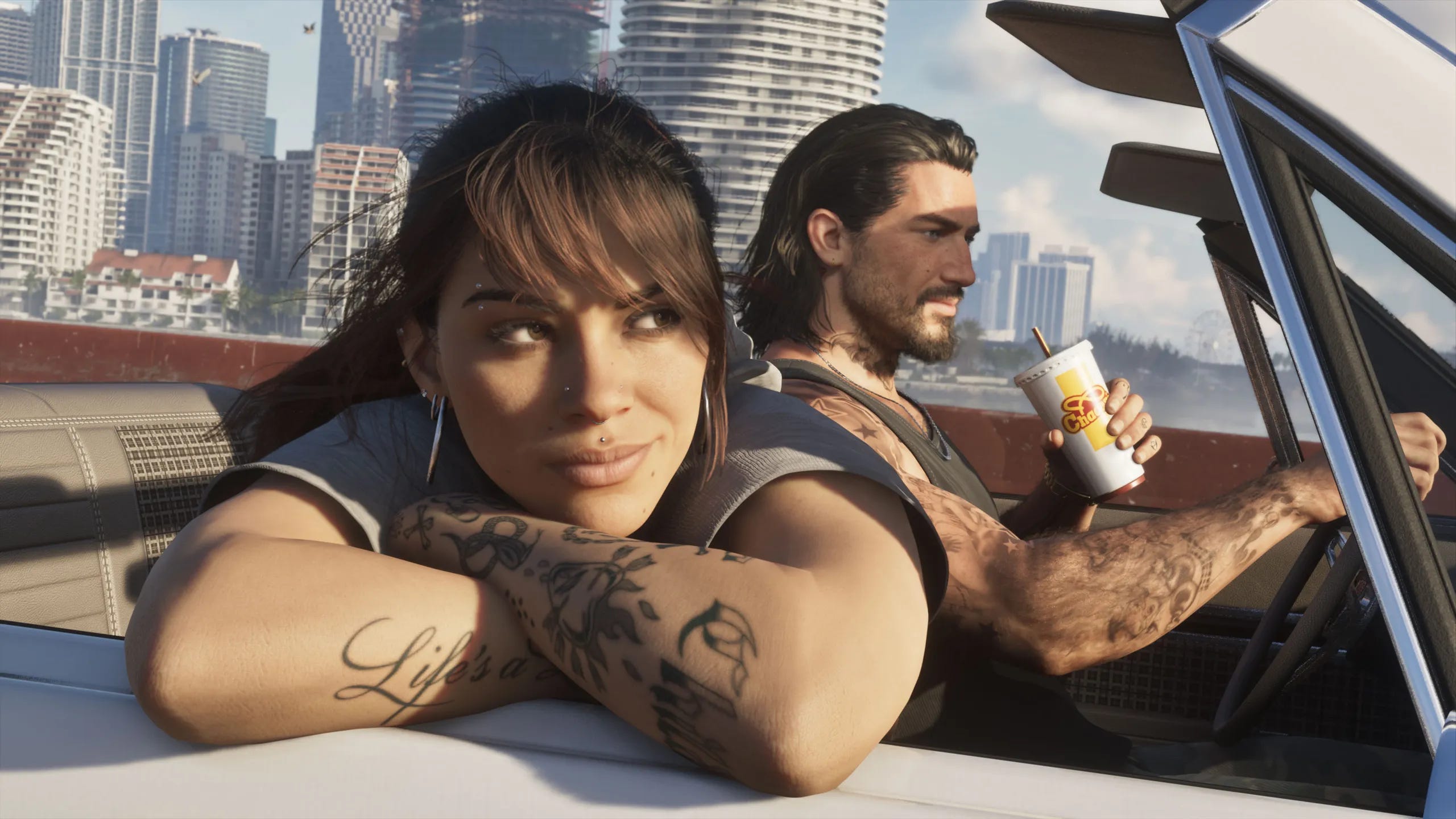
In March 2020, Dan Houser, one of the principal creative forces behind Rockstar’s Grand Theft Auto storytelling, departed the company. That same year, Alexa D’Agostino, whose professional background included psychology and television production at Nickelodeon, joined Rockstar’s writing department. Elizabeth Gauvey-Kern also entered the company’s writing ranks during this period.
With Grand Theft Auto VI, Rockstar appears to have moved away from the cynical, irreverent storytelling that defined its earlier titles, embracing instead a considerably more ideological approach to its protagonists. At the center of this apparent shift is a distinctly feminist vision of the game’s leading characters, one that places particular emphasis on female empowerment and the dynamics between men and women.
Lucia has been thoroughly discussed by the people responsible for bringing her to life.
D’Agostino, whose background includes psychology and television production at Nickelodeon, has described Lucia as being inspired by her immigrant mother from Newark. In her own words, her mother was “rowdy, kind, but not to take any shit.” D’Agostino also expressed her desire to create a woman who could “stand tall next to the likes of Arthur Morgan and Niko Bellic.”
So, it would be one thing if all these writers wanted to do was create a compelling female protagonist. In fact, that kind of thing ought to be encouraged. However, this is the same old story we have seen time and again in so much modern media: making the female character a vehicle for demonstrating that women are just so much better than men.
Now, the protagonists of earlier Rockstar titles weren’t necessarily the best of people. Niko Bellic was a traumatized immigrant and former soldier haunted by his experiences in war, struggling to reconcile his past with his ambitions in America. Arthur Morgan was an outlaw whose loyalty to his gang increasingly conflicted with his conscience. John Marston was a former gunslinger desperately trying to escape his criminal past and fulfill his responsibilities as a husband and father. Even Michael De Santa, despite his considerable shortcomings, was a character whose story revolved around anxieties surrounding family, fatherhood, personal achievement, and the consequences of a life spent pursuing wealth and status.
These were distinctly male protagonists inhabiting distinctly male-oriented stories. Their narratives explored concerns traditionally associated with masculine experience: brotherhood, loyalty, violence, honor, fatherhood, ambition, and the burden of responsibility.
Earlier Rockstar characters were explored through stories that, ostensibly, treated masculinity as something worthy of respect rather than something that needed to be apologized for. Men were allowed to have moments where they could be courageous, selfish, destructive, and protective. They weren’t required to serve as “positive” representations of their sex. They were simply men being the best men they could be given the circumstances of the setting and story.
This brings us to Jason in GTA VI. Just how much of a man is Rockstar willing to allow him to be? Jason occupies the position of Lucia’s supporting partner. While his character development is closely tied to their relationship, Lucia receives considerably more attention in terms of who is driving the story forward.
While there is nothing inherently wrong with portraying a man as devoted to his wife, a distinction must be made between a man whose relationship forms an important part of his character and a man whose character exists primarily in service of his wife. For Jason, his development will ultimately be measured by how well he complements Lucia’s journey (and the game’s “good” ending is a reflection of that).
What has become clear is that the studio’s creative priorities have changed and that its approach to character development is increasingly being filtered through contemporary ideological expectations surrounding male/female identity politics.
D’Agostino’s language surrounding the conception of Lucia makes everything clear. We hear about immigrant authenticity, female empowerment, and the ambition to create a woman who can stand alongside the studio’s most celebrated male protagonists. What becomes abundantly clear is that the character was being developed primarily as a representation of an ideal.
Players expecting the old Rockstar sensibility will be sorely disappointed in this title. The studio’s priorities have definitely changed, and the entire conception of Jason’s character is the clearest indication yet of just how much.
What do you think? Has Rockstar abandoned something important about its older approach to storytelling? Or is this simply the natural evolution of a studio introducing a new generation of protagonists?
