I went into this book expecting a cash grab. Tolkien publishing has a reputation problem: a translation, an essay, or a half-finished poem gets stretched to 200 pages and sold as a new book. When I heard a Second Age book was coming out around the time Amazon launched The Rings of Power, I assumed it was more of the same.
I was wrong. It’s the best-organized Tolkien compilation I’ve read, and much more interesting to a general fantasy audience who loves Lord of the Rings than most of the works out there.
How the book came about
Tolkien left his Second Age material scattered, and for decades readers had to piece it together themselves. For years, all most readers had of it was a few tantalizing glimpses in The Lord of the Rings and its appendices: the forging of the Rings of Power, the building of Barad-dûr, and the rise of Sauron. The fuller story arrived when Christopher Tolkien published The Silmarillion in 1977. Though that book is mostly about the First Age, its final two works revealed the rise and fall of Númenor, the forging of the Rings, and the Last Alliance of Elves and Men. More followed in Unfinished Tales and in Christopher’s twelve-volume History of Middle-earth, which presented his father’s drafts and abandoned versions.
That left a real problem. The Second Age was spread across five or six books, in different formats, with different levels of finish. Some of it is polished narrative and some is raw draft. Some is a dry chronology in an appendix, and some is a scholarly discussion of how Tolkien changed his mind.
Christopher died in January 2020, and the Tolkien Estate has continued publishing under other editors. This book is a new kind of Estate project. It’s an arrangement of existing texts by an editor other than Christopher, built to make the whole Second Age readable in one place.
On timing, HarperCollins announced it as arriving conveniently alongside Amazon’s Rings of Power, also set in the Second Age. The book actually came out two months after the show’s debut. It was released in hardback and deluxe editions on November 10th, 2022, two months after The Rings of Power premiered. So it’s a companion to the Second Age as Tolkien wrote it, not an official companion to the show. That’s part of why I trust it.

The editor
The editor is Brian Sibley, and he’s a good fit. He’s best known for adapting The Lord of the Rings for BBC Radio in 1981, and he went on to write companion books for Peter Jackson’s films. He has spent decades turning Tolkien’s dense material into something general readers can enjoy, which is what this reads exactly like.
What it is
The framework is the “Tale of Years,” the Second Age chronology in the Lord of the Rings appendices. Sibley followed its timeline to assemble a chronicle of the Second Age told substantially in Tolkien’s own words from the published texts. He also wrote new introductions and commentary, and his introduction to the chronology is titled “The Saga of ‘A Dark Age.’”
The sources include The Silmarillion, Unfinished Tales, The Lord of the Rings, and volumes of The History of Middle-earth. Tolkien’s words carry the story. Sibley’s job is to place each piece in order and give you enough context to follow it.
Here is the honest caveat, and it’s worth including. A reviewer in Tolkien Studies noted that the book contains nothing that wasn’t already in print, but its largely chronological rearrangement has value. I agree on both counts. If you want new Tolkien text, this isn’t that. If you want the Second Age as one coherent story, nothing else does it this well.
Why it works
It reads more easily than The History of Middle-earth, which is a magnificent scholarly project but a slog if you want a story. It’s also easier to take in than the appendices, which are packed with information but written in compressed, reference-book style.
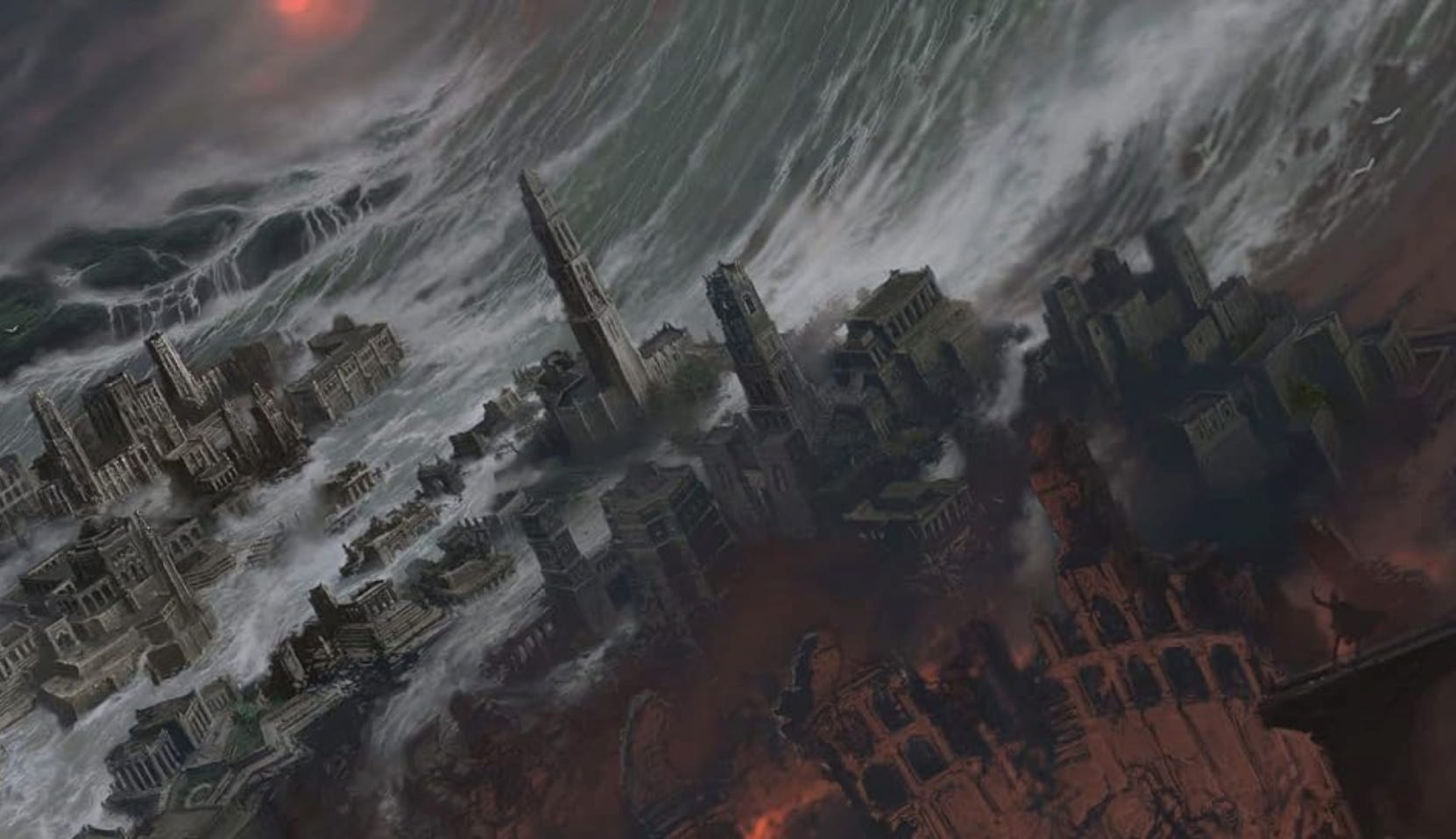
Here the history flows. You follow the rise of Númenor, the slow corruption of its kings, Sauron’s manipulation of the Elven-smiths and then of Númenor itself, and the Downfall. The Last Alliance and the survival of the Faithful follow. The context sits right in front of you, not in a footnote three volumes away.
I’d read almost all of this before, and I still finished it in a couple of days. I came away with a clearer sense of how the Second Age fits together, which is more than I expected from a book of reprints.
The art and the editions
The art is almost as great as the book itself. Alan Lee, who illustrated The Lord of the Rings and The Hobbit and won an Academy Award for his work on Peter Jackson’s films, provides the pictures. The deluxe edition contains ten new watercolors and more than fifty pencil drawings. That edition also includes a newly colored version of Christopher Tolkien’s map of Númenor, and it comes in a slipcase. If you’re a collector, the deluxe edition is a handsome object.
Why read it before Season 3
With The Rings of Power heading into Season 3, this is a good time to pick it up. Amazon holds the rights to The Lord of the Rings and The Hobbit, including the appendices, but not to The Silmarillion and the rest of the legendarium. The show has had to compress thousands of years of Second Age history, and it has rearranged characters, events, and motives to make that work.
Read this book and you’ll know what Tolkien actually wrote about Númenor, the forging of the Rings, and the Faithful who survived the Downfall. Then you can judge the show on its merits. Some changes may work for you and some may not. At least you’ll know which is which. Even fans who love the series may be surprised by how much in the book never made it to the screen.
The verdict
If you’re a Tolkien enthusiast, buy it. It isn’t a grift. It’s a well-edited, beautifully illustrated guide to one of the richest periods in Middle-earth’s history, arranged so a reader can take it in. Plenty of Tolkien books are for completists only. This one is for anyone who wants to understand the Second Age.
Six books. One unforgettable world. The Adventures of Baron Von Monocle is steampunk adventure with the kind of worldbuilding and heart that made you fall in love with fantasy in the first place. Start the series on Amazon.