


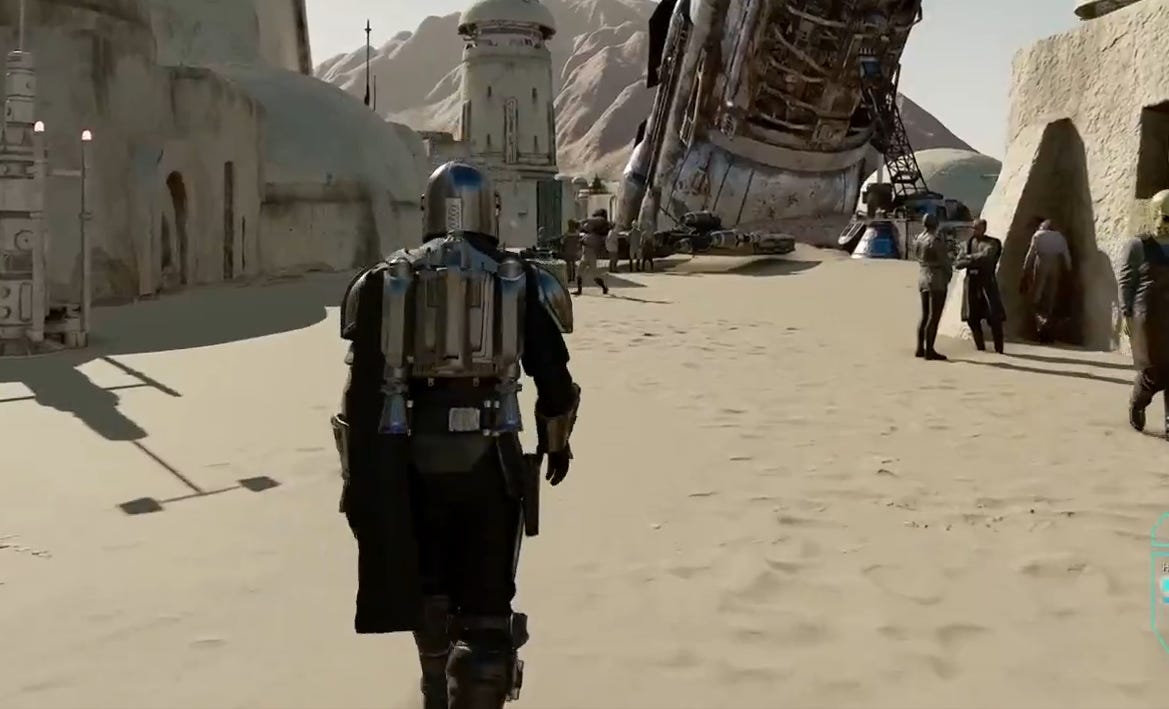
Recently, John F. Trent notified me of something bizarre but revealing: modders have effectively transformed the video game Starfield into a Star Wars RPG. And, no, not a "fun reskin,” nor a "handful of themed tweaks,” but a 250‑gigabyte total conversion with more than 300 mods that rewrite every line of dialogue, every quest, every asset, and now even add fully functional lightsabers. And the wildest part isn’t the scale, it’s that the whole thing installs in a few clicks and runs more stably than many AAA releases.

What's worth remarking on here is this is one of a number of instances where modern AAA gaming is propped up by the labor of fans who will never be materially rewarded for their work. They do it anyway. They do it joyfully, even obsessively, and all with a level of investment that often eclipses that of the original creators.
People might say we’re “less religious” now, but how then does one elaborate on the utility of the act of pouring devotion, time, and creativity into something that cannot repay you? Modding communities build cathedrals out of code, preserve worlds the studios abandon and resurrect games long after the market has moved on. Skyrim and Fallout: New Vegas are primary examples of games that survive because their communities refuse to let it die.
This is not commerce. It’s not even fandom in the shallow, consumer sense. This is religion, plain and simple.
The Strange Case of Conformity Gate
Which brings us to “Conformity Gate,” the viral theory surrounding the Stranger Things Season 5 finale. On its surface, the theory is just another internet rabbit hole: fans arguing that the peaceful epilogue is actually an illusion crafted by Vecna. Fans have dug their heels deep into this one, pointing to odd details like characters folding their hands mimicking Henry Creel’s posture, graduation gowns are the wrong color, D&D book spines spelling “X A LIE,” background characters staring into the camera, and Lucas muttering “I don’t believe in coincidences.”
Netflix has already denied the existence of a secret ninth episode. The cast has given their diplomatic “this is the ending we intended” statements. Officially, the matter is closed. But the theory’s existence stands as the fandom's stringent denial of reality. The true reality, however, is that fans are thinking harder about the show’s themes, symbols, continuity, and metaphysics than the creators ever have or ever will. Fans are treating the show as if its events were really happening and might still reveal some hidden ending if they just believe hard enough.
Sadly, like the modders, they will never be deferred to. Their interpretations will never be canon, their labor will never be acknowledged, and their love will never be reciprocated.
The Devotion Paradox
Across games, shows, and franchises, the pattern is the same:
Fans build worlds they don’t own.
They repair stories they didn’t break.
They elevate works whose creators have moved on.
They pour in thousands of hours with nothing to gain.
This is not the behavior of a disenchanted, secular culture. It’s the behavior of a culture that has redirected its religious impulses into fictional universes. And the industries benefiting from this devotion seem to understand this to some extent. Beyond treating fans as consumers, there is a concerted effort to treat media as a beacon of soft power. Fans are meant to consume the product like everyone else, and also to conform to whatever political messages the creators have endowed their products with.
You will accept the canon ending.
You will acknowledge that Will Byers is a homosexual.
You will submit to your progressive cultural programming.
J.R.R. Tolkien argued that myth is not a lie but a mode of truth or a way of expressing realities too deep for literal language. He believed fantasy reveals “underlying reality,” not escapism but a form of clarity. Lewis, once a skeptic, came to agree: myth is meaning itself, a way of experiencing truth directly rather than abstractly.
Both men believed humans are myth‑making creatures by nature which means we go beyond consuming stories as products; we ought to inhabit them, interpret them, reshape them, and pass them on. Tolkien called this as “sub‑creation” or the human impulse to imitate divine creativity by building worlds of our own.
What modders are doing to Starfield or what fans are attempting to rectify with Stranger Things is precisely the kind of impulse Tolkien is referring to: a grand participating in the ancient human vocation of mythmaking. People are taking a fictional world that exists in fragments and reshaping it into a coherent mythic space that feels true to them. “Conformity Gate” is less a viral fan theory and more a hermeneutic tradition where communities do what human beings have always done: interpret, preserve, expand, and sanctify the stories that matter to them. That goes beyond the simplistic "escapism" that many would otherwise insist on.
Stories are very real. Not in the material sense, of course, but in the sense that they still affect the material world by affecting us.

This is especially true for science fiction where the line between science (a practical reality) and fiction (a fantasy reality) is as blurry as the human imagination can make it. There are more than a few Gen X today who are mad that the Star Trek prophecies of idyllic global multiculturalism, exciting alien encounters, and other storylines have not come true yet.
About 3 years ago, I started building an unreal engine model of a set piece that spans several of my science fiction stories.
It has now become clear that I will never use it for anything, so I've made a few passes at releasing it into the wild, thinking that hobbyists and enthusiasts might make CGI movies with it.
Reading this essay makes me think I should be more clever about getting the word out.
http://johndyerwrites.com/2025/10/15/call-for-collaboration-ue5-cinematic-showreel/