



The first two episodes adapt Taliesin, Lawhead’s novel about the last princess of Atlantis and the Celtic bard who becomes her husband. Charis (Rose Reid) escapes Atlantis’s destruction with her father, King Avallach, and a remnant of their people. They sail to Britain, where they establish a new kingdom among the Celtic tribes. Meanwhile, Taliesin (James Arden) is a young bard whose people are displaced by invading forces. The two groups occupy the same land, leading to political tension and cultural clash.
Charis and Taliesin meet, fall in love, and marry despite the political complications. Their union bridges Atlantean and Celtic cultures, setting the stage for Merlin’s birth and the eventual rise of Arthur. The episodes end with Merlin’s birth and the tragedy that shapes his early life, transitioning from Taliesin’s story to Merlin’s.
The series makes necessary compressions from the novel. Lawhead’s book spends significant time on Charis’s youth in Atlantis and Taliesin’s early training as a bard. The show condenses these into focused scenes that establish the essentials while moving the story forward. For viewers unfamiliar with the books, this creates some accessibility challenges—the names Charis, Avallach, and Taliesin aren’t as familiar as Arthur, Merlin, and Lancelot. But for readers of Lawhead, the adaptation is meticulous and faithful.
The writers incorporated dialogue directly from Lawhead’s prose, and the key scenes are recreated with care. The bull dancing sequence, where Charis performs the dangerous Atlantean ritual and is injured, is lifted almost directly from the novel. Rose Reid was the only cast member actually in the ring with professional bullfighters for this scene—a commitment to practical filmmaking that’s rare in modern television. The sequence uses choreography, timing, and practical effects to create tension without expensive CGI, and it’s one of the highlights of the first two episodes.
Another standout is Taliesin’s performance before the court in episode two. The scene mirrors the book perfectly, with Taliesin singing a Celtic song that captivates the audience and establishes his reputation as a bard. The song feels authentic—old, haunting, and distinctly Celtic. The show plays up Taliesin’s role as a bard throughout, giving him multiple opportunities to perform and demonstrate why he’s respected in his culture.
The Casting: Rose Reid Steals the Show

Rose Reid is phenomenal as Charis. She’s strikingly beautiful, which is essential for a character described in the books as the most beautiful woman in the world, but she also brings depth and vulnerability to the role. Charis is the last princess of a fallen civilization, bearing the weight of her people’s survival as she navigates a foreign culture. Reid captures that burden without making Charis passive or fragile. She’s the Lady of the Lake in all but name, and Reid makes her the emotional center of the first two episodes.
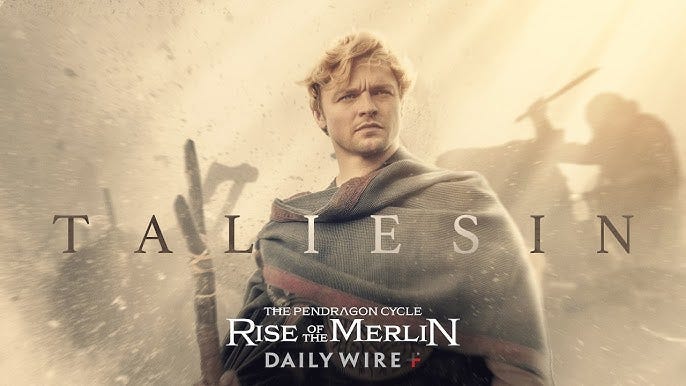
James Arden is solid as Taliesin. He doesn’t have Reid’s screen presence, but he conveys the character’s intelligence, sensitivity, and growing confidence as a bard. The relationship between Charis and Taliesin develops naturally, and the chemistry between Reid and Easterbrook sells the romance that drives the story.
The supporting cast is competent, with King Avallach and the Celtic chieftains filling their roles effectively. Morgan, the temptress who becomes a background antagonist, is introduced subtly, setting up conflicts that will presumably pay off in later episodes.
What sets this production apart is the cast’s commitment to authenticity. The actors worked with accent coaches to ensure their Celtic and Atlantean dialects felt consistent and real. They went through horseback riding boot camp to handle the extensive riding scenes without relying on stunt doubles or CGI. The physical preparation shows. When characters ride horses, fight, or perform physically demanding tasks, it looks real because it is real.
This commitment to practical performance is increasingly rare in fantasy television, where green screens and digital doubles have become the default. The Daily Wire’s approach prioritizes authentic performances over technological shortcuts, and the result is a show that feels grounded and tangible.
The Production: Practical Effects and European Authenticity
The Pendragon Cycle proves that fantasy television doesn’t require Game of Thrones budgets. The show prioritizes character-driven scenes, political negotiations, and relationship building. When action is needed, the production uses practical effects, makeup, and physical filming techniques rather than defaulting to CGI, which makes this feel like a TV show out of the 90s rather than something modern, and that’s a good thing.
The production filmed extensively on location in Europe, giving the series an authentic period feel that soundstages can’t replicate. The Atlantean refugees’ settlement looks like a real community. The Celtic villages feel lived-in. The forests, coastlines, and landscapes are real locations that ground the fantasy in tangible reality. This commitment to location shooting adds production value that CGI environments can’t match.
The costumes also look gorgeous and set the scene perfectly. The production design emphasizes authenticity. The sets are simple but effective, built practically rather than digitally for the most part, other than some of the scenes with the fall of Atlantis, which are placed more into the background with implied destruction in Charis’s memories that flash at times than spending much time with it on screen.
The music is a highlight. The Celtic-inspired score enhances the atmosphere without overwhelming the scenes, and Taliesin’s songs are genuinely good, which is an important part of the novels that translates well here. The show understands that music is central to the character and the culture, and it treats the performances with respect.
The Faithfulness: Lawhead Fans Will Appreciate This
For readers of Lawhead’s Pendragon Cycle, The Rise of Merlin is a faithful adaptation that respects the source material. The writers clearly love the books and have done their best to translate Lawhead’s prose to the screen. The dialogue incorporates lines from the novels, the key scenes are recreated with care, and the thematic concerns with faith are preserved, which is refreshing to see on modern TV.
The show doesn’t shy away from Lawhead’s Christian themes. Charis’s people worship the old gods, but the arrival of Christianity in Britain is treated as a positive force that brings hope and moral clarity. The show doesn’t preach, but it doesn’t hide its perspective either. That will appeal to The Daily Wire’s core audience while remaining accessible to general fantasy fans who appreciate stories with spiritual depth.
The decision to keep the content clean is a major selling point. The show avoids graphic violence and explicit sexuality, making it appropriate for families. There’s mild violence, but it’s not gratuitous. There’s romance, but it’s handled without delving into any excesses or having sex scenes. This is fantasy television you can watch with your kids, and that’s increasingly rare.
The Challenge: A Backstory to a Backstory
The first two episodes face a structural challenge that’s difficult to overcome: they’re essentially a backstory to a backstory. Merlin only appears at the very end of episode two as a newborn before a teaser time jump, and he’s the titular character of the series. The show is called The Rise of Merlin, but the first two episodes focus on his parents’ story. That’s faithful to Lawhead’s novels, but it creates accessibility issues for viewers expecting Merlin to be the focus from the beginning.
My wife did not read the series as I did, and she told me she had a little bit of trouble following the first two episodes compared to my watching of it. There are some pacing issues that get generated from skipping over a lot of different times to fully compress this into two episodes, since it covers the entire Taliesin novel, which has a lot of different time passes in and of itself.
This is a seven-episode season covering two novels and three generations. The first two episodes establish Charis and Taliesin’s story. The next five will shift to Merlin’s perspective, with Arthur appearing as a child toward the end. That’s a lot of time jumps and character transitions for a limited series, and it’s impossible to judge how well it works without seeing all seven episodes.
The faithfulness to the books so far makes me optimistic the creative team will pull it off. They’ve demonstrated respect for Lawhead’s vision and a commitment to adapting the material properly rather than taking shortcuts. But the proof will be in how they handle the transition from Taliesin’s story to Merlin’s, and whether they can make Merlin’s early life compelling enough to justify the time spent on his parents.
This is a show that needs to be judged as a complete season rather than individual episodes. The first two episodes cover a full novel’s worth of prologue, necessary setup for what’s coming, but not the main story. Viewers need to understand that going in, or they’ll be frustrated waiting for Merlin to appear.
The Faithfulness: Lawhead Fans Will Appreciate This

For readers of Lawhead’s Pendragon Cycle, The Rise of Merlin is a faithful adaptation that respects the source material. The writers clearly love the books and have done their best to translate Lawhead’s prose to the screen. The dialogue incorporates lines from the novels, the key scenes are recreated with care, and the thematic concerns of faith, cultural clash, and the cost of survival are preserved.
The show doesn’t shy away from Lawhead’s Christian themes. Charis’s people worship the old gods, but the arrival of Christianity in Britain is treated as a positive force that brings hope and moral clarity. That will appeal to The Daily Wire’s core audience while remaining accessible to general fantasy fans who appreciate stories with spiritual depth.
The decision to keep the content clean is a major selling point. The show avoids graphic violence and explicit sexuality, making it appropriate for families. There’s violence, but it’s not gratuitous. There’s romance, but it’s handled with restraint. This is fantasy television you can watch with your kids, and that’s increasingly rare.
The Verdict: A Promising Start Built on Craft
The Pendragon Cycle: The Rise of Merlin is a solid first effort from The Daily Wire. The first two episodes are faithful to Lawhead’s Taliesin, with strong performances (especially from Rose Reid), authentic production values built on practical filmmaking, and a commitment to character-driven storytelling over spectacle. The cast’s physical preparation shows a dedication to craft that modern television has largely abandoned. The European location shooting and practical effects give the series a tangible authenticity that CGI-heavy productions can’t match.
The structural challenge of adapting a multi-generational story into seven episodes creates accessibility issues for viewers unfamiliar with the books, and the first two episodes function as prologue rather than main story. But the faithfulness to Lawhead’s vision and the quality of execution so far make me optimistic the series will succeed once all seven episodes are available.
For now, The Pendragon Cycle is a promising start that proves conservative media companies can produce quality fantasy television through commitment to craft, practical filmmaking, and respect for source material. It’s not Game of Thrones, but it doesn’t need to be. It’s a character-driven adaptation of a beloved fantasy series that delivers clean, family-friendly entertainment built on authentic performances and real locations.
Rating: 8/10
Faithful to Lawhead’s novels with strong performances and solid production values, but uneven pacing and limited accessibility for viewers unfamiliar with the books keep it from perfection. Recommended for Lawhead fans and families looking for clean fantasy television.
What do you think? Are you watching The Pendragon Cycle?
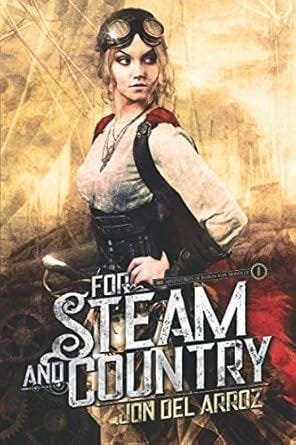
If you enjoy clean fantasy fiction with great worldbuilding and a classic feel, read The Adventures of Baron von Monocle six-book series and support Fandom Pulse!
This could be the best thing on the planet, but I won't give my money to unhinged America hating Ben Shapiro. I despise that worm.