



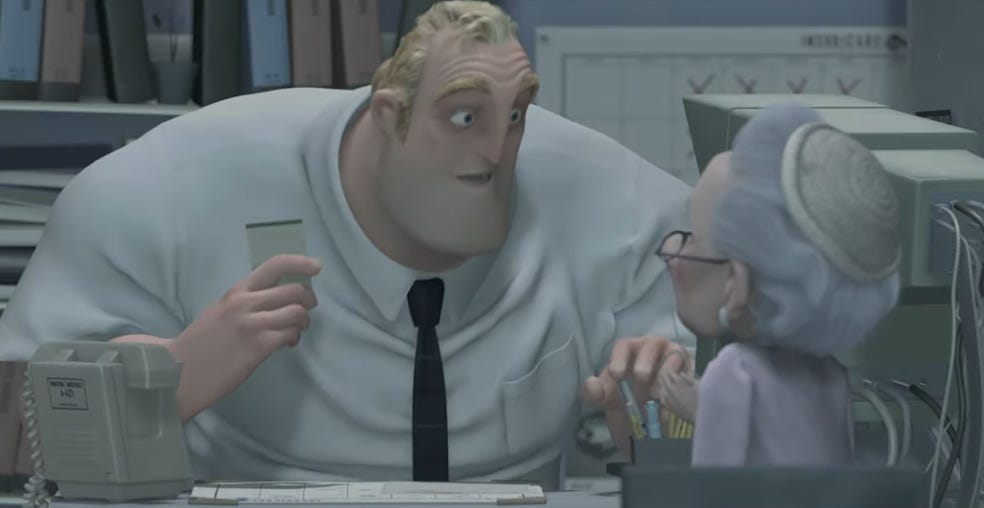
Mainstream stories have fallen into a patterns that are neither new nor insightful. Here exists a repeated gesture that has hardened into a habit: characters who will later become heroic or mythic are introduced as mundane office workers. The He‑Man trailer shows its titular character as an office employee with a nameplate that reads He/Him. Buffy Summers, in a now deleted script for Buffy the Vampire Slayer, was revealed to have been working in an insurance company before her supernatural calling emerges. Even the ostensibly outlandish Metroid Prime 4 indulged in this by having one of the story's integral side characters, Miles McKenzie, briefly mention working in an office cubicle.
The repeated use of an office cubicle is a holdover from earlier works that would use such a setting with purpose. The problem now is that the purpose has been forgotten and exists solely as a trope whose utility only serves to gratify itself. Moreover, the usage is one of many signs of what modern stories now resemble: escapism rather than vocation. The characters are not called from meaningful lives. Instead, they are escaping from empty ones.
The clearest ancestor of this pattern is The Matrix. Thomas Anderson (Neo) begins in a cubicle because he is a slave. His corporate life was a symbol and the cubicle was a visual echo of the real condition of humanity. Just as humans were rendered as living batteries for machines. Thomas Anderson is rendered as a slave to corporate machinery.
Nowadays, the commentary on the nature of the workplace is limited to the desire to escape it. The writers admit to a problem whose solution is escape, yet the only escape the world offers is counterfeit. It is not true liberation; instead, it is media itself. Thus, we are subliminally taught that the only doorway out is the doorway that leads back into the theater.
Modern media continually gestures toward captivity and then sells the illusion of freedom as entertainment. That is essentially what "escapism" is.
This is the meta commentary hidden inside this trope. The work exposes the wound but refuses to diagnose it. It identifies the emptiness of cubicle life but offers no account of what would make a life meaningful except the outlandish. It signals that something is wrong with the world, yet its answer is in the pursuit of fantasy and nostalgia.
Escapism is not a path. It is part and parcel to the product itself. It is a cage leading into another cage.
So, the trope names our captivity but refuses to imagine a world beyond it. Moreover, the cubicle is not chosen because it fits the character. It is chosen because it has been made familiar to us. It is a template that can be applied to any figure regardless of their future role.
The office becomes a universal pre‑heroic chamber, compressing any character into a single shape the writer desires before the story even begins.
This is a shortcut used by a lazy writers who are given zero incentives to improve upon their work. The pattern repeats because it requires no imagination. Through its utilization, writers can eliminate the possibility that the character might already be living a life with texture, responsibility, or any meaning whatsoever.
In mythic and theological traditions, a calling does not fall upon the formless. On many an occasion, a calling falls upon those whose lives already contain substance. The shepherd boy who becomes a king is not escaping boredom. He is already living a life shaped by responsibility. The farmhand who becomes a prophet is not fleeing monotony. He is already attuned to the rhythms of the world.
Modern writers ignore this structure. They imagine characters who are chosen for greatness yet begin in lives that contain no sign of worthiness. Miles McKenzie is conceived as a future Federation trooper, yet his origin is clerical routine. He‑Man is conceived as a figure of mythic force, yet his origin is office drudgery. Buffy is conceived as a slayer, yet her origin is insurance paperwork.
These origins do not prepare the character for a calling. They prepare the character for escapism.
This conditions the audience.
This is a form of imaginative captivity. Thank to a variety of technological influences that have affected our imaginations, too many people have difficulty conceiving of worthiness outside the structures of bureaucratic labor. This is why we readily recognize the cubicle as the default shape of human life. And so, even those destined for greatness must begin inside it. The heroic is not allowed to emerge from a life that is already enriched. Instead, must emerge from a life subjected to a preconceived notion of a daily grind.
The result is a shift in the meaning of the story. The character is not answering a call. Instead, the character is escaping from a life that contains nothing. The mythic becomes a fantasy of exit rather than a vocation of transformation.
Of course, none of this is to say that office work is unworthy. But we know why these characters reference it or why they are placed in it. Office work has become the only imaginable pre‑heroic life because the writers recognize the unfulfilling nature of the corporate wage slave. Yet the writers' depictions only exploit the setting, giving audiences about an hour's worth of counterfeit heroism where they watch He/Him-Man fight Skeletor before they inevitably return to to their own drudgery.
If there is one point I want this essay to make, it is this: real worthiness does not come from running away from ordinary life. It grows out of how a person moves through the ordinary. Media should not exist to enable our escapist fantasies; it should help us see reality more clearly and understand how to live within it.
Fandom Pulse is reader-supported independent journalism. Paid subscribers get exclusive scoops and investigative reporting daily.
Step into the dying deserts of Barsoom like never before. In Guns of Mars by Chuck Dixon, a thousand years after John Carter’s legendary arrival, a hard-bitten survivor named Kal fights for his life across a savage, crumbling Mars, where honor clashes with betrayal, ancient weapons meet desperate grit, and every step could be your last.
If you crave classic Edgar Rice Burroughs adventure with a raw, unflinching edge straight from the master of action comics, this pulse-pounding tale is your next must-read. Grab your copy today and ride the red sands!


Another necessary aspect for this to work is that, at some point, people must at least see themselves reflected in that situation. A while ago, that was believable; today, I don’t buy developers and artists from California being in that same place. They may complain about many things, but that environment no longer exists for them specifically — especially a setting full of quotas and people working for the first time. They only use the empty shell of the trope itself. That’s why the trope should change to unemployment or delivery jobs, if I may say so.
As you mentioned, in classical myths and stories, the shepherd boy who becomes a hero or turns out to be the son of a god was a common trope in Greece because many people at the time had been shepherds in their childhood, worked in that field, and later moved on to something else.
However, I have to appeal to an important part of escapism, since every work of fantasy or fiction must necessarily include escapism. As I read about a month ago: “The entire adventure fantasy genre has as its main purpose to be an escape from reality, a recess from life, an interruption of routine.” It is something mandatory because it allows the creation of scenarios that could not exist; in fact, this is the reason for the success of the “isekai” formula. Therefore, escapism per se is not the problem, as it is necessary. However, what I do notice is that those who use escapism today have delusions about what it is; they yearn for escapism as the solution to all their problems. It is not a 15-minute recess — it is the desired thing itself. And while there are things in real life where escaping seems to be the answer, one can realize that they can export their problems to others without realizing it and never address their own issues.
It goes without saying that the immediate response of this mindset to any difficult situation is the same: flee to another place and never return to face anything.
“As an additional note, the observation of where I got the phrase about escapism makes you see that, if one thought that isekai is the worst genre at this point, it turns out that Hollywood managed to turn the ANTI-ISEKAI into a genre even worse than ISEKAI, although I would prefer to call it antifantasy. But it’s grotesque what that trope achieves.
Great stuff , as always. You just made me realise that the "cubicle slave" premise works because most men are passive and looking to shift blame.
It's just a job, pays bills etc, no one stops them from doing something else. There is comfort in validation when you're living in silent desperation.