



For fifty years, from 1948 until his death in 2001, Poul Anderson was the working writer other working writers pointed to when they wanted to explain what serious science fiction looked like. He wrote seven Hugo-winning stories, three Nebula winners, four Prometheus winners, and enough novels, novellas, and shorter work to fill a small library. He was the sixth president of SFWA. He was one of the founders of SFWA. He was one of the founders of the Society for Creative Anachronism. The SFWA named him a Grand Master in 1998. The Gandalf Grand Master of Fantasy Award came his way in 1978, twenty years earlier. He was inducted into the Science Fiction Hall of Fame in 2000.
The catalog is one of the largest and most consistent in the history of the genre. And for a stretch of the late twentieth century, before the trad-pub prestige conversation drifted somewhere Anderson could not follow, he was regularly attacked as a fascist for the crime of being a Republican before that was a socially permitted position inside American SF.
The wider genre conversation has been content to leave him mostly alone for the past twenty years. The catalog is still there. Almost nobody talks about it the way they should.
The Danish American
Poul William Anderson was born in Bristol, Pennsylvania, on November 25, 1926, to Scandinavian parents. His father died when Poul was young. His mother took the family to Denmark for a period before World War Two, then to a Minnesota farm when the war broke out. He grew up bilingual, deeply attached to Danish literature and culture, and this shows up throughout the fiction. His command of Scandinavian mythology and Old Norse poetry is one of the things that separates his fantasy work from every imitator who came after Tolkien.
He took his bachelor’s degree in physics from the University of Minnesota in 1948. He was already selling stories to Astounding by the time he graduated. His first novel, Vault of the Ages, appeared in 1952. The science background is not decorative. Anderson’s fiction is rigorously scientific in ways almost nobody else in the field managed. His hard SF is calculated. His fantasy is grounded in real historical detail. His alternate histories are worked out by a physicist.
In 1952 he met Karen Kruse. They married in 1953 in Berkeley, California, moved to the Bay Area, and stayed there. Their daughter Astrid was born in Berkeley. The Andersons lived in Orinda, in the East Bay hills, for the rest of Poul’s life. He became a Californian in a way that shaped the fiction, though he never lost the Minnesota-farm sensibility either.
His Wife Karen
Born June Millichamp Kruse in Erlanger, Kentucky, on September 16, 1932, she was already deep in SF fandom when she met Poul. She coined the term “filk music,” which is what SF fandom’s musical tradition has been called ever since. She coined the term “sophont” for a generic sentient being, a word every worldbuilder in the field has since used. She wrote the first published science fiction haiku, “Six Haiku,” in The Magazine of Fantasy & Science Fiction, July 1962. She was a founding member of the Society for Creative Anachronism, under the SCA name Karina of the Far West. She was inducted into the Baker Street Irregulars for her Sherlock Holmes scholarship.
She was also her husband’s collaborator across four decades. The King of Ys tetralogy, Roma Mater (1986), Gallicenae (1987), Dahut (1988), and The Dog and the Wolf (1988), was cowritten with Karen. She contributed anonymously to the Last Viking trilogy. The collaboration was real, not honorary. When Poul died in 2001, Karen continued as an editor and fan community figure until her own death on March 17, 2018.
Their daughter Astrid Anderson Bear married the science fiction novelist Greg Bear in 1975. Greg Bear was one of the leading hard SF writers of his generation, author of Blood Music, Eon, Darwin’s Radio, and Moving Mars. He died on November 19, 2022. Astrid remains active in the SF community and coauthored an authorized biography of her father, Starfarer, in 2024.
The Anderson family was, and is, a science fiction household. Multiple Hugos and Nebulas at dinner. That fact is worth stating outright.
The Technic History and Why Flandry Is Buried Treasure
Anderson’s central future history is the Technic Civilization sequence, a projection of human interstellar civilization from roughly 2100 to 7100 AD. The sequence has two major protagonists separated by centuries of internal chronology. Nicholas van Rijn is a merchant prince of the Polesotechnic League, a period of free-trade capitalism expanding out into the stars. Dominic Flandry is an intelligence officer of the Terran Empire, a period several hundred years later when the League has collapsed and the Empire is fighting a losing rearguard action against its rival, the Merseian Roidhunate, before the coming Long Night.

Van Rijn is Anderson doing the free-market space opera in high gear. Flandry is where Anderson does his best work, and Flandry is where most modern readers have no idea what to look for.
The problem is structural. Anderson wrote Flandry across four decades, mostly as short stories, novellas, and short novels scattered through Analog, Galaxy, F&SF, and various magazine slots. There is no single Flandry novel that stands as the obvious entry point. There is no consistent series numbering. Some books are fix-ups. Some are original novels. Some novellas were later expanded. Some were never expanded. If you walked into a used bookstore in 1990 and tried to figure out how to read Flandry, you would have needed a chart.
That is where Baen Books stepped in.
Between 2008 and 2011, editor Hank Davis, working with Poul Anderson scholar Sandra Miesel, produced The Technic Civilization Saga in seven omnibus volumes. Twelve novels. Thirty-one shorter works. Everything Anderson ever wrote in the Technic universe, arranged in internal chronological order, with Miesel’s meticulous chronology as an anchor. The seven volumes are The Van Rijn Method (2008), David Falkayn: Star Trader (2009), Rise of the Terran Empire (2009), Young Flandry (2010), Captain Flandry (2010), Sir Dominic Flandry (2011), and Flandry’s Legacy (2011). Four of the seven volumes are Flandry.
This is one of the great archival publishing projects in modern SF. It rescued a fifty-year serialized epic from the fragmentary condition Anderson had left it in and made the whole arc readable for the first time. If you have never read Flandry, you are not reading around in it. You are starting with Young Flandry and going straight through to Flandry’s Legacy. That is how the story was meant to be read. Baen made it possible.
Flandry himself is Anderson’s James Bond in a dying empire, an intelligence officer with the sensibility of a Roman legate in the third century AD who knows the barbarians are coming and does his job anyway. The novels are pessimistic, morally complicated, occasionally romantic in the older sense, and unafraid to admit that civilizations do end. Anderson understood Spengler, understood Gibbon, and built the sequence on the honest premise that empires fall and the men who defend them cannot save them, only delay the end and preserve what can be preserved.
The Time Patrol

The Time Patrol stories are Anderson’s second great future history, and they are structurally the opposite of Flandry. Where Flandry watches civilization decay, the Time Patrol prevents changes to real historical timelines. The protagonist, Manse Everard, is an American recruited into a hidden organization from the far future whose job is to preserve history as it happened, correcting incursions and paradoxes across every period from prehistory to the near future.
The stories are rigorously researched. Anderson used his physicist’s approach to time paradox and his medievalist’s love of primary sources to give the sequence a texture nobody else in the time-travel subgenre managed. Time Patrol (1955) started it. The Guardians of Time (1960), Time Patrolman (1983), The Year of the Ransom (1988), The Shield of Time (1990), and Time Patrol (1991) round out the sequence, most of it collected in a single Baen omnibus in 2006. “Delenda Est,” in which Carthage wins the Punic Wars and modern Europe never happens, is one of the finest alternate-history stories ever written. “The Sorrow of Odin the Goth” and “Star of the Sea” are anthropological SF at its most demanding.
The High Crusade, Three Hearts and Three Lions, and the Fantasy Work

The High Crusade (1960) is the novel every reader should hand to a friend who says they do not read science fiction. English knights in 1345 are recruited into a war of galactic conquest when an alien scout ship lands in Lincolnshire and Sir Roger de Tourneville decides that flying to France was the plan anyway and the aliens can bring him. The tone is dry, the medieval detail is meticulous, and the premise is played straight rather than for laughs. Sir Roger de Tourneville ends up as Emperor of a substantial chunk of the galaxy through the application of longbow, cavalry charge, and honest peasant tactical thinking against opponents whose technology has made them soft. It should not work as a novel. It works completely.
Three Hearts and Three Lions (1961) is Anderson’s contribution to modern fantasy, and its influence on the field is larger than anyone talks about anymore. Holger Carlsen, a Danish engineer fighting the Nazis in World War Two, gets translated into a parallel medieval world where the forces of Law and Chaos are literal cosmic factions in an ongoing war. The Law/Chaos framework became the theological engine of Michael Moorcock’s Elric sequence, and through Moorcock it became the alignment system in the original Dungeons & Dragons rulebook. Every fantasy reader who has ever rolled up a Lawful Good paladin is playing in Poul Anderson’s cosmology, whether they know it or not. Anderson wrote it in 1953 as a magazine serial and revised it into novel form in 1961.

Fire Time (1974) is the underappreciated one. A trinary star system on a planet called Ishtar experiences a thousand-year cycle in which the red dwarf companion star brings devastation, forcing every civilization on the planet to periodically collapse and rebuild. The novel weaves that cyclic catastrophe together with a human colonial-empire question and a war humans are fighting elsewhere in the galaxy. It is Anderson at his hardest and his most demanding. It got Hugo and Nebula nominations, was outshouted by other 1974 titles at both ceremonies, and has never received the sustained attention it should have.
The Broken Sword (1954) is the dark Nordic fantasy Anderson wrote in the same year Tolkien was publishing The Fellowship of the Ring, and it is the darker book. Tau Zero (1970) is the pure hard-SF cosmological adventure about a ramscoop starship whose braking system fails and which ends up traveling to the heat death of the universe. A Midsummer Tempest (1974), an alternate-history Shakespearean fantasy, won the Mythopoeic Award. The Boat of a Million Years (1989) tracks a small group of humans born immortal through ten thousand years of history and into interstellar exploration. Operation Chaos (1971) and Operation Luna (1999) build an alternate-history universe in which magic works and are among the funniest and warmest of Anderson’s late novels. The Hoka stories, cowritten with Gordon R. Dickson, are the pure comedic SF.

Nobody in the genre before or since had this range. There was a period in the 1960s and 1970s when Anderson could turn out a Hugo-caliber novella, a hard SF novel, a historical fantasy, a Time Patrol adventure, and a comic Hoka story in the same year and none of them read as coming from the same hand.
The Politics
Anderson started his political life as a liberal, moved toward conservatism through the 1960s as the Vietnam War and the campus protest movement pushed him to the right, and settled into a libertarian position that he held for the rest of his life. He won four Prometheus Awards, the libertarian SF prize, including one for The Stars Are Also Fire, another for The Star Fox, and one for the classic novella “No Truce with Kings.”
Being a Republican and later a libertarian in the 1960s Bay Area SF scene, particularly around the Berkeley Worldcon, was not popular. Anderson caught the label “fascist” repeatedly, thrown at him by New Wave writers and left-liberal editors who understood conservatism only as a moral failing. He kept working. His response, so far as anyone can reconstruct it, was to keep producing at industrial scale, keep winning awards on merit, and keep writing the kind of hard-headed, freedom-oriented, historically informed fiction he thought the genre needed.
This is a point worth belaboring. When people talk about the current politicization of publishing and awards, they sometimes act as if the problem started in 2015 or 2020. It did not. Anderson was navigating a version of it in 1968. He kept his head down, kept writing better than his critics, kept picking up Hugos and Nebulas anyway, and left behind one of the most respected catalogs in the history of the field. He is a model for how to survive the era we are in now.
BayCon and the SCA
Anderson attended the 1968 Berkeley Worldcon, known as BayCon. He was not the Guest of Honor that year (that was Philip José Farmer). He was a working presence throughout the event. He emceed the Society for Creative Anachronism’s presentation, a formative moment for the young organization he had helped create in 1966 with Karen, Marion Zimmer Bradley, and Diana Paxson. Randall and Alison Garrett performed a calypso review of Three Hearts and Three Lions on the main stage as convention entertainment. BayCon 1968 is one of those Worldcons that lives in the memory of anyone who attended it, and Anderson was in the middle of the mix.
The SCA is worth mentioning by itself. The organization that took the medieval reenactment and cultural preservation movement and gave it international structure was founded in Anderson’s backyard, quite literally, on May 1, 1966, in Berkeley. He and Karen were among the founders. The SCA now has more than 30,000 members. It exists because Poul and Karen Anderson helped make it exist. That is not a small legacy for a working SF writer to have.
The Final Years
Anderson kept producing at high volume into his seventies. The Stars Are Also Fire (1994) and its companion Harvest of Stars sequence carried him through the mid-1990s. Genesis (2000) won the John W. Campbell Memorial Award. He was still writing new work when he was diagnosed with cancer in 2001.
He died on July 31, 2001, in Orinda, California, of prostate cancer. He was seventy-four years old. Karen survived him by seventeen years.
The tributes from the working writers of his generation were unanimous. Robert Jordan called him one of the great masters. David Drake modeled significant portions of his own military SF on the Flandry books. Larry Niven and Jerry Pournelle both cited him as a formative influence. John C. Wright has written extended appreciations of Anderson’s political and philosophical work. The debt the field owes him is enormous.
Why He Matters Now
The indie and crowdfunded SF space is currently rebuilding exactly the kind of fiction Anderson was writing at industrial scale for fifty years. Hard SF with working science. Fantasy grounded in real historical scholarship. Adventure stories that take civilization seriously as a thing worth defending. Freedom-oriented politics that assume the reader is an adult. Protagonists who solve problems by being competent rather than by being emotionally validated. Every one of those instincts is Anderson’s.
Baen has done more to keep his work in print than any other publisher, and the Technic Civilization Saga volumes are the single most important recovery project in twenty-first century SF publishing. If you have never read Anderson, the entry points are clear. Start with The High Crusade if you want the short punch. Start with Three Hearts and Three Lions if you want the fantasy foundation. Start with Young Flandry if you want the Flandry sequence, which is the real prize. Start with Time Patrol if you want the alternate history. Start with Fire Time if you want to see what a serious hard SF novel looks like. Start with Tau Zero if you want to see what happens when a physicist follows the equations to the end of the universe.
Then keep going. The catalog is enormous. There is a lifetime of reading in there. Anderson wrote for readers who could hold their own, and the modern indie SF audience is exactly the audience he was writing for all along.
He was one of the great ones, and he is still one of the great ones, and the mainstream conversation losing him is the mainstream conversation’s loss.
Which Poul Anderson novel or story do you think deserves the most attention from readers today, and which entry point did you use to first find your way into the catalog?
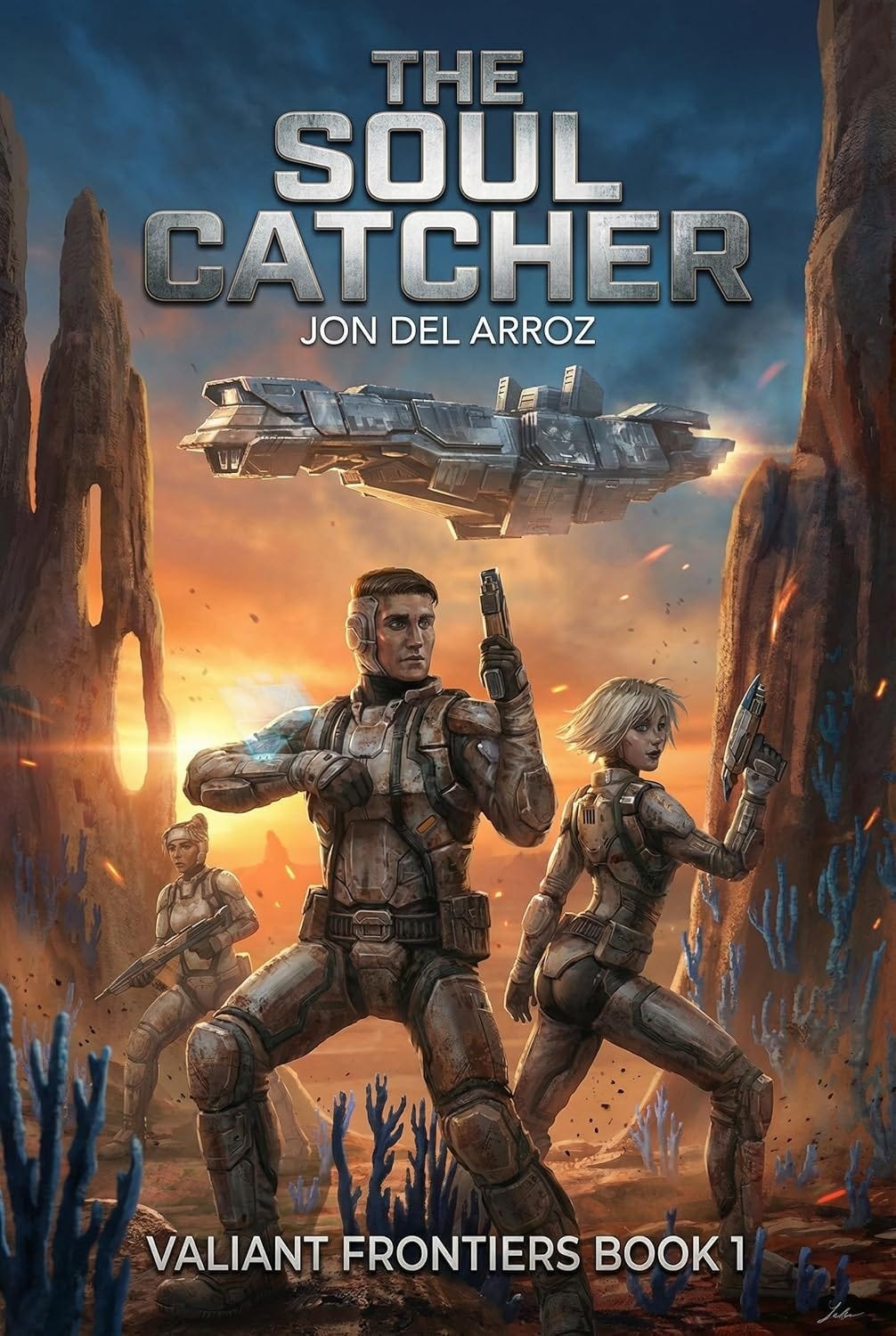
First contact with the Oridians was supposed to be humanity’s proudest moment. Instead, their chief engineer is dead, their ship is sabotaged, and an ancient alien technology is stealing souls. Book one of the Valiant Frontiers series delivers exploration, mystery, and the kind of crew you’ll want to follow across the galaxy. Read The Soul Catcher on Amazon and start the adventure.
NEXT: Brandon Sanderson Calls Out J.K. Rowling’s Fantasy Snobbery: With a Terry Pratchett Assist
Loved the Flandry stuff back in the day! Glad to hear it’s not scattered all over the place now.
If you like viking fantasy I would suggest Lars Walker. He is a Christian as well. His books are very good