


Hard science fiction received its mega-based installment with Poul Anderson releasing Tau Zero in 1970, a book that has largely been ignored in recent years by the sci-fi establishment but stands the test of time.
Poul Anderson, despite having what one might argue is more talent than Isaac Asimov, Arthur C. Clarke, and Robert Heinlein, has been largely ignored by the elites in publishing in recent decades since his death in the 1990s. A large reason for this may be the fact that he was a staunch Republican with a reputation for being called a “fascist” by leftist extremists, much like we see them doing to anyone they blacklist in modern times.
Despite his based politics, it was a different time in publishing where they truly could be diverse and inclusive. During his career, he published more than fifty novels and received fifteen different Hugo Award nominations, of which he won seven. No one could argue Anderson was anything but a master of the craft of science fiction, but many of his books are not found outside of small press ebook editions today, unless you’re searching through a used book store.
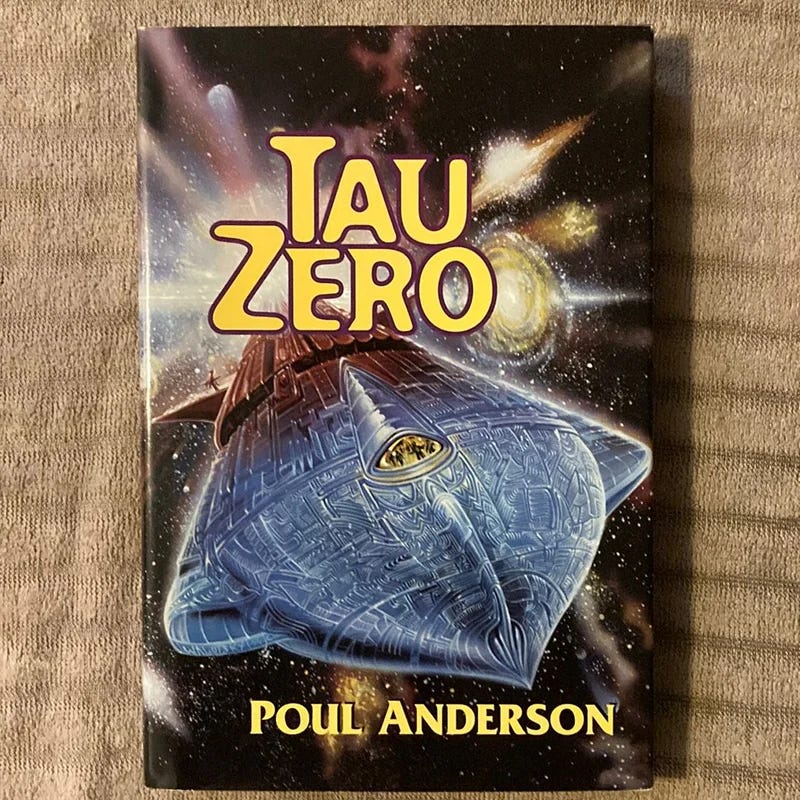
Tau Zero was one of those novels which was well-received by the science fiction community. The premise is simple: a starship is setting off to a colony but goes out of control to where it can’t decelerate, and so it keeps accelerating while it tries to come up with a solution to the problem. As they do so, relativistic effects make it so eons pass on the outside while the ship ages normally as they pass. It is the quintessential hard science fiction as it focuses on real physics with the aspect of the tau getting closer to zero (the speed of light) which they can never get to completely. It also received a Hugo Award nomination at the time.
However, the book is also based on a social sciences perspective. The main character is a strong, brooding male security officer who is known for being hard on the rules of law & order on the ship, though everyone respects him because they know he’s honest and fair.
Unlike most novels that focus as a captain as the main lead, the captain isolates himself so he can make judgments and focus on the mission of trying to get the ship to eventually decelerate safely.
Several of the characters are depicted as Christian, hold services on the ship, and are not shown as being foolish for doing so—something that most hard science fiction avoids as many authors view science as their ultimate religion and lambast faith as a result.
As the psychology of them potentially never being able to slow down and get back to a world wears on them, the women also have worries about never being able to have babies. One woman actually foregoes contraception intentionally and lies in the logs because of her biological imperative.
When brought to security about it, the man stands up for the baby, saying, “Abortion is murder.” He also voices he would rather die than allow that to happen to his child.
This is quite a change from what we see in modern science fiction, like in Mary Robinette Kowal’s new novel, where child murder is accepted without any consequence. It shows how radically our society went from something obvious and non-controversial in that abortion is evil to pushing an anti-human death cult agenda in a span of a few decades.
While the book does slow down toward the middle (it was originally published as a short story that was expanded, and it seems as if Anderson did pad it out in some spots), the overall weight of psychologically never coming back to the ones they love, watching earth and everything fades around them, and outliving the end of the universe is quite an interesting premise and holds up well.
The based elements are also radical by today’s standards, with the sexes being portrayed accurately. Anderson does venture into the late 60s and early 70s boomerisms, where the characters sleep around and are encouraged to do so because they want to “spread their genetic material” to repopulate humanity, but overall, men are presented as men, women as women, and abortion as wrong. It’s something that surely would have been blacklisted by modern publishing.
What do you think of Poul Anderson and Tau Zero? Leave a comment and let us know.
For a great adventure fiction novel geared toward male readers, read The Demon’s Eye, an incredible new classic fantasy novel. Support Fandom Pulse!

NEXT: Military Sci-Fi Book Review: Off Midway Station by Marc Alan Edelheit
Standards. Hard decisions. Faith to counter hopelessness. Sounds like Fantacy. Will have to find a copy
I enjoyed it, but the ending was very much a case of space opera intruding on the harder sci-fi elements.