


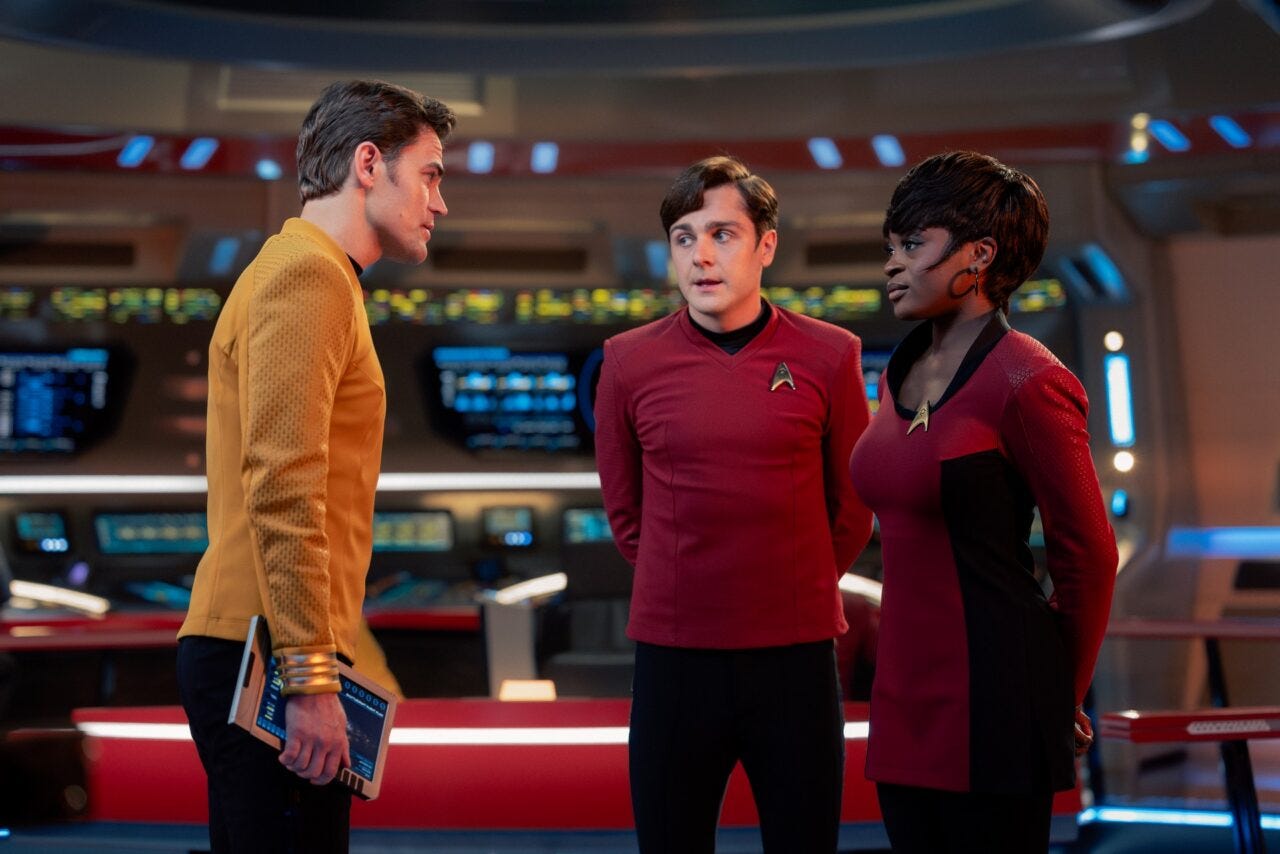
“Tomorrow’s Enterprise,” the season 4 finale of Star Trek: Strange New Worlds, is a strong time travel episode and the best look yet at what this series could be. It’s got a massive flaw, though in identity politics that ruins the episode, like they always do.
Pike’s Enterprise studies a white hole. Uhura, back from a Starfleet refresher course, hears music coming from the hole before an energy blast knocks her down. She then transmits a signal into the anomaly and reaches a version of herself from one year in the future, and a later pulse makes the two swap places. The future Uhura has come to save Scotty from a fatal console explosion. Each Uhura holds half the solution, and the other half waits on a tablet she left for herself.
Celia Rose Gooding carries it. As the future Uhura she matches the cadence Nichelle Nichols gave the character in The Original Series, and the gap between the two versions shows her range. The older Uhura’s look recalls Nichols’ classic portrayal, and she has spent the year in between learning to bluff well enough to beat everyone at poker. The effects team pulled out the stops, and the pacing keeps both timelines moving without a slack stretch.
The white hole is soft science even by Trek standards. In real physics, a white hole is the time reversal of a black hole, a solution Einstein’s equations allow. Nobody has observed one, no known process would form one, and the math suggests it would be unstable. Spock gives the crew the standard theory, that white holes are the reverse side of black holes. The episode gets away with it because the anomaly is a birth. The signals come from beings calling themselves midwives, warning the ship away from the arrival of a cosmic newborn, and the white hole is that birth. An alien delivery explains the behavior better than physics could.
The title is a clear reference to “Yesterday’s Enterprise,” and critics see homage to The Next Generation in how the story links two points in time through a strange phenomenon. An anomaly bridging eras also recalls “All Good Things…” The stakes here are smaller, Scotty’s life against the fate of humanity, but they land on the characters.
Red Dwarf fans will recognize the device. Lister meets future versions of himself in “Future Echoes” and “Out of Time,” and the sitcom plays it for laughs. Here it plays as drama, with Uhura running into her future self through the episode and a life at stake. Nothing in the coverage suggests the writers borrowed from the sitcom. Meeting a future self is one of the oldest devices in the genre.
One reviewer read the Scotty and Uhura pairing as validation of the awkward romantic bit between them in Star Trek V: The Final Frontier. In one timeline Scotty is still asking Uhura for a drink, and in the other the two are secretly a couple. A few scenes push it further than they need to, but Original Series fans will be glad to see it. The script also touches Pike’s knowledge of his fate, a nod the series has earned.
Then comes the line that damages the episode. Future Chapel says she once dated a girl who claimed to be from the Department of Temporal Investigations, and the script adds, “Really nice arms, though.” The joke has no bearing on the plot. It exists to remind the audience that Chapel dates women, a point the series made in season 1’s “Spock Amok” and has now made again.
In the Original Series, Chapel’s love interest is Spock, and Strange New Worlds itself built a relationship between the two before breaking it up in “Subspace Rhapsody.” Each new line about her dating history pulls the character further from the woman Majel Barrett played. This one lands in an episode that rebuilt her 1960s look down to the hairstyle, modeled on Barrett’s. Jess Bush looks great in it, and the dialogue undoes the effort. The show is doubling down, and the choice is nonsense for a character whose defining trait in the Original Series is her love for Spock.
One more complaint: “space baby” comes up several times as the name for the alien entity, then gets turned into a joke. The writers should have coined a term for the creature. The line reads as millennial writing that knows how trite it sounds and leans on irony to cover it, and it undercuts an otherwise serious episode.
The finale shows what Strange New Worlds can be when it commits to its source: the hair, the cadence, the classic anomaly structure. It should have leaned into The Original Series all season. The show has one season left. Will it spend that season building toward the characters the Original Series gave audiences, or keep rewriting them?
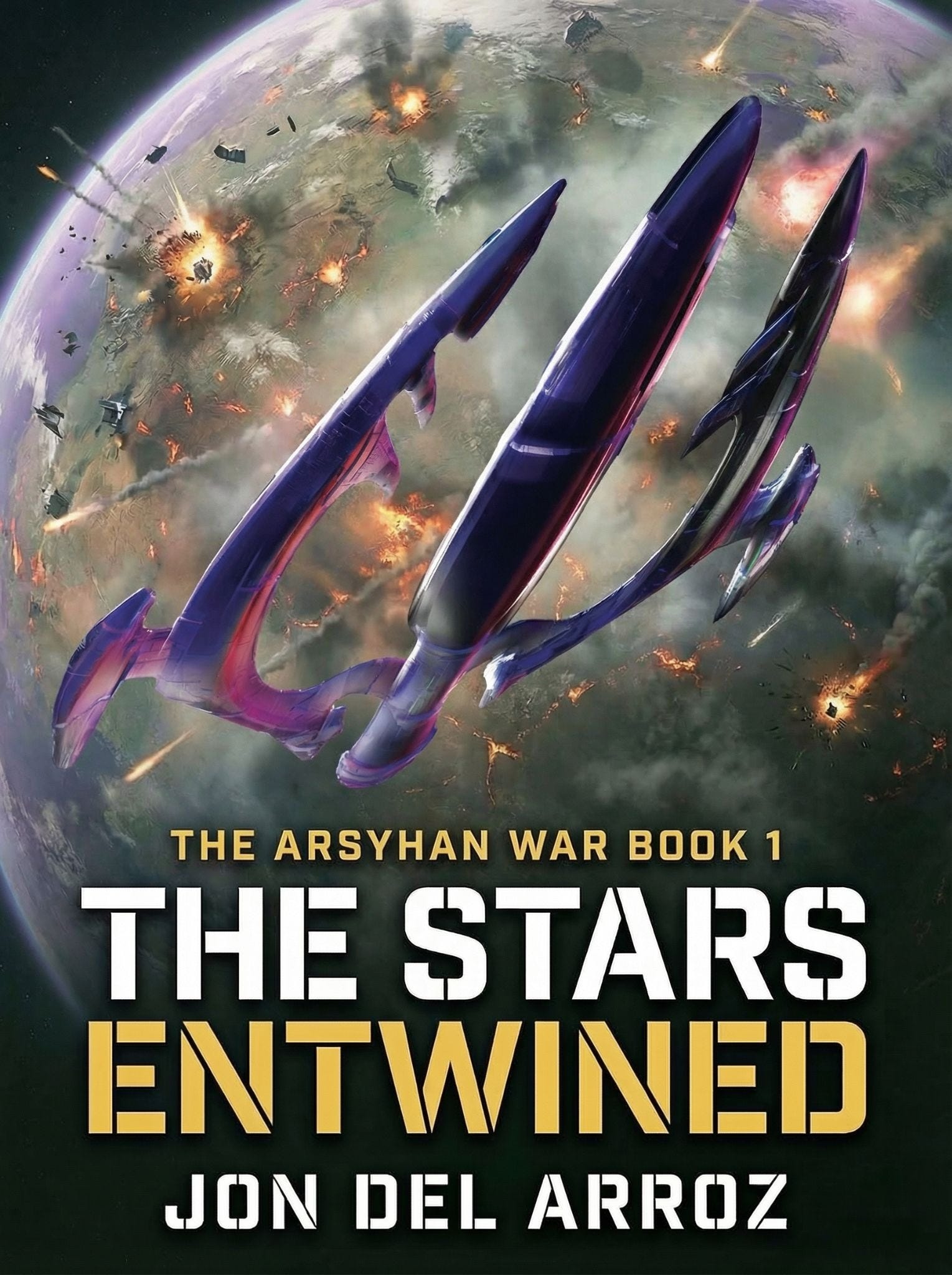
If the golden age of Trek and Babylon 5 left a hole in your sci-fi diet, The Stars Entwined fills it — interstellar espionage between two civilizations on the brink of war. Read The Stars Entwined on Amazon!
JDA: I hear Ivermectin cleans out the parasites you had to endure eating toilet slop for four seasons.
First decent episode this season, and almost like a real Star Trek story… not really tight regarding the pseudo-science, but more than made up for by a good plot and some nice character moments & world-building. Finally… but sadly way too late. 9 of 10 were junk… can't make up for that with just this one.